Sunday, May 11, 2008

Game Until Your Eyeballs Fall Out

One of my all-time favorite Calvin & Hobbes comics starts with Calvin reading from Karl Marx. "'Religion is the opiate of the masses,'" Calvin reads. "What does that mean?"

And over in the corner, the family TV is thinking to itself, "It means Karl Marx ain't seen nothin' yet!"

Over at the The Geek, John Birmingham asks the question nerds have been posing since the launch of Star Trek: The Next Generation. Is the creation of a fully-functioning holodeck which is cheap enough to be installed in every home the death-knell of civilization?

It can be hard enough dragging your head out of clunky old Second Life at times. But as someone here commented a few weeks back, the day they invent the technology to let some fat, middle aged dad imagine he's got pre-KFed Britney sitting on his lap in the study at home, is the day Dad never leaves the study. Or something like that.


We gamers see this a lot. We know the guy who lives for WoW. I knew a girl in college who dropped out because school was interfering with her far more important LARP ("It's bigger than the Roman Empire!"). In many respects, for us nerds, the future is now. Perhaps this is part of the problem for the guy we all dread at cons, the overweight fellow who smells like he hasn't bathed in days, whose clothes are stained and tattered, and who clearly has abandoned even the rudiments of personal hygiene.

Obviously, these folks are not responding to having some Britney-hologram wriggling in their laps, but what they do get is no less visceral. Within our games and our small communities, we receive the validation, the victory, the acceptance, and the human touch (even if it's only mind-to-mind through the words of a blog) that people are generally supposed to get from society at large. Most of us who embrace the label of nerd or geek or whatever experienced rejection from that society in our youth. Some of us turned our backs on that larger society, to a greater or lesser extent, and never come around to embracing it. Why jump through all the hoops required, all the social forms and niceties, the daily and yearly rituals, the genuflections to empty pomp and lesser minds, when you can find more personal struggles and victories, more heartfelt validation, and more sublime communion with our fellows through these smaller communities? This, I think, is why nerds have been so ready to embrace the internet, since it is the first community in human history where what you say is more important than what you wear.

However, we can never truly cut ourselves off from the rest of the world. In the small community of RPG enthusiasts, we produce books and games that go winging their way out into the world to bridge the distance between ourselves and society at large. Among tiny enclaves of programmers who have turned their back on the corporate world has sprung the open license communities that have proven so prolific and talented that industry has reversed itself to embrace them. Even if people desired to utterly cocoon themselves from the rest of the world (and the success of MMOs seems to conclusively prove that they don't), there would still be the need to strive against adversity and to triumph. There is no reason why those triumphs could not be victories for civilization. Society is already fracturing as we abandon our limited choice of a handful of TV channels to embrace our own, personal little niche among the now 500+ options available to us. But is that so terribly different from the way things were before the steam engine, the automobile, and the airplane, when we lived in tiny communities scattered across the landscape?

So no, I don't see the holodeck causing civilization to collapse, no matter how realistic the fake people inside them get to be, or how convincing the interactions are. We still feel a need to earn our way in whatever world we inhabit. We still want to win, even if the victories are small and personal. And we still want to feel that human touch, the random moment of connection that makes hearing your favorite song played on the radio more satisfying than pulling it up on your iPod. So long as these things remain true, we will continue to push back against adversity and expand our boundaries, both as individuals and as
communities.

Saturday, May 10, 2008

Don't Touch Those Dice!

Not unless you absolutely have to.

Sham's got some very interesting thoughts about the thief over at his Grog 'n Blog, and the use of dice rolls to overcome obstacles:

Too many hidden traps which go off unerringly, damaging the characters and slowly (or instantly) whittling away at their hit points and resources become something other than traps. Such traps become abstract, losing their identity, reduced to mere collections of numbers.

The very notion of removing elements of deduction and logical thinking is the antithesis of the Empty Room Principle. Spot check? Not on your life, unless you either tell me you are specifically looking for something, or I, as referee, judge that your character might have a chance, not a static number, of noticing something based upon the prevailing circumstances.


I couldn't agree more. When the Trollwife picked a magic-user for her a solo character, and then had to negotiate traps by investigating them and finding logical ways to disable or avoid them, it created some of the best dungeon-delving I've ever run.

So the thief is on the chopping block for my Moldvay/Cook/LL hack. If somebody wants to play a stealthy fighter type badly enough, I'll make it happen for them. But I've got some ideas in mind for skills that might just make the thief obsolete anyway.

Savage Worlds Goes Digital

Via the Evil DM comes word of Savage Worlds Online:

Digital Adventures, LLC and Pinnacle Entertainment Group are proud to present Savage Worlds Online, a new community designed to support and bring together gamers using the Savage Worlds Ruleset for Fantasy Grounds II to play their favorite Savage setting online with friends across the globe!

At the moment Savage Worlds Online (SWO) supports a forum for everything Savage World and Fantasy Grounds, and a gaming calendar for linking up with other SWO members to find or host a game. There will also be product giveaways from Savage Worlds licensees, gaming and development blogs, officially sponsored PEG events, product support, gaming advise, and all great geekness associated with the Savage Worlds setting from Australia to Denmark to England to Arizona!

In the future we'll also have a live chat area for players to form ad hoc games, officially sponsored organized play events, discounts on SW Fantasy Grounds downloads and other Savage Worlds products, and much more down the road.

Frankly, I think this is a wonderful idea and I'd love to see more like it. If you're a small-time RPG publisher (and if you're not WotC or White Wolf, this probably includes you), the internet is a real equalizer for your game. Not only can it be used to help gamers anywhere in the world find someone else to play your game with, it can allow you to run demo games in front of the entire world, rather than just the small audience you manage to attract at your local con.

Happy Duranmas Duranmas!

Apparently, there's a Schwarzenegger connection, because I celebrated with "Total Recall".

Friday, May 09, 2008

Spears Shall be Shaken

In my post “Shields Shall be Splintered”, I mentioned briefly my plans for weapons in my hack of Moldvay/Cook/LL. To the best of my knowledge Moldvay/Cook was the first edition of D&D to offer a wide array of variable damage for weapons. Most do 1d6, though a few do 1d4 damage. Two do 1d8 (the sword and battle axe), and two do 1d10 (the two-handed sword and pole arm).

It’s a simple system, and it works, but there have been many other options floated from time-to-time, including damage by class and a simple 1d6 for all weapons.

I’m going to wuss out and split the difference a bit, here. To keep things simple, the default on weapons is 1d6. Weapons built to be swung two-handed get 2d4. This keeps things simple and it’s easy to know what you should be rolling. Using one hand? 1d6. Using two hands? 2d4.

To get the two-handed bonus, you must be using a weapon made to be used with two hands. Using both hands to swing your dagger doesn’t benefit you.

A few weapons break the rules. Spears, for instance, can be used two-handed, but they still only do 1d6. They can, however, be set to receive a charge and do double-damage in that case. They’ll also get a little love when I talk about initiative.

Torches, of course, can light you on fire. Not sure how I want to handle that. An extra 1d4 ‘til you put it out?

Flails are not in the Moldvay/Cook books, but I’m adding them in. As an added quirk, they ignore shields. Why? Because that’s how they were designed to work; the length of chain allowed the damaging head of the weapon to swing around behind the shield and clobber your foe. I might still allow the target to sacrifice their shield in exchange for ignoring a successful “to hit” roll.

And then there are staves. Ok, I’ll have to admit a bit of prejudice here, I love staves and always have. I think they are among the coolest weapons ever devised, and this mostly comes from reading tales of Robin Hood as a boy. The back-and-forth of staff combat, its flexibility as weapon, and its easy availability have always appealed to me. So I’m doing something special with staves: highest die of 2d6.

What is up with that? Well, I couldn’t really justify the full-on 2d4 that halberds and two-handed swords get. I also wanted to represent the ease and flexibility of the weapon, how an attack could come from either end of the staff, or even the middle. The highest die of 2d6 represents that, giving a touch more damage due to the speed and sneakiness of the weapon. It’s also the damage roll for using a weapon in each hand.

So here’s what my weapons look like:

Bastard sword: 1d6 or 2d4

Battle axe: 2d4

Club: 1d6

Dagger: 1d6

Hand axe: 1d6

Lance: 1d6 (double on charge)

Mace: 1d6

Pole arm: 2d4

Short sword: 1d6

Spear: 1d6 (double when set to receive charge)

Staff: highest single die of 2d6

Sword: 1d6

Torch: 1d6 + burning damage (1d4?) until put out

Two-handed sword: 2d4

War hammer: 1d6

And there you go. Simple and quick and intuitive, I hope. Since the average person has 1d6 hit points, this means every weapon can be fatal on a single strike, while the big, two-handed weapons are especially fearsome, as they ought to be.

Adventure Flowchart

Badelaire of Tankards & Broadswords has posted a flowchart made up by his friend Darkwing, explaining just how to do this adventuring thing. "A warning though - some of the humor might be a little too dry for some people..."

Find it here.

Orcs in 4rt

I'm surprising myself by being very meh on a lot of the interior 4e art we've seen so far. Part of the problem is considering Paizo to be the standard for the industry. They're not; it's clear they're a cut above in terms of layout and art direction. Green Ronin stumbles at times, but at others, they've clearly shown themselves to be capable of absolutely gorgeous books, such as Blue Rose.

But D&D is supposed to be the industry standard, and I remember being wonderfully in awe of some of the stuff I saw in the 3.0 Monster Manual. Todd Lockwood and Sam Wood did some very evocative, menacing work in that book.

The stuff so far for 4e has been less than stunning. Some have been better than others. Some might have been just fine in another context. But nothing so far has gotten me all that excited. Partly, I'm sure, I'm pickier than I used to be. Partly it's a matter of styles changing. Still...

Let's look at the orcs, just released today. I can't quite make out the artist's name in the bottom right corner. It looks like "RCH". Anyone know who this is?

In terms of anatomy, it's not bad. It's clear that all four of these villains are of the same race even though they're also clearly not identical. The colors aren't bad and there's lots of fun detail. But there's not much real menace here. Starting with the figure on the right, it's very easy to imagine him casually talking about how he wants to plant a few rose bushes along the back fence, maybe put in a new tree behind the garage. Even with all his accouterments of death and barbarian splendor, his body language is utterly suburban.

The orc in the back is the best, though I feel that's mostly because you can barely see him. And again, I'm not getting much of a sense of menace, in spite of all his severed heads. I certainly get no sense that he's commanding anything like the eldritch power of his god, or that he's the one in charge, in spite of his being a "Leader" class monster as an Eye of Gruumsh.

The orc on the far left looks like he's breaking out his dance moves. No menace and no sense of impending attack. In fact, he makes me wonder if there's some sort of subtle dig here on a '90s grunge-band I'm missing.

The one in the middle is the worst. I assume he's supposed to be charging in to attack. What he actually appears to be doing is throwing a temper-tantrum. The odd stance, the timidity with which he holds his axe, the way his head is tilted back and his eyes are squinted shut, it's easier to imagine him stomping up and down and crying about not getting to play with the big kids rather than rushing forward to indulge in bloodshed and mayhem.

The background shows a certain competence in color choice and depiction, but the composition is horrible. Why is the world so curved, as if photographed with a fish-eye lens? Why are the trees and orcs standing at such bizarre angles, as if all of them were radiating out like spokes on a wheel? It gives the entire picture a slight sense of vertigo and repels the viewer, rather than drawing them in to linger on this page.

I really don't know what to make of this. There's a certain level of artistic competence on display here, but not much follow-through. Was this rushed? Is this an example of too many cooks giving conflicting art direction? Was the artist attempting to mimic miniatures that have already been produced, or, conversely, attempting to create poses and looks that would be easy to reproduce as miniatures? Was there a goal for the art that I'm missing? Any of these could be the truth, and it's entirely possible that I'm judging this piece based on standards and assumptions that had absolutely no bearing on the goals and desires of the artist or the art director. What I can say for certain is that this art doesn't do a thing towards inspiring me to put orcs in my game. For me, that's the highest and most important goal for art in a monster book.

Random Esoteric Critters of the Flame Princess

Last Wednesday, Jeff Rients gave us a link to Lamentations of the Flame Princess, a publisher of old school gaming goodness. They appear to have but a single product in their inventory so far: The Random Esoteric Creature Generator for Classic Fantasy Roleplaying Games and their Modern Simulacra.

Yeah, try saying that three times fast.

Anyway, RPG.net has posted a review of TRECGfCFRGatMS (That's not much better, is it?) by Jason Vey. Mr. Vey likes it and finds it "
useful, not just for the oldest edition of Our Favorite Game, but for pretty much any kind of fantasy, horror, or esoteric sci-fi game you'd like, of almost any system out there." He does, however, ding it a few points for presentation (which he admits is probably hampered by a lack of resources) and the author's somewhat foaming-at-the-mouth ranting against more successful game publishers in the introduction.

Microlite20 Fundraiser

Greywulf is attempting to raise money to purchase better hosting for Microlite20:

The server that has been the home for Microlite20, my zenified version of D&D, is spending more time down than up right now, to the point where it’s overdue time to jump ship.

In order to do that, I’d like to call on the help of all the folks out there who love and play Microlite20. I’ve selected MochaHost as the new home for Microlite20, and that’s going to cost around $90 for 2 years, including domain. For that we get 300Gb/month bandwidth, 10Gb storage and more pre-installable toys than you can shake a stick at.

I think it’s time for Microlite20 to pay it’s way in the world, so if you’d like to see the Macropedia up, all the time, want your name in lights and have the eternal thanks and gratitude of the Microlite20 community, Make a Donation. How much you donate is entirely up to you - a dollar or two will go a long way - but bear in mind that the quicker we reach $90, the faster I’ll be able to get M20 up and running on a shiny new home. And more cash means even more shiny!!!!

In return, along with all the thanks and adoration, I’ll send all contributors a username & password so they can host their own blogs, story hours and house rules up there. There’ll be a forum too with free registration for all, and maybe even a PDF store.

Lots of 4e Preview Stuff

Find it all here. We've got a bit of Keep on the Shadowfell, a pair of the warlord's at-will powers, a trio of traps, and a PDF of orcs. Oh, and a blurb on the sequel to Shadowfell which appears to be based around a neat idea swiped from Ptolus. ;)

I haven't had my view of 4e shattered by any of this, and I've had a few of my assumptions confirmed. Nothing horribly earthshattering, all-in-all, but if you're one of those who has been sitting on the fence, wondering if you should or shouldn't convert your game to 4e, you might find the info and other links in the article very useful.

Thursday, May 08, 2008

This is an Improvement

blog readability test

Movie Reviews


Before I got married, the reading-level of my writing was consistently in high school, and sometimes higher. Long, complex sentences, some of which were admittedly run-on, and poor word choice made my work harder to read than it needed to be. Thanks in large part to help from the Trollwife, my writing has clearly improved.

Thanks again, Best Beloved. :)

Clouds on the Horizon

How's this for a collection of doom and gloom:

Wizards really needs to boost their art budget. The artists of late are certainly proficient, but they're not really exciting or dynamic. Bring back the likes of Brom and the earlier artists who conveyed emotion and action in their work. The current batch all seem to be based on mid-90's comic books with big dramatic poses that don't really say much. Just think of the Carbon Rod.
- Halvormerlinakyad

Before we began play we spent about an hour gossiping about 4e and looking over Pat's new D&D Minis set. You'd have been hardpressed to find an upbeat opinion at that table, which is pretty damning. The four of us may be all D&D players, but we're all over the map in terms of playstyle preferences. Not a man jack of us is convinced that Wizards can deliver a decent online product and no one seemed real enthused about buying the corebooks next month. Doug even discussed getting off the D&D train altogether. Grim times. I hope we're all wrong.
- Jeff Rients

As one of the people who works on the D&D website, I’ll toss in a few reactions.

First, this take on the website demonstrates what can be accomplished by a single person working toward a single vision. Unfortunately, that’s not the case with the D&D site. It serves many masters, and they all get a voice in how it’s put together. The web team wants one thing, the brand team wants another, marketing wants a third, and corporate tosses in a fourth. Everyone knows what happens when an elephant gets designed by a committee. No one gets everything he wants; it’s all a compromise.

But second, yeah, we do pay attention to things like this. We (the web team) have looked at this build and tossed it around a bit. There are things we like and things we don’t, as might be expected. But no one dismissed it out of hand. We’re always open to good ideas.

- Steve


That last one, to my mind, is the real kicker. I've discussed before the apparently clumsy marketing put out by WotC for 4e. Now, of course, all of the above are, but for the last, anecdotal. And I can't prove that Steve actually does work for WotC. But I'm neither feeling nor seeing much passion for 4e. And if you've ever been bitten by the Games Workshop bug, you know exactly what I mean by passion.

Games Workshop is a monster of marketing. Their entire enterprise is built on it. They sure don't have the best rules for table-top wargaming. They sure don't have the best looking miniatures, either. But they are far and away the most successful, and that's entirely the fault of their marketing. Everything they put out is slick, polished, bright, and tempting. They know exactly what is "cool" about their product, and they highlight it without restraint or apology. Every publication is focused and clearly vetted with an eye towards tempting the consumer, and it works. I can't stand their rules, I think their miniatures are overpriced for what they offer, and there are a hundred things I'd rather do than paint their minis or play their games. But I can't deny that I feel a gentle longing when I flip through a copy of White Dwarf.

World of Warcraft isn't far behind. It's no accident that Blizzard's products share a certain visual "accent" with Games Workshop. WoW characters may seem simple by the standards of other MMOGs, but they are also iconic, easy to identify and identify with. The visual language is simple, and goes straight to the heart of gamers. Blizzard knows what their game is about, both in terms of gameplay and in terms of more visceral aspects, the look and feel of the world and how their customers interact with it. Blizzard has always been tops in knowing what they want from a game and delivering it to their audience.

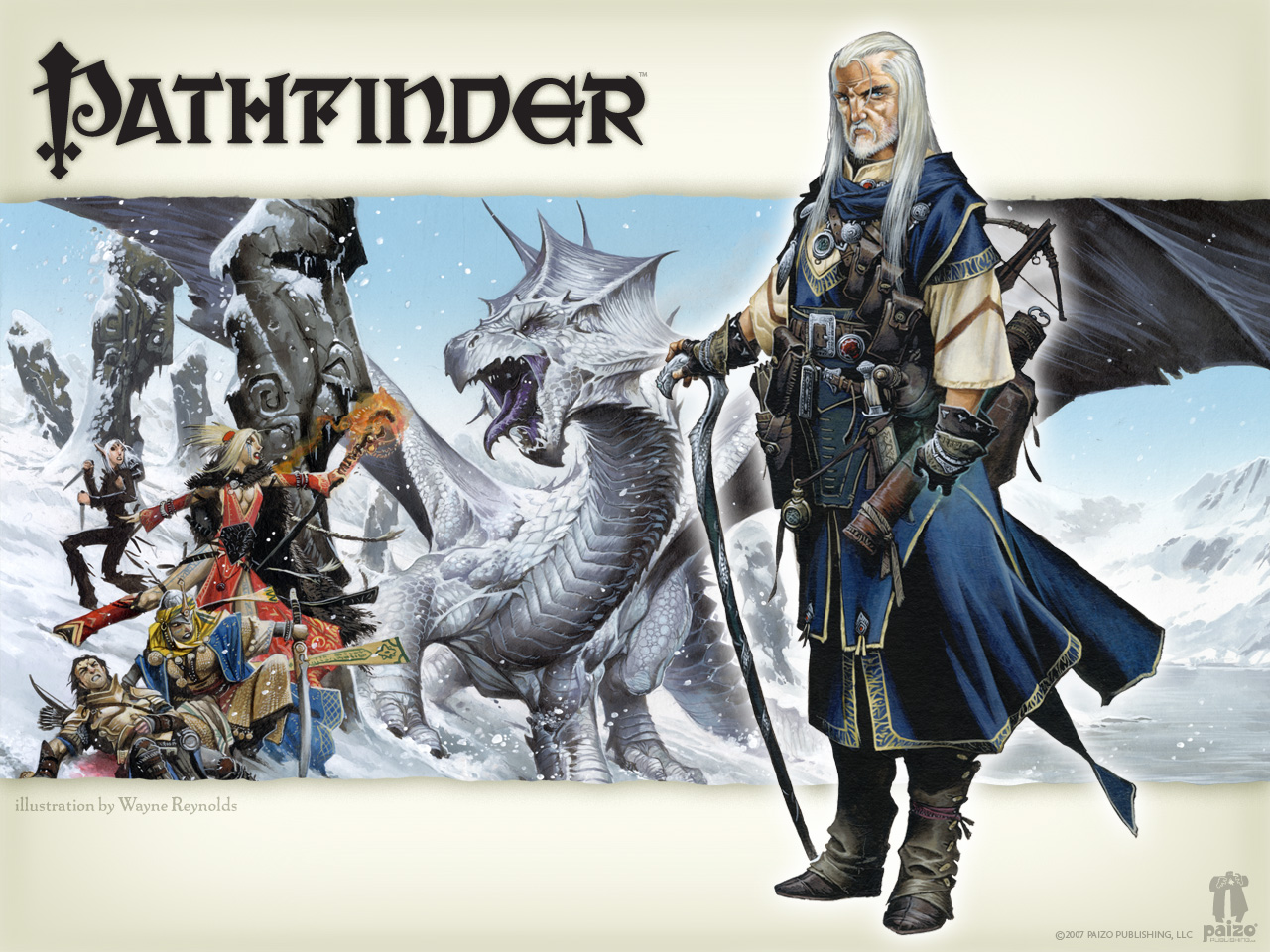
So what is D&D? Or, to be more specific, what is D&D 4.0? It's admittedly a bit harder for a pen-and-paper RPG because the final answer depends a lot on what the DM and the players want it to be. But it's vital for marketing to be able to answer these sorts of questions. Paizo understands this, and lot of their success can be attributed to the easy visual identification that Wayne Reynolds has given their cover art and their iconics. They may never use another piece of Reynolds' art ever again, but because he did those first half-dozen covers, and because he defined their iconic characters visually, that look and style will forever be associated with Pathfinder to the hobby.

But you don't even need good art to do this. No one has ever accused the GURPS RPG of enjoying exceptional art (though I'll argue that a number of their covers have been very evocative). Yet anyone who's had even the most casual brush with the game knows exactly what it's about. Love it or hate it, you recognize what GURPS is and what its goals are. There is no mystery about its point-buy character creation, its deep, textured rules aimed at simulation, and it's broad palette, ideally suited towards a truly universal generic RPG.

So what is D&D 4.0? Wayne Reynolds did the covers, but unlike Paizo, they haven't thrown them up everywhere to advertise them, nor have we seen wallpapers from WotC using them or anything like that. In fact, 4.0's online presence appears to have stagnated, with the look and theme of the D&D web page being exactly what it has been for years now. Instead of seeing 4.0 when you go to the D&D web page, you see 3.5. I was just at my FLGS at the end of last week, and they had a little display up counting down the days till the launch of 4.0, but instead of having any 4.0 material there for advertising, they had an arrangement of 3.5 books. I remember before the launch of 3.0, that same store had a life-sized cardboard warrior from WotC, all done up in the brown-and-red palette that would come to define the visual theme of the game. What will 4.0 look like? If it wasn't for sneaked pics from GAMA, I probably wouldn't know.

And what about how the game plays? Gone is the Great Wheel and a handful of other, albeit minor, traditions of the game. Now we have healing surges and characters described as "strikers" and "controllers". How strong is the link between the game that was, the game that is, and the game that's soon to be? Gone also are the dead-tree versions of Dragon and Dungeon magazines, which might have told us. Instead, we must find the answers on an official web page that is still very much a legacy of 3.5, and ENWorld, the fan page that made a name for itself chronicling the launch of 3.0.

Now, I'm not going to go on record as saying that 4.0 is doomed. Far from it. Tons of people will buy the core books, and some of those who have pre-ordered don't even intend to play it, but only promise to "look it over" in order to "give it a fair chance". And the grognards will be the first to tell you that oD&D and AD&D managed to take the world by storm without a unified artistic vision or a marketing and branding blitz. Fair 'nough. But beyond having fun talking
about the release of 4.0, I really don't feel a hint of emotional investment in the game. It comes out less than a week before the Trollwife's birthday, and the core books aren't on the short list of presents I plan to get for her. Frankly, I just don't care, and in this case, apathy is far, far more disturbing than hate.

¡Muy Caliente! (And NSFW)

One of the joys of having a blog is using a service like StatCounter that tells you, vaguely, who is hitting your web page. It gives you IP addresses, and from that, it can tell you what city and country they are in when surfing your blog. It's fun to pull up the map feature and see little pins in far away places I've never been to but where the love of gaming is shared, like New Zealand and Turkey, or places I've read about in history books but haven't yet visited, like England and the Ilse de France. Probably the most far-afield hit came a few days ago from Ho Chi Minh City.

It also sometimes gives you the link a person used to find your web page. This morning I saw one from Argentina with the following referring URL:


www.derol.com.ar/foro/viewtopic.php?t=14024&start=60

Now, I don't speak much Spanish, but growing up in Texas, I've learned enough to get myself into trouble ("Dos cervezas, muy frio, por favor!"). So I started scanning the message board to see if I could figure out why my blog was linked.

I got as far as the seventh post before I had to do a double-take on one of the avatars.

I need to learn Spanish, and spend more time on boards like that. ;)

Muchos gracias, Zulgyan!

Preview of Keep on the Shadowfell

Thalmin over at ENWorld has posted some information on the D&D 4e intro adventure, Keep on the Shadowfell:

The adventure is an 80 page book, including front cover. Full color throughout, includes small shots of poster maps as encounter keys. Also includes a couple of non-tactical maps (like a map of the area, map of a walled village.)

The 3 double-sided poster maps cover dungeon and wilderness encounter areas.

The Quick-Start Rules booklet is 16 pages, including front cover. Ten pages are the pregens, which include level-up info for 2nd and 3rd levels. The other 5 pages are pretty much what we have seen from the DDXP demos.


You can find more general information about the adventure and how it was designed here.

M20 Thieves World

El Diablo Robotico has posted his basic conversions for playing a Thieves World campaign with the Microlite20 rules.

I think that has to be a record for the most links I've ever crammed into a single sentence before.

"When Danger Reared its Ugly Head, he Bravely Turned his Tail and Fled..."

Ripper X continues the great advice columns with a post on retreating in AD&D:

A retreat is organized! And it should all be done at once. A single fighter leaving the front to seek a cleric or drink a potion is withdrawing, and hopefully a comrade will protect him while he is performing this action. A retreat on the other hand is an entire party or group admitting defeat but attempting to escape.

I've never used the rule referenced that someone fleeing has an AC of 10. Rather, fleeing characters don't get their DEX bonus and the attacker gets a +4 to hit for attacking from behind. Still, that's bad enough in most cases, so yeah, organizing your retreats can be very important.

In Defense of Pipeweed and Klava

James Maliszewski has posted his appreciation for the embrace of anachronism in old school gaming. I’ll admit that there’s something wonderfully liberating about the blatant flirting with anachronisms that warms my heart. It lends the games a giddy sense of possibility, just like the impossible number of sentient monsters listed in the Monster Manual or the mild disregard for ecology in the dungeon. When you step foot in an old school dungeon, anything can happen and likely will!

Still, my love of verisimilitude can only take so much, and the “silly” dungeons (like Castle Amber by Moldvay) often grated on me. However, strict historical recreation and verisimilitude are not the same thing. Before I’d ever heard the word verisimilitude, I thought my goal was, in fact, historical accuracy. I banished tomatoes and tobacco from my fantasy worlds, converted gold to silver, and decreed all precious gems were polished and not cut, in order to better reflect the realities of medieval Europe.

Which, when you step back and look at it, was silly, since none of my games actually took place in medieval Europe. There was absolutely no reason why my fantasy worlds needed to model 12th century Britain or France. As I studied the history of the ancient Middle East or pre-Columbian Central America, my horizons expanded and I embraced the possibilities of my fantasy worlds. Tomatoes and pumpkins filled their harvests, pipeweed smoke filled their taverns, and their calendars were built around alternating periods of drought and monsoon. I even made room for the fantastical, placing green-hued poison oaks in their forests and night-blooming twilight glories in their gardens.

That said, words carry more meaning than is encompassed by mere dictionary definitions. If your starship captain speaks in furlongs and pounds instead of metric measurements, that says something subtle but important to your audience. At the dawn of the 21st century, pipes and tobacco seem archaic and quaint, but they were standard equipment for the engineers that worked on the Apollo program for NASA. A good analogy is coffee. A lot of people get annoyed when authors and gamers come up with replacement words for things like coffee and tobacco. But coffee is a thing strongly associated with the modern and mundane world. Yes, coffee has been drunk for centuries, yes it’s of ancient and foreign pedigree. But if you say the word to a modern audience, they think Seattle and Starbucks and Styrofoam cups of bitter caffeine that barely keep one awake through interminable board meetings. With every sip of coffee your elven warrior drinks, a bit of his fey glamour dies.

It isn’t anachronism that is fatal to verisimilitude, but association, and association is all about perception and not truth or accuracy. Where you need to draw the line is going to be an individual matter, for each player and each group. As we continue to push the boundaries of fantasy to encompass different cultures (like the recent embrace of oriental fantasy with games like Exalted) and different time periods (such as the pseudo-Victorian fantasies of steampunk), the load that verisimilitude can bear without breaking grows. Internal consistency, more than any one feature, no matter how anachronistic, is far more important to preserving the suspension of disbelief that is the first step towards wonder and empathy.

Wednesday, May 07, 2008

More (Kinda) on D&D Insider

Bill Slavicsek's latest Ampersand column is about the future of D&D Insider. There's not much there, except to say that what we've seen should not be taken as representative:

What you’ve seen since the announcement has been just the tip of the iceberg. The magazine content has been geared toward teasing and previewing the upcoming edition. When the new edition arrives, everything changes. The magazines take on all the depth and crunch we’ve been promising, and the cycle of D&D 4th Edition really kicks into high gear. It’s a cycle of analog products complemented by digital offerings that, in turn, influence organized play and are reflected in a vibrant community that provides feedback and suggestions—that leads to the next analog product, and the ongoing cycle of 4th Edition.


The article is a bit business-speaky but it is nice to know there will be a rigorous support for .pdf in the online offerings.

Nazis. In. SPAAAAAAAAAAAAAACE!

Video here.

(Via AintItCoolNews.)

Geek Related Gives a 4e Rundown

Over at Geek Related, mxyzplk has posted a rundown, with links and commentary, of most of the previews released by WotC to date on D&D's 4th edition. He's not terribly impressed, and I suspect it has a lot to do with sharing my appreciation of verisimilitude:

Every damn monster they’ve showed off “marks” someone and does stuff to it. I still haven’t heard any kind of “what does this mean in game world” explanation - it’s a clear gamism over simulationism decision and it grates on me.


Keeping his point-of-view in mind, I'd definitely recommend taking a look if you haven't had the time to keep up with WotC's daily release of preview material.

Anderson Goes Viking While Vance Goes Pao

If you’re hungry for more shield-shattering goodness, take a gander at The Silver Key, where Mr. Murphy has posted his review of Poul Anderson’s Hrolf Kraki’s Saga. This isn’t an original tale by Mr. Anderson, but rather a retelling of the life of one of the greatest Viking heroes.

Speaking of reading the classics, I’ve been trolling my local used bookstores for novels by the authors often mentioned as inspiration for Gygax, Arneson, and the other greats who started the RPG hobby. Jack Vance, of course, is high on that list, and I’d never read anything by him (or, at least, I can’t recall ever having read anything, though it’s likely I’ve come across a short story or two). My last visit to the used bookstore turned up The Languages of Pao. This is a science fiction tale that has nothing to do with “Vancian magic” or the fantasy genres in general. Still, I hoped it would be an interesting start into exploring his work.

“Interesting” is a bit of an understatement. Here’s the short review: if you’re into sociology-porn, if the Sapir-Whorf Hypothesis is the sort of thing that gets you all hot and bothered, sure, look this one up. Otherwise, it’s probably not worth your time.

Ok, that’s the short review. The longer review follows, only I’ll warn you that I may slide into matters of personal political philosophy. I’ve done my best to banish such things from Trollsmyth, which I see as a haven from all that sort of stuff. So if I get a bit strident, please forgive me.

The “hero” of the tale is Beran Panasper, whose father is Panarch of Pao. The Panarch is the absolute ruler of the world, and his rule is facilitated by the culture of Pao. The people of Pao number in the billions, and all share a unified culture. The dislike change and violence, and prefer conformity and stasis. Their idea of a national sport is to gather in huge crowds and perform “drones”, chanting for hours in unison. When faced with adversity, the Paonese response is passive-aggressive. This makes it easy for the Panarch if, for instance, he has to murder a few million of his subjects in order to stave off an impending famine.

Beran’s uncle decides he’d make a better Panarch than Beran’s father, so he murders the current Panarch. The visiting techno-wizard Palafox spirits Beran away before he, too, can be murdered by his uncle, and hides him on the world of Breakness. Beran is enrolled in a course of education on Breakness while his uncle faces a passive-resistant revolt on Pao, and then invasion by a neighboring world of warriors. In desperation, he turns to Palafox for help.

The prescription suggested by Palafox is a remolding of the Paonese culture. Palafox designs a program to transform the Paonese from passive, bucolic serfs centered around changing their language. He creates three languages for Beran’s uncle, and they set about using these languages to create three new cultures on Pao. One, speaking Valiant, are warriors who are eager to die for glory. Another language is created for engineers, which inspires them to build and design and improve. Finally, a third language aimed at cogitation and planning (and based on the language of Breakness) is introduced to inspire the creation of a supervisor caste. Entire populations are uprooted and moved around as territories are marked out where only the new languages are to be spoken. It’s impossible to read about this massive social engineering program and not think of the Cultural Revolution. And, indeed, millions are displaced and hundreds of thousands die in the chaos the results. Beran hears about these horrors and, as the rightful Panarch, feels some obligation to “set things right”, which, to his mind, means returning things back to the way they were. Thus begins a three-way conflict between Beran, his uncle, and Palafox, who has his own megalomaniacal plans for the Paonese.

Now, I suppose we’re supposed to root for Beran because he’s the viewpoint character, but really, he’s extremely hard to like. The fact that he wants to be an absolute tyrant over a world of listless ciphers hardly makes him loveable. You can’t root for his uncle because, in addition to being a murderer, he’s singularly incompetent, and behaves stupidly throughout the book. And Palafox is a manipulative bastard. If the book wallowed in the wickedness of the characters, that might have been a fun read, something like a sci-fi sociology-porn version of Karl Wagner’s Dark Crusade. Unfortunately, I was never quite able to dislodge the feeling that Beran was, in fact, meant to be a hero, and not an anti-hero. Maybe I’m dense and missed the intended satire? As our three main characters clashed in their attempts at social engineering on a grand scale, the primary emotion I felt was tepid revulsion at their banally vile behavior.

So I really can’t recommend this book, unless the idea of using language as a tool in massive social-engineering projects tickles your fancy. Otherwise, there’s little here to enjoy in The Languages of Pao.

Beauty is in the Eye of the... Er, You Get the Picture

This is a real contest, really being held and sponsored by WotC. If you've got a thing for beholders, or juts have artistic talent in general, you should check it out.

And don't worry if you have just "some" artistic talent, because I can tell you that most of the big-time pros will not be up for "selling" their work for a mere $100.

Tuesday, May 06, 2008

Learning From the Mistakes of Others

Scot Newbury is back after a long blogging hiatus with his postmortem of his Realms of Rylon campaign.

Jeff Rients Channels Ryan Dancey

Jeff has a great post on his blog today, entitled The D&D Toolbox. He hits on lots of cool topics, and just when you think he's gone off on a wild tangent, he ties it all together with an awesome idea:

THAT is what I want from an OGL D&D pdf. Total effin' customizability. Give me a bigass checklist in the front of the file, like the ones that you can find in the back of old RoleMaster Companions. Allow me, through judicious checking and unchecking of little option boxes, to drill down to the exact version of D&D that suits my tastes. Give me the option of typing in additional text, or have the output of the program be in a form that I can easily edit. Then I can print out a copy for each player in a campaign and I will know that we're all on the exact same page.


How cool would that be? Frankly, it's exactly what I'm doing with my Moldvay/Cook/LL hack. When I'm done, I'll have a PDF that I can give to my players, based on the LL PDF but with my houserules in it. In essence, I'm going to be doing what Jeff wants to be able to do, but only because I have access to the Acrobat software necessary to make it happen. You could do a bunch of copy-and-paste into the word processor of your choice and do the same thing, but again, that's an ugly, time-intensive cludge.

How much cooler would it be to have a giant database of rules and systems that you could pick and choose from? Want combat to be light and simple? Pick the minimal options. Want more detailed combat, with individual weapon-vs.-armour aspects? Just check the options and activate them in your personal rules set. Brutal and bloody? Abstract and quick? Complex and tactical? Just choose the rules modules you want to use, and the rest will remain in the toolbox, ready if you ever want them. Then seed with appropriate clip-art, hit , and you have your very own RPG rulebook, custom tailored to your campaign.

Thing is, haven't we heard something like this before?

Review and Response for XXXI

James Maliszewski has posted a review of XXXI. "Uh, say what?"

One of my main complaints about XXXI is its title, which makes it hard to know just what it's about. As it turns out, the book is a description of the Imperial Town of Tell Qa, which is a complete setting for urban adventures, as well as a springboard for lots of other excitement and intrigue. The center of the book contains a nice map of Tell Qa done in the style of the old JG modules, right down to most buildings being regularly shaped and streets laid out in a grid-like pattern.


"Oh, ok, I see." The review is primarily positive. However, it's spawned this response from James Mishler, president of Adventure Games Publishing. Both are worth checking out if you're interested in either retro gaming or the business end of the hobby.

Shields Shall be Splintered!

I'm working on giving the shield a bit more love in my Moldvay/Cook/LL hack. The shield really doesn't get the prestige it deserves. There's a reason it was a staple of the infantryman's gear from the dawn of history all the way into the 17th century. Shields work. They stop blows, they can be moved to intercept attacks coming from almost any direction, and they can be used to attack your foes. Simply lowering your AC by a mere point is hardly representative of the value of a good shield.

However, things are complicated by my adoption of some popular houserules for weapon damage. To whit, I'm considering tossing the plethora of different dice types for weapons and just adopting 1d6 for single-handed weapons and 2d4 for two-handed weapons. This is a variation on schemes I've seen elsewhere. Fighting with two weapons allows you to roll 2d6, and you take the better roll.

So you can see that there's a lot of value to fighting without a shield in improving the damage your character dishes out, making the shield an even less likely choice. What can be done to rehabilitate the shield and make it a worthwhile choice mechanically?

I'm considering allowing the shield to act as ablative armour. One thing historical shields frequently did was shatter. A strong blow with an axe or a sword could cleave a shield, splintering the boards. Viking duels often had a three-shield rule, allowing each combatant to enter the contest with a shield on his arm and two spares in reserve. (I believe this was seen in "The 13th Warrior", but it's been a while since I've watched it, so my memory could be faulty.)

With my houserule, you get the usual -1 to your AC with a shield. However, any time you take damage, you can opt instead to say your shield absorbed the force of the blow. The shield is shattered and must be discarded, but you don't take any damage from that hit. It's quick, it's easy, and it's valuable.

What about magic? Should a shield ward you against the ferocity of a fireball or a lightning bolt? My instinct is to say yes, but that makes a shield incredibly valuable, and takes a lot of the sting out of those spells. Maybe you can sacrifice the shield in exchange for an automatic save and half damage? Do you get to decide after you've rolled the save, or do you have to choose before you roll? We can go crazy with this and say that shields crafted from the wood of the rowan tree can be sacrificed for a successful save versus any spell, even those that don't deal damage directly.

What about magical shields? I'm kinda meh about the idea of mundane swords being able to shatter magical shields. On the other hand, I certainly don't want a warrior being able to just ignore hits every round because his shield won't break. Maybe each +1 gives the shield a 10% chance to survive the blow? Maybe I just won't have magical shields in my campaign? Seriously, in the quarter-century-plus I've been playing D&D, I think I can count the number of magical shields in my games on one hand.

(I also considered allowing the shield to give its bearer an AC of 3 versus a single opponent, but then you have to keep track of who it's been used against, and the character's AC jumps around between 3 and whatever their armour grants. It's a lot more hassle in the thick of dice-rolling. And I just love the visceral feel of shields being cloven in twain under the blows of a dangerous foe.)

Ganging Up

Szilard of Neitherworld Stories has an interesting post on 4e encounter design. He begins by discussing the problem of BBEGs (Big Bad Evil Guys), massive "boss" monsters who tend to be singular and lurk at the bottom of the dungeon, letting their minions soften up the PCs before they themselves attack. The problem, however, (and this has been true in almost every iteration of D&D) is that the group of PCs almost always have many more attacks than the single monster, and they will almost always concentrate those attacks on the big boss. This usually turns it into hamburger within two rounds, which tends to feel anticlimactic, exactly the opposite of what you're trying to achieve with your big boss fight at the end of the adventure.

WotC has considered this issue in their design for 4e. Szilard, however, is less than impressed with what he's seen:

Instead, though, Wizards seems to be focusing on giving enemies more attacks through two methods: (1) Giving monsters more attacks (which I've already written about) and changing encounter design such that the default assumption is that there are a number of enemies equal to the number of PCs.

I can see a lot of problems with this. First off, it seriously limits the sorts of foes PC face. Most monsters won't be encountered alone. This will lead to PCs guessing that there's an ambush when they only see the single enemy who has been laid out as bait. It may well also ring false to players that they are always running into things in groups of four.


This is a bit of a surprise and dissappointing if true. With their emphasis on terrain features, it would have been easy to add all sorts of interesting wrinkles to hinder the PCs. Maybe the wizard can't cast lightning bolt because he's too busy using levitate to keep everyone out of the acid. Tunnels full of obscuring mist might force the PCs to spread out in order to find the BBEG, who can then launch hit-and-run attacks at the flanks, engaging only a few of the PCs every round. And that's not even touching on the interesting alterations you can make to monsters that Szilard has discussed in the past.

As always, it comes down to the DM to be creative and make fights interesting. Even with a broad list of abilities, players will usually discover their optimal attack and spam it over and over again until their target falls. That's just the smart way to play, and 4e doesn't seem to change that. The burden of keeping things fresh and interesting, therefore, is squarely on the GM's shoulders. Here's hoping the 4e DMG is full of neat ideas and inspiration to help lighten that load.

Monday, May 05, 2008

Chatty's 10 Word Contest Update - Date With a Kobold

You have until Tuesday, May 6th, at noon (that's tomorrow as I post this) to enter the Chatty DM's 10 Word Adventure Concept contest. To further entice you, he's added more prizes, specifically, issues of Kobold Quarterly, so no lallygagging!

UPDATE: Ok, maybe a little lallygagging. Just long enough to read Chatty's review of the Evil DM's The World of Broadsword:

However, the true added value of the book (and testament to Jeff’s skills) comes from the Gazeteer section of the book. There, following an old school, color hex map of the proposed game world, Jeff created a series of 15 one page entries for its major regions.

What makes it so interesting is that Jeff used an actual corporate planning tool called SWOT analysis (Short for Strengths, Weaknesses, Opportunities and Threats) to flesh out key regions of the world.

Thus after a short description paragraph, each given regions gets fleshed out in terms of where it shines (Strength), how it can be exploited (Weaknesses), Adventure Hooks (Opportunities) and things that can befall it (Threats) catching PCs in the middle of it. I’ve rarely seen a settings write-up provide so many plot ideas and adventure hooks in so little space.

More Magical Swords

Tankards & Broadswords is quickly solidifying its place among my favorite RPG websites. Most recently, Badelaire has posted seven magical swords with a bit more personality than most you encounter in RPGs:

Each of these weapons is a powerful magic item, but they probably aren't game-breakers, and acquiring just one of these swords would be a quest in itself. Also, if the players are going to get the full effect of the weapon's power, they'll have to be facing the sorts of foes the weapon is designed to combat, and while the bearers of the swords have special abilities and protections, the rest of the party may not be so lucky.

2e Brawls

Ripper X has taken a break from a series on running epic-level campaigns to discuss adjudicating "friendly" tavern brawls in 2e AD&D.

Zen and the Art of Spell Casting

It must be magic week on the D&D intrawebs. James Maliszewski has posted his response to the question, "[i]f clerics and magic-users both use the same game mechanics -- memorization, spell slots, etc. -- then why do they use two entirely different spell lists?" He's got an intriguing answer:

Under my interpretation, both are "sorcerers" in a broad sense, for both tap into the same universal power source. The difference is that magic-users bend that power to their wills, which is why they acquire spells faster and their magicks are generally destructive and self-aggrandizing. Clerics, on the other hand, bend themselves to match the warp and weft of the universe's power; they improve themselves in accordance with its laws.


This solves a lot of the mysteries of D&D magic in any edition. How can both sides in an internal religious dispute still have magical powers if at least one of them must be considered heretical? Why doesn't worshiping a more powerful god give you more powerful abilities? How can clerics worshiping demons get the same powers as those who worship true gods? What about clerics who are worshiping beings that claim to be gods, but really aren't, like in the module Against the Cult of the Reptile God?

It also explains the high-level spell acquisition of paladins and rangers. Both classes come to the same harmony with the powers that underpin the universe, but in a very round-about way. Finally, rangers don't have to choose a divine patron when they reach a high enough level to start casting spells. The spells don't come from gaining the attention of the gods, but rather from an inner discipline that slowly brings the ranger into line with natural flows of energy in the universe.

But you can take this idea even further. How is the high-level fighter able to take on entire armies of foes and emerge victorious? How can the high-level thief pick the pocket of even a wary individual? Could it be that they also achieve the same sort of harmony with the same natural energies, albeit in a rather limited way? This would make Earthdawn and D&D far more similar in their metaphysical underpinnings.

It's a neat idea, and certainly worth further consideration. As for me, I'm going to continue tinkering with my sacrificial mechanics. After all, one of the joys of early editions of D&D is how amenable they are to being bent around the themes and tropes of individual campaigns.

Sunday, May 04, 2008

Review of Labyrinth Lord

Andrew Montgomery has posted a short, positive review of Labyrinth Lord, the retro-clone of Moldvay/Cook D&D, the set that got me started in the game.

Author Dan Proctor clearly envisioned LL as way for people to legally write and sell OD&D materials. LL operates under its own OGL, and allow people to do so. I think he felt this was a way to generate more interest and material for an old, beloved game, a way to keep it alive. No, no one is going to make any real money by doing this, but they might earn some minor compensation for their efforts, and for some even just making a few cents per download might make the difference between posting their old scenarios or keeping them in the shoe box under the bed. At its heart, this—more than anything else—is what LL is all about. Its an effort to get people to write new material for OD&D.

It's short and sweet and over at RPG.net.

Making Sacrifices

I’ve never really been a big fan of spell points. Even when I’ve disparaged Vancian-style magic, spell points haven’t leaped up at me as a good solution. In part, this is because I consider verisimilitude to be the highest good after fun in my RPG gaming. Vancian magic may be annoying and almost completely unlike the way magic works in most novels, comic books, or movies, but at least it feels more like magic than a spell point system. Choosing spells feels more magical and involves fewer layers of abstraction between you and your character. It’s also quicker than spending points, since by choosing what you’ve prepped, you’ve cut down on the available options at the time of casting.

That said, I’m contemplating a spell-point system for clerics in my next campaign. Why? Primarily, because it bugs me that magic-users and clerics use the same mechanic for spells. If magic is so similar for them, why can’t they pinch from each other’s lists? Yeah, I could come up with all sorts of reasons, but it would just make me happier if they used different mechanics.

There are good game reasons for them to use the same mechanics, though. It means that the cleric and the magic-user will be united in their need for rest in order to recover their spells. They’re also likely to need that rest at the same time, making the group more likely to stop in order to recharge the magical batteries of their spell-slingers.

I think I can keep those benefits, and offer more. By moving to a spell-point system, I also make the cleric a lot more flexible and powerful. I don’t have a huge problem with this, because in my games the cleric is always getting dumped on by the temple hierarchy. There are all sorts of ways to rein-in your clerics, from temple politics to cranky deities. So I’m not too worried on this score.

There are two benefits I see to a spell-point system. The first is improved healing. If, instead of having healing done by spells, I instead have the cleric burn spell points to replace hit points on a one-per-one basis, that really opens things up. Like the 3rd edition D&D rule where the cleric can swap another spell for a healing spell, this actually allows the cleric to do something other than cast cure spells all day long. It makes the cleric more interesting to play, but doesn’t punish the party for it. It also means that low-level clerics aren’t stuck with helping only one person, with everyone else just having to suck it up until after the cleric rests. (In my experience, that just leads to the party camping out for three or four days while the cleric sleeps, casts cure light wounds, sleeps, casts again…)

The second, and more important benefit from my point of view, is that it gives me something to hang sacrifices on. I’m not talking about the wishy-washy sort of sacrifices you see people performing around Lent (or the fasting period of your religion of choice), where people give up sodas or chocolate. Heck, no! I’m talking about that old time religion, with snow-white bulls and ornate, unwieldy daggers, and priests up to their elbows in blood.

(Yeah, I know, James Maliszewski and others have pointed out how the cleric in OD&D was based on Roman Catholic tropes, and carried those trappings all they through into 2nd edition and beyond. That’s all well and good, but if I’m going to say my clerics are part of a polytheistic pantheon full of savage moon gods and devious spider crones, how exactly does that fit with a priest who behaves like he just stepped out of Father Francis O’Malley’s seminary lecture? Remember, I want greater verisimilitude, so if I’m going to have my clerics worshipping non-Christian polytheistic deities who are red in tooth and claw, then by God they should act like it!)

So, here’s the deal: spells cost 4 points per level to cast. The number of points you can have maximum and the highest level spell you have access to is based on your level, and this pretty much mirrors the way things were done in Moldvay/Cook D&D. When a cleric performs daily devotions, the DM or player rolls 2d10. The cleric gets their Wisdom score minus the roll plus 4 spell points (with a minimum of 4). The cleric cannot pray for more points for another 24 hours, and cannot “store” more spell points from prayer than their level allows.

However, spell points from sacrifice are held above and beyond that limit. The cleric can only be benefiting from a single sacrifice at a time (this keeps the cleric from spending down time just sacrifice entire herds of sacred cattle and racking up hundreds of spell points). Generally, a cleric gets 4 spell points for every hit die of the creature being sacrificed. If the cleric instead sacrifices wealth and jewels, rather than living creatures, it’s much less efficient, returning only 1 spell point per 40 gp value. (And note that this wealth isn’t spent on the temple, or given to the poor, or anything like that. It is sacrificed to the god and thus lost to the mortal world.)

Animals suitable for sacrifice must be exceptional in some way, and must cost at lest 150% of their standard list cost. (I’m probably going to use the costs from 1e’s PHB for livestock.) They must also be ritually prepared, and a proper sacrifice requires one quarter hour per HD of the sacrifice for preparation and performance of all the necessary rituals.

Can sentient creatures, people, humanoids, and the like be used for sacrifice? That probably depends on the god, but in general, I’d say yes. However, note the prep required in the previous paragraph; a cleric can’t simply wade into combat declaring, “I’m sacrificing this orc I’m fighting to my god!” (However, I am tempted to allow that sort of thing under special circumstances. The idea of a cleric charging into combat shouting some variation on “Blood and souls for my lord Arioch!” is just too cool to ignore.)

Ok, that’s enough for now. I’m going to roll this around in my head for a bit and see if I can find any real problems. If you see some glaring oversight, please let me know.

Saturday, May 03, 2008

Just Say No!

The Chatty DM offers a lukewarm review of the latest Pathfinder issue, Seven Days to the Grave. I think I agree with him. It sounds like there are some inexcusable sins here. Like this, for example:

To my eayes, the plot feels rather railroady as it assumes that the players will help the uncle (a NPC they met in the 1st part of the adventure) of a young girl that fell sick from the plague. It’s expected that the PCs will cough up the cash needed to heal her.

Then the adventure assumes that the players will side with the church that charges to heal people to investigate the plague further.

He then elucidates in the comments:

I read it more into details and the NPC requesting help actually resorts to insults and guilt-tripping if the players refuse to cooperate. Not a good sign…

No, not a good sign at all.

There was a series of excellent GMing articles a few years back in the pages of Knights of the Dinner Table. I forget the name of the author, but one of his pieces spoke specifically to this issue, and he referred to it as the Garden of Eden problem. Basically, it boils down to this: if the adventure requires the PCs to take a specific action (i.e. eat the forbidden fruit) before the rest of the adventure can proceed, you’re just asking for a train wreck. What happens when the players refuse to bite? Usually, the DM gets pushy, which usually leads to the players digging in their heels, and the adventure ends up getting tossed as a bad idea and everyone decides to play cards or something instead while tempers cool down.

These sorts of decision choke-points are killers for even an otherwise good adventure. Even worse are those that don’t require any interaction with the players, but instead rely on the dice rolling up a success at a critical juncture. I see this a lot in home-made adventures. Sure, it makes sense for the vampire lord to hide his coffins behind a secret door, but if the PCs must find his hidden crypt to complete the adventure or move to the next stage, what are you going to do when even the elf rolls poorly on the search or notice check? What are you going to do when the players say they search the body of dead messenger, but their checks fail and they don’t notice the red mud on his boots that will lead them to Beggar’s Canyon? If the game requires the PCs to succeed on a check, then there’s really no point in rolling, is there? Just give them the success and move on.

Now, I’m not saying that moral choices and spot checks need to be banished from your game. Instead, they need to lead to bonus goodies that help the PCs, but are not required for victory. Make the final climactic battle with the vampire lord be in his throne room. If the players don’t find his hidden crypt, then of course he doesn’t really die. He’s defeated, and must flee, but he’ll return looking for payback later. Maybe that spot check also reveals basilisk scales caught in the mud on the messenger’s boots, so the party now knows they need to be prepared to face that sort of beast. And healing the little girl should reward the players later in the adventure in some way that makes a later climactic battle easier, but it shouldn’t be required for the adventure to even begin.

UPDATE: WotC gets it:

Success or failure in a skill challenge also influences the course of the adventure—the characters locate the temple and begin infiltrating it, or they get lost and must seek help. In either case, however, the adventure continues. With success, this is no problem, but don’t fall into the trap of making progress dependent on success in a skill challenge. Failure introduces complications rather than ending the adventure. If the characters get lost in the jungle, that leads to further challenges, not the end of the adventure.

Friday, May 02, 2008

Another GSL Update

The folks at WotC asked for some "interview" questions from ENWorld readers on the GSL and promised answers. Those answers have arrived:

Q) Many questions have been raised since the announcement last week. I think the one question everyone wants to know is: is the limitation the GSL places on publication of OGL based products limited on a "per company" basis or a "per product" basis? That is, is the effect merely to limit re-issuing the same product, or is a company that publishes a GSL product thereafter limited in their ability to publish any OGL products?

A. The restriction is on a per product line basis.

Q) How does this pertain to a company's catalog of existing OGL-based products? For example, if Necromancer Games publishes a Tome of Horrors 4e, would they have to stop selling their existing 3e OGL products via RPGnow?

A. Publishers will be able to continue to sell their backlist under the OGL. If those products had the d20 system logo on them there will be a 6-month sell off period after which they will not be able to use the d20 system logo.

Q) Can existing OGL products be updated to the GSL and what are the restrictions, if any?

A. Existing OGL products can absolutely be converted to 4e GSL products, so long as they adhere to the terms of the GSL. In fact, we want to see publishers update their popular product lines to 4e.


There's more at the link. It's not exactly clear as day (what, for instance, constitutes a "product line"), but it does appear that there will be a GSL after all. Probably.

Maybe you should just ask me again on June 6?

"...but I was thinking more an article about what you put in tankards."

Badelaire has been one busy blogger. Not only do we get a nice little rundown on adult beverages of ancient pedigree, but also a discussion of magic swords inspired by the Sword of Goujian.

And then there's the post between them. Er, let's just say, don't read it while eating, ok? :p

Care to Host 12 Dragons, 50 Cyborgs, and 380 Orcs?

Jeff Rients is planning to start up Worldwide Adventure Writing Month (abbreviated WoAdWriMo) next month. Unfortunately, he needs a net-place to host it:

I'll make a new Yahoo Group if I need to, but does anyone have any other ideas for a place that can host the finished adventures and maybe a discussion forum? The forum was relatively low-key last time, but the download section needs to be able to handle at least a couple thousand 5 or 10 MB downloads over the course of a week.


If you think you can help out, let Jeff know. In the meantime, I'll be scratching my head, thinking about what sort of adventure to submit.

Outsider Update: Page 53

Here.

The Ancient Rivalry

I see what they did here!

It's a Ferrari. Or Maybe a Duesenberg? No, Wait, a DeLorean!

Dr. Rotwang's posted a review of Hollow Earth Expedition: Secrets of the Surface World:

I like the equipment section, because --

-- okay. Let's talk about the equipment section for a bit. The equipment section is pretty long. It describes everything, all the weapons and vehicles and gadgets and stuff, and it does so in the style of a catalog. You can look at this two ways: You can roll your eyes at an over-long equipstuff chapter and say, "come ON! Pad the book out a bit more, WILL YOU!?", or you can look it over and go, "Cool! If my bad guys are Japanese, they fly these planes...and they carry this type pistol! Oh, and this boat has a neat description I can use to help my players visualize it!" I respond to it the second way. Could you have guessed?

This is Old School to Me

From Mr. Rients' recounting of their Gygax Memorial campaign:

The back half of the session was fabulous. The players figured out that brute force was not going to work against the evil cleric Lareth the Beautiful and his soldiers. So they started getting creative, like setting ambushes with flaming. I really dug it when removed a door from its hinges and then used it as a mantlet shield to force their way in, toppling several of Lareth's men. Finally it came down to just the PCs against Lareth and his nigh-impossible-to-hit Armor Class.

That's when Doug declared that they were going to attempt to overbear Lareth. Bless their miscreant hearts, that was the first time I've ever been in a AD&D game that actually used the overbearing rules. And it worked, too! Four PCs (two were down by this point) against a single man was just overwhelming. So congrats to them for making Beggar Mobs work in their favor.

Szilard, one of the players, adds this on his own web page:

I suspect that a lot of people who are enamored of old-school gaming (including, but far from limited to, Jeff) see older games as more conducive to this sort of play. For some of them, it probably is. If you are GMing a game and you aren't comfortable with the rules, you aren't likely to be comfortable making calls on the fly - or pitting the PCs against challenges they'll find near-impossible without ingenuity. Similarly, on the PC side, some of that cleverness in newer and more complex games can be internal to the character - whether it is a particularly neat build or a neat synergy between a couple of the PC's abilities. Some of this is going to replace the need for situational cleverness unless the GM forces the issue with challenging encounters that don't play directly to the strengths of the PCs.
Yeah, that's pretty much it for me. Tweaking my stat block or finessing an extra plus or two through feat selection just doesn't give me the sort of buzz that using the orc chieftain's throne for a bridge across the piranha-filled pit trap does. Different strokes for different folks, as they say, and I hope the group is able to work out their stylistic differences to not only keep the good times rolling, but maximize the fun for everyone by keeping things constantly fresh and new.

Trapped in a Hoary Web(page)

Michael Sigler at Dragon Ave has posted video proof that foamy rants aren't just for trolls! Ok, it's not that bad, but he's got no love for WotC's D&D web page. After getting a lot of feedback on his presentation, he decided he'd rather put-up rather than shut-up, and posted what he would do to make it better.

Frankly, it ain't no contest. Even if you think issues like gutters, shadows, and font-choice don't matter to you (and they do, they're just subtle enough that you might not be aware of it), it's clear that Mr. Sigler's version is cleaner, easier to navigate, and far more gentle on the eye.

Myself, I gave up trying to find what I wanted on their web page quite some time ago. If I want to find out what's new and exciting at WotC, I find links to it at ENWorld and RPG.net. I certainly hope WotC has plans to overhaul the web page for the release of 4th edition and the official launch of D&D Insider.

(Via ENWorld.)

Thursday, May 01, 2008

Doing Unto Others Before They Do Unto You: the Sharp and Stabby

Tankards & Broadswords has a great post up with a lot of fun links to articles on actual scholarship on European medieval fighting techniques. Historians can (and do) argue about how things really were done, but there's no substitute for trying it out yourself, which is what those folks do.

And if you're the sort who prefers videos to text, how about:

exactly how much faster is a longbow than a crossbow?

could the longbow really punch an arrow through armour?

what about stronger armours?

and just how cumbersome was all this armour, anyway?

was a helm useful for stopping sword blows?

All of these are from a great series out of England called "Weapons that Made Britain". If you can find the episodes at a video store or have a friend who recorded them off the History Channel, they're definitely worth the time to watch.

As for me, I'm really looking forward to Badelaire's post about tankards! ;)

Hit Points, by Any Other Name...

Over at ENWorld, someone (maybe Morrus) has posted thoughts from their initial foray into 4th edition. (Scroll down to May 1st. Unfortunately, near as I can tell, ENWorld doesn't have a way to link to an individual post.) Among other things, there's this comment:

Hit points, hit points, hit points... I feel that at this point in the stage, hit points really need to be renamed and rebranded. Yes, I know they're a sacred cow and they aren't going away any time soon, and yes, I like the mechanic because it's simple, cinematic and abstract, but they really need a new name! Over the past couple of editions, we've been moving away from the "hit points are physical damage" model, although D&D never completely divorced them from the concept. At this point, though, we've reached the point where hit points represent everything - damage, fatigue, luck, divine favour, and morale.

Once you get your head around this basic truism, all the random damaging and healing effects suddenly make sense. Why does the monster take damage just because he attacked someone other than the paladin challenging him? Morale; he's backing out of a fight and that weakens his resolve. Second Wind? Watch a Rocky film. It's all cinematic, and it works. Just, whatever you do, don't think of it as physical damage.


In spite of my general misgivings about 4e, this is something I'm rather grooving on. I can't wait to use my own version of Robert Fisher's injury table in my own games, as I think it manages to do something very similar, by driving home the idea that losing hit points doesn't necessarily mean getting hit. Which would be helped along a lot by changing the name of the "to hit" roll, too.

Humperdink, Humperdink, Humperdink!

Here’s a bit of advice for Dungeon Masters. When creating NPC’s names, say them out loud. If you can, give them to someone else to read. I may have to go back and change my primary mage’s name. The first time I heard a character say Fhakahn out loud I softly chuckled.

- jeffx

Doing What's Fun

Taking time out of his busy blogging schedule to actually, you know, play an RPG (Gee, maybe I should try that?), the Chatty DM has made some interesting observations:

Lessons Learned

  • Story trumps combat when a gaming group is getting tired of an adventure
  • Paying tributes to old memories is fun, at least for the DM
  • There is such a things as too many meaningless fights, no matter how retro-stupid-nostalgic one may get.
Oh yeah...

And here's where I stumble a bit when I hang out with the true grognards and dish about the old-school experience. For me, there was no such thing as a useless fight, because the players were simply scared to friggin' death of the dice. Seriously, you bring some 1st level characters built by Moldvay's book to the Caves of Chaos, and it can get ugly really, really quick. They did everything they could to avoid touching the dice, which meant everything could be a "story" encounter, including the stereotypical single orc guarding a chest.

Yeah, I know, we were weird. ;)

Anyway, the true lesson here, I think, is this: do what everyone is enjoying. Even if that means playing D&D without rolling any dice. It may feel odd, at first, but if you and everyone else is really having fun, run with it.

AC -6!

My copy of Fight On! arrived in the mail yesterday, but I wasn't able to pick it up until today. There have already been a number of good reviews, so I won't bother with another. Suffice to say, I ain't disappointed.

I will say this about Lulu, however: they certainly treated the magazine with respect. Because I am both cheap and poor, I requested the least expensive shipping option. Well, you wouldn't know it from the delivery. The box Fight On! came in was one of those sturdy, fancy cardboard boxes with a lift-out top, secured by a pair of plastic bands. Inside the box was a shrink-wrapped package, securing the magazine firmly to a board of stiff cardboard, to further prevent the magazine from being bent. The magazine itself was secured in a foam sleeve.

I'm still agog at all this protection. I mean, I was expecting it to arrive in an envelope, and if I was lucky, it would be one of those with the bubble-wrap lining. My magazine arrived in style and comfort, looking like it had just come off the presses.

Quote of the Day

The entirety of AD&D 1st was good for my vocabulary. At 10 years old, I didn't know ebeans about girls, cars, or life, but I knew what a "portcullis" and a "trebuchet" were. Of course, it would take a few more years and the UA before I could really figure out what a "glaive-guisarme" was.