So lots of comments about shields and armour and weapons.
The thing about Western Europe was, they were constantly evolving their weapons and armour to outdo their neighbors, or last year’s models. The corollary to that is, every weapon was specifically built to handle a particular job. Sure, some were modified farm implements, but they kept being used because they proved to be useful.
Those polearms with all the hooks on them? Great for dragging enemies off their horses.
Polearms with hammers and axeblades on them, as well as maces, are great for mauling armour and concussing the folks inside with their heavy blows.
Single-handed swords suck at penetrating heavy armour, but are great against lightly armoured (or, even better, unarmoured) targets, where those long, sharp edges can leave really nasty gashes.
The axe, favored weapon of Richard the Lionhearted and Robert the Bruce, was a compromise between the two. The bearded axe could be hooked around the edge of a shield so you could pull it out of someone’s hands, or just jerk them around with it.
The flail could get around the shield entirely.
And so on. Different tools for different jobs. How do we model this in D&D? Not well, I’m afraid. Gygax’s weapon-vs.-armour-class table was one stab at it, but as I understand it, even he didn’t use it. The other options I can think of require rewriting the combat rules entirely, and end up looking something like the table-crazy Arms Law from Rolemaster.
Monday, June 20, 2011

 PDF
PDF

Saturday, June 18, 2011
Carts, Horses, and the Arrangement Thereof
Over at “The Sky Full of Dust” they’re designing an RPG! It looks like a fun project. Mr. Forster has started his exploration of rules by poking at stats. I think he might have things a bit backwards, however. Yes, stats, if you chose to use them, will form the bedrock of your game and its mechanics. But, exactly because of the central place of stats, you might want to leave them as the last thing you nail down solidly.
 I'm going to use an example from wargaming. When designing a wargame based on an historical battle, exactly what features you focus on depend upon your interpretation of what happened in the battle. The battle of Hastings is a great example for this. The old story of the Battle of Hastings was that Harold’s army was all tuckered out after marching all the way north to York to fight Hardrada’s Viking army at Stamford Bridge before marching all the way back down south to fight at Hastings. Under this model, the most important attributes are the resilience, morale, and rested-ness of your troops. The game is strategic and probably solo with the player taking on the role of Harold and trying to do as little as possible to thwart the Vikings in order to leave enough troops in good enough condition to stop William.
A more current theory about the battle says that the deciding factor was matériel, the Norman use of combined arms and mobility versus the Anglo-Saxon static shield wall. This is a much more tactical view of the battle, in which the placement of troops, the layout the terrain, and individual unit statistics become vital. Balancing the resilience of the shield wall, the long-range harassing affect of archers, and mobility of cavalry in statistical form is central to modeling this sort of battle.
But there is also a third view of the battle. At one point in the fight, word spreads that William has been slain. Hearing this, William removes his helmet to show his fleeing warriors that he is in fact alive. His soldiers rally, and William notices that parts of the until-then impenetrable shield wall had broken loose to chase his fleeing soldiers. The shield walls quickly reformed, but it gave William a clever idea. After a few more feints, his soldiers faked being routed. Sections of the shield wall broke off to chase down the fleeing Normans, but were themselves surrounded and wiped out by prearranged ambushes. With the shield wall fatally compromised, the Normans are able to chop it up and wipe it out piecemeal.
 If you want to model this view of the battle, you’re less worried about some sort of rock –paper-scissors balancing act between infantry, cavalry, and archery, then you are about the command presence of officers, the obedience of the troops, and the morale of individual units.
The same holds true for RPGs. A game about slaying vampires and finding a date for prom ought to have very different stats from a game about exploring dungeons. Mr. Forster has decided to limit himself to just three stats, boiling them down to only those immediately useful in combat. But now what is he going to do about adjudicating those abstract languages rolls? Does everyone have the same chance of knowing a language? Or is it based on class? I could certainly see reducing things down to a single stat measuring mental strength which would handle learning languages, resisting spells, and similar issues. But if he's making the game I think he's making, there's a good argument for stats beyond those used in combat.
And what sort of combat does he want? To-hit rolls and hit points work great, but they're not the only option. What about a combat system based more on unit tactics, shield walls of hirelings or hired goblin skirmishers? In that sort of the game, charisma could be far more important than individual stamina. On the other hand, a game in which combat is specifically designed to only take up a limited number of decision points might not need hit points at all. Instead, the vital combat stats might be which schools of combat your character has mastered (di Grassi versus drunken boxing or somesuch).
You can start with stats and have everything flow from that. But to my mind, it makes more sense to decide what sort of structures you want in your game and then design your stats to support those. The stats are the bedrock of your game, and as such, go a long way to not only defining what the PCs are like, but also what your game is about. Having a solid idea as to what both the players and the PCs will be doing in an average game session can go a long way to helping you decide which stats you need.

A more current theory about the battle says that the deciding factor was matériel, the Norman use of combined arms and mobility versus the Anglo-Saxon static shield wall. This is a much more tactical view of the battle, in which the placement of troops, the layout the terrain, and individual unit statistics become vital. Balancing the resilience of the shield wall, the long-range harassing affect of archers, and mobility of cavalry in statistical form is central to modeling this sort of battle.
But there is also a third view of the battle. At one point in the fight, word spreads that William has been slain. Hearing this, William removes his helmet to show his fleeing warriors that he is in fact alive. His soldiers rally, and William notices that parts of the until-then impenetrable shield wall had broken loose to chase his fleeing soldiers. The shield walls quickly reformed, but it gave William a clever idea. After a few more feints, his soldiers faked being routed. Sections of the shield wall broke off to chase down the fleeing Normans, but were themselves surrounded and wiped out by prearranged ambushes. With the shield wall fatally compromised, the Normans are able to chop it up and wipe it out piecemeal.

The same holds true for RPGs. A game about slaying vampires and finding a date for prom ought to have very different stats from a game about exploring dungeons. Mr. Forster has decided to limit himself to just three stats, boiling them down to only those immediately useful in combat. But now what is he going to do about adjudicating those abstract languages rolls? Does everyone have the same chance of knowing a language? Or is it based on class? I could certainly see reducing things down to a single stat measuring mental strength which would handle learning languages, resisting spells, and similar issues. But if he's making the game I think he's making, there's a good argument for stats beyond those used in combat.
And what sort of combat does he want? To-hit rolls and hit points work great, but they're not the only option. What about a combat system based more on unit tactics, shield walls of hirelings or hired goblin skirmishers? In that sort of the game, charisma could be far more important than individual stamina. On the other hand, a game in which combat is specifically designed to only take up a limited number of decision points might not need hit points at all. Instead, the vital combat stats might be which schools of combat your character has mastered (di Grassi versus drunken boxing or somesuch).
You can start with stats and have everything flow from that. But to my mind, it makes more sense to decide what sort of structures you want in your game and then design your stats to support those. The stats are the bedrock of your game, and as such, go a long way to not only defining what the PCs are like, but also what your game is about. Having a solid idea as to what both the players and the PCs will be doing in an average game session can go a long way to helping you decide which stats you need.
Ack! Nearly Forgot!
Tomorrow is FREE RPG DAY!
 If you're in the Austin area, it looks like the place to go is Dragon's Lair. (Unfortunately, it doesn't look like Tribe is taking part.) If you're willing to drive a bit further north, however, Jeff Dee will be demoing Villains & Vigilantes at Rogues Gallery!
Art by Jeff Dee, and used without permission or any claim of ownership. But since I'm advertising his demo, I figure he won't mind too much.

Art by Jeff Dee, and used without permission or any claim of ownership. But since I'm advertising his demo, I figure he won't mind too much.
Friday, June 17, 2011
Shields and Turtles
Oddysey is continuing her hate-on for the shield! Ok, seriously, she brings up some good points:
 The "heavier" comment generally isn't true (most were actually lighter than the bastard swords she discusses in the previous paragraph) but the large unit stuff is. Unfortunately, it's nearly impossible to speak about medieval European swordsmanship because they kept changing things all the time. Vikings used shields in large part because most Joe-vikings didn't have body armour (and they did shield walls). Most mounted knights wanted shields because being on horseback made it hard to protect their left side. That lasted until the armour got good enough that the shield became redundant. The Spanish sword-and-buckler dude used his shield to get past the wall of sharp pointies surrounding a formation of pikemen so he could get to the soft, stab-able center. The story of medieval European arms and armour is one of constant flux and innovation, as warriors adapted their kit to the foes they expected to fight.
I think Oddysey nails it here, from a gaming perspective:
A game with valuable defensive strategies is a game of interminably long combats. Low-level fights against weak armour tend to be pretty snappy; but pit your 2nd level fighters against guys in plate and be prepared for a whole lot of dice rolling: miss-miss-miss-miss... And that's in a fight where the only real defensive choice is which armour you put on before the fight starts. Imagine how ugly it could get if the goblins could form a shield wall or a turtle? I've often considered building a combat system around the rock-paper-scissors of thrust-parry-feint, but again, that sort of focus just makes combats take longer, and that's not at all what I want in my gaming these days.

Art by Albrecht Durer.
My understanding of older styles is that shields were mainly used when the sword was a heavier weapon that didn't allow for much finesse, and in large, well-trained units where each individual soldier's use of the shield contributed to the defense of the unit as a whole.

I think Oddysey nails it here, from a gaming perspective:
The main reason I think D&D doesn't favor shields remains that split between offensive and defensive strategies, and honestly it's a pretty good one -- more offense means shorter combats, and shorter combats means more time for the parts of the game that I find actually interesting.
A game with valuable defensive strategies is a game of interminably long combats. Low-level fights against weak armour tend to be pretty snappy; but pit your 2nd level fighters against guys in plate and be prepared for a whole lot of dice rolling: miss-miss-miss-miss... And that's in a fight where the only real defensive choice is which armour you put on before the fight starts. Imagine how ugly it could get if the goblins could form a shield wall or a turtle? I've often considered building a combat system around the rock-paper-scissors of thrust-parry-feint, but again, that sort of focus just makes combats take longer, and that's not at all what I want in my gaming these days.

Art by Albrecht Durer.
Thursday, June 16, 2011
For Helium!

Wednesday, June 15, 2011
Kill it With Fire!
Timeshadows writes:
Since she’s the dissenting voice in this so far, I figured she deserved a proper, longer response. Though I have to admit, I’m not sure I understand her argument.
My father played one, maybe two sessions of D&D with me after I got the Mentzer Basic box for Christmas. He never forbid me to play the game, and even encouraged my interest in it, but he never played it again himself. The game, quite simply, was too violent for his tastes.
RPGs are all about violence. The latest iteration of the “gateway game” has a huge miniature combat component to it, and just about all the other rules are tacked onto that. The world of computer RPGs is even worse; the mmogs that allowed you to bake bread or play music in the tavern are all but gone, driven out by those that focused on grind-tastic combat.
I hope we’ve buried the old canard about women not liking violence in their RPGs. These games are largely about violence, violence against women and men and children and animals, self-inflicted violence and certainly undeserved violence. Even if orcs spawn from pods by the power of the mystic underworld, even if those orcs never make it to the surface to attack the towns and cities the PCs use as home-base, the threat of violence against women is always lurking in the background.
And don’t try to feed anyone any lines about how violence against women drives away women. There have been far too many examples to the contrary for that to be convincing.
Now, you might have an argument when it comes to graphic depictions of violence against women, a la Cannibal Corpse. Though, honestly, you also might be able to just stop at “graphic depictions of violence” and leave it at that. The dripping-intestines thing does appear to be something that primarily appeals to guys (though not exclusively) and I don’t have any market research handy to back that up. I just haven’t seen anyone else jump on that bandwagon for a product targeted primarily at women.
But, as far as being “wrong,” I’m afraid it’s all bathwater and no baby; if you want to purge the hobby of violence against women, you’ll have to purge the hobby out of existence. And you’ll be tossing out most entertainment appealing to women as well. I’m not sure why it’s more important now than in the past (America, at least, is far less dangerous today than it’s probably ever been) either.
As for my father, eventually we did play a few home-made RPGs in later years, sci-fi games focused on things like planetary geological surveys and collecting animals for study. We had fun, but good luck selling that sort of game to RPGers today, male or female.
That shit is just as wrong, and more-so, today, in this age, than it was in more Victorian years of my own lifetime.
--Not only that, it's *Fucking Stupid* for a Niche of a Niche hobby trying to find new players --players who haven't bought into the Cannibal Corpse mindset, that is.
Is that /so/ *Fucking* hard to understand?
Since she’s the dissenting voice in this so far, I figured she deserved a proper, longer response. Though I have to admit, I’m not sure I understand her argument.
My father played one, maybe two sessions of D&D with me after I got the Mentzer Basic box for Christmas. He never forbid me to play the game, and even encouraged my interest in it, but he never played it again himself. The game, quite simply, was too violent for his tastes.
RPGs are all about violence. The latest iteration of the “gateway game” has a huge miniature combat component to it, and just about all the other rules are tacked onto that. The world of computer RPGs is even worse; the mmogs that allowed you to bake bread or play music in the tavern are all but gone, driven out by those that focused on grind-tastic combat.
I hope we’ve buried the old canard about women not liking violence in their RPGs. These games are largely about violence, violence against women and men and children and animals, self-inflicted violence and certainly undeserved violence. Even if orcs spawn from pods by the power of the mystic underworld, even if those orcs never make it to the surface to attack the towns and cities the PCs use as home-base, the threat of violence against women is always lurking in the background.
And don’t try to feed anyone any lines about how violence against women drives away women. There have been far too many examples to the contrary for that to be convincing.
Now, you might have an argument when it comes to graphic depictions of violence against women, a la Cannibal Corpse. Though, honestly, you also might be able to just stop at “graphic depictions of violence” and leave it at that. The dripping-intestines thing does appear to be something that primarily appeals to guys (though not exclusively) and I don’t have any market research handy to back that up. I just haven’t seen anyone else jump on that bandwagon for a product targeted primarily at women.
But, as far as being “wrong,” I’m afraid it’s all bathwater and no baby; if you want to purge the hobby of violence against women, you’ll have to purge the hobby out of existence. And you’ll be tossing out most entertainment appealing to women as well. I’m not sure why it’s more important now than in the past (America, at least, is far less dangerous today than it’s probably ever been) either.
As for my father, eventually we did play a few home-made RPGs in later years, sci-fi games focused on things like planetary geological surveys and collecting animals for study. We had fun, but good luck selling that sort of game to RPGers today, male or female.
Pardon Me if I Offend
My younger readers can be forgiven for having a blasé attitude towards music. I imagine it's hard to conceive of a time when it meant something to be a fan of Billy Idol, George Michael, or Madonna. I feel the same way about the Beatles or Elvis; what the heck was all the fuss about?
Things are different now, however, and in a very interesting way. Back then, you could be both offensive and acceptable. Sixth-graders could dress up like KISS and air guitar in an official school production.
Hell, you could sing "Rudolph the Red-nosed Reindeer" in an official school function.
This was a different age. Public intoxication was frowned upon, but not illegal. You could go to a public park with a picnic and drink a beer. Whether or not a restaurant or bar allowed smoking was up to the owner. Democrats and Republicans could discuss politics together without ending friendships.
It wasn't that there were no rules; the rules were just understood to be flexible. You could break them. You could get in trouble for breaking them. But it was also generally understood that most rule breaking was not a threat to society at large. It was also generally believed that a healthy society could stand to be offended every now and then. Many even assumed that such occasional offense was healthy.
 I am not going to argue D&D's popularity was largely based on any dark reputation. (I will, however, argue that Saturday Night Live stopped being funny when it stopped being offensive; there's a reason the Lonely Island bits are much funnier than the rest of the show.) I will argue the travails of D&D's dark past, where it was assailed by “angry mothers” and decried as witchcraft, are overblown. Yes, some mothers and other relatives did snatch away books and burn them at church meetings. But not in any significant numbers. You can still find first edition books floating around the used-bookstore economy. There was no great purge, and I don't recall Gygax being subpoenaed to appear before a congressional hearing.
The truth is, nobody gives a damn what we do in our little hobby anymore than you give a damn for what model railroaders paint on the sides of their boxcars. Understand that most moralistic condemnation, when it rises to the level of media attention, is mostly just a good old-fashioned shakedown. You and I don't have enough money to make the effort worthwhile.
Most of you have no idea what happens in my games. I imagine some of you would be horribly offended. I am, without a doubt, a "lawn-crapper." So are the guys at Paizo. So is James Raggi.
In the Doom & Tea Parties campaign, most people are assumed to be bisexual, slavery is practiced by nearly every culture, and human sacrifice, while rare, is certainly not unthinkable. Am I making a statement in my game? Not really. These are just tools to create interesting situations for us to play with. Most of these issues are less personally offensive to me than the idea of acquiring wealth and power through home invasion, murder, and piracy. And everyone who enjoys D&D knows that those create interesting situations that lead to fun.
If the stuff I bring up in my games, or that Raggi and Paizo publish, offends you, I shudder to think how you will feel when you discover what your sister was reading when she was twelve.
Art by William Hogarth.
Things are different now, however, and in a very interesting way. Back then, you could be both offensive and acceptable. Sixth-graders could dress up like KISS and air guitar in an official school production.
Hell, you could sing "Rudolph the Red-nosed Reindeer" in an official school function.
This was a different age. Public intoxication was frowned upon, but not illegal. You could go to a public park with a picnic and drink a beer. Whether or not a restaurant or bar allowed smoking was up to the owner. Democrats and Republicans could discuss politics together without ending friendships.
It wasn't that there were no rules; the rules were just understood to be flexible. You could break them. You could get in trouble for breaking them. But it was also generally understood that most rule breaking was not a threat to society at large. It was also generally believed that a healthy society could stand to be offended every now and then. Many even assumed that such occasional offense was healthy.

The truth is, nobody gives a damn what we do in our little hobby anymore than you give a damn for what model railroaders paint on the sides of their boxcars. Understand that most moralistic condemnation, when it rises to the level of media attention, is mostly just a good old-fashioned shakedown. You and I don't have enough money to make the effort worthwhile.
Most of you have no idea what happens in my games. I imagine some of you would be horribly offended. I am, without a doubt, a "lawn-crapper." So are the guys at Paizo. So is James Raggi.
In the Doom & Tea Parties campaign, most people are assumed to be bisexual, slavery is practiced by nearly every culture, and human sacrifice, while rare, is certainly not unthinkable. Am I making a statement in my game? Not really. These are just tools to create interesting situations for us to play with. Most of these issues are less personally offensive to me than the idea of acquiring wealth and power through home invasion, murder, and piracy. And everyone who enjoys D&D knows that those create interesting situations that lead to fun.
If the stuff I bring up in my games, or that Raggi and Paizo publish, offends you, I shudder to think how you will feel when you discover what your sister was reading when she was twelve.
Art by William Hogarth.
Tuesday, May 31, 2011
Combat in Play-by-Post

Still, PbP has a lot to recommend it, especially in terms of the wide availability of players and GMs, and its low-impact requirements for participation. It’s just that the usual, extremely granular combat systems of most RPGs don’t suit it well. They create a continuous series of bottlenecks that are fatal to the momentum of a game.
Even old school D&D, with its very simple back-and-forth style of combat can get bogged down as you wait for players to declare their actions, then wait for the DM to report the results. But D&D’s combat serves an important purpose. It allows combat to be exploration by other means. Is this a monster we can beat? Are we dishing out enough damage to it? Is it dishing out too much damage to us? Does fire harm it more than steel? What about magic?
This is why resolving an entire combat in a single roll is a sub-optimal solution as well. It doesn’t give the players time to react, or a chance to learn anything about their foe.
The compromise between efficiency and interaction would be, I think, three decision points. Chatting about this with Oddysey, she suggested a flow of initiate, adjust, and follow-through for these three decision points (though she didn’t actually use those words). The first decision point is initiating the combat and possibly setting the stakes. The GM responds to the player’s initial actions, leading to the second decision point: press ahead or adjust tactics? The GM lets the players know what happens in either case, and that sets up the final decision point: go for the kill, or cut your losses and pull out.
In this case, I’m thinking efficiency does not necessarily mean brevity. At the table, many small, iterative actions make sense. That sort of thing is death to a PbP game, however. Complexity, both in the actions of the PCs and in the descriptions of the results from the GM, is probably a virtue here. If it takes five minutes to resolve and describe an action, that’s just fine in a PbP when you can find your five minutes at any point of the day. This detail and complexity can also give the players more to work with as they make their choices. Do they screen with their drones and drive a wedge of capital ships into the enemy line? Form their own line of battle and duke it out with heavy graser cannons and torpedoes? Or do they curl into a defensive ball and shield their more vulnerable ships from the assault? A more detailed, tactical view, I think, would work much better in this sort of game than a simple, “I attack the nearest goblin.”
Art by Hippolyte Bellange.
Saturday, May 28, 2011
So Fox Hunting is Immoral, but this...
This is ok?
I think it may be time for a bit of that vaunted "fierce moral urgency" here!
I think it may be time for a bit of that vaunted "fierce moral urgency" here!
Thursday, May 26, 2011
Scenery on the Cheap
Yep, trolls are thrifty bastards (that is to say, cheap). And I'm not much into miniatures anyway. But if you're, say, rooting through the underhive, searching for heretics to purge, and you do enjoy using miniatures, you might wanna check out this guy's paper scenery and such, more than suitable for use with your favorite 28 mm miniature plastic-man-dudes.
 Of especial note, you might be interested in his IKUBE liveable habitat modules, control panels and warning labels, and rather familiar-looking cargo ship.
It's all free, but I suspect he wouldn't mind a tip or two on his paypal account if you find his stuff useful.

It's all free, but I suspect he wouldn't mind a tip or two on his paypal account if you find his stuff useful.
Wednesday, May 25, 2011
Fantastical Draught Animals

Insects: renowned for their amazing strength. Easily led, as well; you just sprinkle a trail of guiding goo on the ground in front of them, and they’ll go wherever you lead them. Also, may be able to climb even vertical “slopes” and some may be able to fly.
Giant Flightless Birds: nothing says you’re not in Kansas anymore more better than these. Carrying capacity tends to be not as good as a horse, though they may be faster in a sprint.
Giant Frog: amphibious, but on land, your stuff will arrive well-shaken from all that hopping.
Giant Lizards: tough, strong, and possibly omnivorous, so easier to feed. At dinosaur size can carry insane amounts of cargo. Generally not terribly swift, however, and might not be good for much when it gets cold enough to snow.
Giant Snakes: possibly amphibious. Will need to avoid the frozen wastes, due to being cold-blooded.
Giant Turtle: it’s slow, and it’s already lugging around that giant shell, and it has the same cold issues as other reptiles. Still, if you need the added protection of the shell, I suspect there’s nobody better.
Roc: can supposedly fly off with fully grown elephants or serve as mounts for storm giants, so these are your go-to critters for heavy lift. Keeping them well-fed may be a challenge, however.
Spiders: how much they can carry depends on their size. Plus, can go up vertical walls, and might even weave their own packing/belaying material.
Wyverns: flying, but nasty, vicious, and just how much can they carry on the wing? Probably better for courier services. Ditto for hippogriphs, gryphons, pegasi, and similar winged critters.
Art by Charles Theodore Frere.
Saturday, May 21, 2011

Friday, May 20, 2011
"No Soliciting"
Check out these amazing monasteries, perched high atop natural pillars, in Greece. Surely, the secrets of the World Before might still be safe in one of these places?


Wednesday, May 18, 2011
Twisted Cheetos
The other day, Zak wrote:
And that describes my games fairly well. Aided by the fact that nearly all my play is online via text-chat these days, I strive to make the rules fade into the background as much as possible. Setting and character become the primary focus, and the trappings of play fade into the background. And there is nary a cheeto-orange fingerprint on any of my gaming books.
 And yet, while Zak is clearly a proponent of “attitude two,” I love Vornheim. Sure, I wince a bit when Zak extols the virtues of letting players know that such-and-such an event is the result of random generation, but when it comes to building a world that is both insane and hangs together, Zak is a master.
I’ve never played with Jeff, but I get the feeling that, at his table, mutant plant doxies engaging in fishslapping contests with wookies is crazy-wacky-ha-ha fun. Nobody looks deeper into what’s going on, or what it means. They just enjoy it for the gonzo fun that it is.
I don’t get that feeling at all from Zak. Sure, it looks like playful gonzo on the surface, but... There are three adventures included in Vornheim, and while all give only a cursory brush at the details (Zak’s stated goal is very much to supply tools and raw materials in this book so that you can build your own things with them, and the adventures are very much in that spirit), those details invoke a chain of connections all through the work. In one, the seemingly random nature of the architecture is a clue as to the nature of the place. The villain of another appears on a random encounter table later in the book. Other random encounters invoke long-lost friends, clowns driven by a sense of justice, ancient festivals, mysterious watchers, capers-in-progress, or domestic disputes.
 And many of them are just freaking bizarre! Ok, sure, you’ve seen the stuff on his blog that’s disturbing, right? You know about maggot nagas, nephilidian vampires, and hollow brides. This book is full of stuff like that. Zak dribbles more creativity and inspiration on page 3 (territories surrounding Vornheim) than most books manage in their entirety. And that's a pale shadow of page 7 (oddities in Vornheim). And much of it hints at darker unpleasantness. As Zak says a handful of times, the results of certain actions depend “on how goth the campaign is.” Other actions can result in drastic transformation of the gameworld, kinda-sorta similar the infamous possibilities of Raggi’s Death Frost Doom.
Frankly, I don’t understand how Mandy Morbid sleeps at night after playing in Zak’s game. Maybe the cheetos keep it light and fun, but in the right hands, some of this stuff could easily be the stuff of nightmares.
Attitude one:
Like pre-modern art, the game is like a window into another world. Just as brushstrokes and picture frames are considered necessary but distracting elements in a traditional painting, dice, rules, Cheetos are necessary but distracting elements in the game. Whatever can be done to limit their hold of the mind of the player and promote pure immersion is appreciated.
And that describes my games fairly well. Aided by the fact that nearly all my play is online via text-chat these days, I strive to make the rules fade into the background as much as possible. Setting and character become the primary focus, and the trappings of play fade into the background. And there is nary a cheeto-orange fingerprint on any of my gaming books.

I’ve never played with Jeff, but I get the feeling that, at his table, mutant plant doxies engaging in fishslapping contests with wookies is crazy-wacky-ha-ha fun. Nobody looks deeper into what’s going on, or what it means. They just enjoy it for the gonzo fun that it is.
I don’t get that feeling at all from Zak. Sure, it looks like playful gonzo on the surface, but... There are three adventures included in Vornheim, and while all give only a cursory brush at the details (Zak’s stated goal is very much to supply tools and raw materials in this book so that you can build your own things with them, and the adventures are very much in that spirit), those details invoke a chain of connections all through the work. In one, the seemingly random nature of the architecture is a clue as to the nature of the place. The villain of another appears on a random encounter table later in the book. Other random encounters invoke long-lost friends, clowns driven by a sense of justice, ancient festivals, mysterious watchers, capers-in-progress, or domestic disputes.

Frankly, I don’t understand how Mandy Morbid sleeps at night after playing in Zak’s game. Maybe the cheetos keep it light and fun, but in the right hands, some of this stuff could easily be the stuff of nightmares.
Monday, May 16, 2011
A Slow Boat From Finland
So I had my copies of Vornheim and the LotFP RPG: Grindhouse Edition sent 2nd class. Oops. They just arrived today. (The t-shirts I got as presents for folks arrived first.)
I haven't had the time to read 'em yet, but yeah, Vornheim is crazy with every available surface turned into a gaming aid. It's wild and looks like fun.
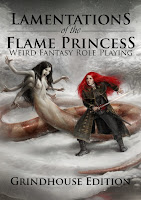 The Grindhouse edition of LotFP is a huge leap in quality over the original version. The books are thicker and more solidly bound, there's more art and the layout is a lot better. You could tell that Raggi had a larger budget to work with, and a much better idea of how to get what he wanted in the books. The rules look the same, but these books will be a lot easier to use at the table, and nobody is going throw their back out lugging these around. If for nothing else, I applaud Zack and Raggi for their attempts to slay the giant, cumbersome, unwieldy coffee-table gaming book. ;p
I haven't had the time to read 'em yet, but yeah, Vornheim is crazy with every available surface turned into a gaming aid. It's wild and looks like fun.

Tuesday, May 10, 2011
Thor Review

And I’m thinking, “Huh, that looks like JMS.” And while I have no idea if that was him or not, I wasn’t surprised to see Straczynski has a story credit on this flick.
Combine JMS with Branagh and you get “operatic.” I swear, I kept waiting for someone to break into an aria. The motivations are bigger than life, and just as murky. The gestures are grand. And the plots are twisty, complex things. During the movie, you’re thinking, “Wow, how many moves is Loki thinking ahead on this?” After the movie, at the fridge, you’ll be thinking, “Oh, wait, how many moves was Odin thinking ahead on this?” Loki is clearly Odin’s son, perhaps even more than Thor is.

It’s all insane, wild, over-the-top… and it works. If you’ve enjoyed the other Marvel flicks, you’ll enjoy this one, maybe even more. Its visions of the land of the gods and the land of the frost giants are wonderfully baroque. And then they manage to make it not look utterly ridiculous when it shows up on the streets of rural New Mexico, maybe by pointing out just how ridiculous it is.
And that’s part of the fun. One minute it’s all realms and kings and the sacred oaths of warriors, and the next its slapstick humor, mostly at Thor’s expense. It’s an amazing combination, the juxtaposition both humanizing the God of Thunder and keeping the film from being too grandiose. The film needed to be about 15 minutes longer (Loki’s motivations needed more teasing out, I think, and we needed the SHIELD folks to more actively earn Thor’s respect) and we don’t get nearly enough of the Warriors Three Plus One. Still, things are nicely lining up for The Avengers. Captain America is looking better by the day, and to see these characters all brought together for a massive crossover movie, well… If they can pull off another flick at this level of quality, it should be a barnstormer.
Tuesday, May 03, 2011
Ladies of India

I'm happy to report that such sentiments are apparently being ignored.
Go India!
Monday, May 02, 2011
The High Cost of Gabbing
I don’t want to seem to be beating up on –C, because that’s not my intent at all. There’s some neat stuff on that blog, and I hope it garners the author what’s desired. And mulling over responses to my last post, I realized something that should have been obvious to me from the get-go about this.
Folk wisdom to the contrary, talk isn't always cheap. The truth is, -C, by charging in commentary for his work, was asking too much. If your readership is a bunch of college students with lots of time on their hands but always strapped for cash, yes, exchanging words for words is a more than fair trade.
But the bulk of the OSR is clearly old farts with jobs. And families, and interests outside of gaming. Thoughtful, insightful, and useful commentary, forget full-blown critique, is hard. Sometimes I can whip up one of these blog posts in a quarter-hour, 20 minutes. And I'm a professional. I imagine most folks can take the better part of an hour easily to write, massage, and post 300 to 400 words.
That’s time that could have been spent ensuring the next promotion, landing a new client, or in any number of ways that actually put jingle in your pocket. It can actually be cheaper, as well as easier, for you to pay $10, $20, or even $40 for gaming materials then to spend (there’s a reason that’s the word to use there) a half-hour commenting on them.
Time is money, and the older we get the more expensive time tends to be. This is why building a community is harder than acquiring customers. Folk wisdom also tells us that the customer who complains is worth their weight in gold, because most will simply stop buying from you and never tell you why. Feedback is awesome, but incredibly hard to get, even under the best of circumstances.
Folk wisdom to the contrary, talk isn't always cheap. The truth is, -C, by charging in commentary for his work, was asking too much. If your readership is a bunch of college students with lots of time on their hands but always strapped for cash, yes, exchanging words for words is a more than fair trade.
But the bulk of the OSR is clearly old farts with jobs. And families, and interests outside of gaming. Thoughtful, insightful, and useful commentary, forget full-blown critique, is hard. Sometimes I can whip up one of these blog posts in a quarter-hour, 20 minutes. And I'm a professional. I imagine most folks can take the better part of an hour easily to write, massage, and post 300 to 400 words.
That’s time that could have been spent ensuring the next promotion, landing a new client, or in any number of ways that actually put jingle in your pocket. It can actually be cheaper, as well as easier, for you to pay $10, $20, or even $40 for gaming materials then to spend (there’s a reason that’s the word to use there) a half-hour commenting on them.
Time is money, and the older we get the more expensive time tends to be. This is why building a community is harder than acquiring customers. Folk wisdom also tells us that the customer who complains is worth their weight in gold, because most will simply stop buying from you and never tell you why. Feedback is awesome, but incredibly hard to get, even under the best of circumstances.
Saturday, April 30, 2011
Capitalism, Bitches!
“Money is the sincerest of all flattery.”
– Robert Heinlein
The prolific –C has decided he’s not going to give it away for free anymore. I can’t say I blame him, and I wish him luck with his foray into for-pay game development. I hope more follow his lead.
I don't have any problem with anyone who wants to give away their work for free. Heck, I've given away lots of stuff for free: shields shall be splintered, the table of Death & Dismemberment, and all of my Labyrinth Lord/B/X classes. But I didn't expect anything in return for any of these. Not even comments. If you want feedback, you have to make it as easy as possible for people to let you know what they think. It doesn't get any easier than asking them to pay for it. It may not be very detailed feedback, and it's possible to misunderstand exactly why people are paying for your stuff. But that doesn't change the fact that it is exceptionally easy.
Even better, getting a little scratch makes it easier to offer more. Let's be honest here; we are only getting Vornheim because Raggi made money on previous projects that he had could then spend on Vornheim. Vornheim could not be made on the cheap. Even if Zak had wanted to give it away for free (I'm sure he could make a lot more money if he'd spent the time on painting) it wouldn't have worked. It had to be a hardback that you could take to the table with a dust jacket and interior covers and all of that. Vornheim simply could not have worked as a PDF or a Lulu POD project.
The other cool thing about money is that it doesn't suffer bullshit. The web is full of all sorts of nonsense about RPG publishing that simply isn't so. Three years ago, everybody knew that boxed sets didn't work. It was boxed sets which had killed TSR. Everybody knew this as an indisputable fact. Nobody was going to invest in a boxed set project.
I don't need to tell you how things changed since then.
Time and effort and care and stress and dedication cost money. We all need to keep a roof over our heads. We all need to pay our bills. We all need to put food on the table. Compensating people for the time and effort and the blood and sweat and tears they put into gaming allows them to put more into gaming. It means artists can spend more time drawing dragons and sorcerers and paladins instead of illustrating instruction manuals for electronics. It means designers can spend more time testing and tweaking and thinking of new ways to do things. It means writers can give us more adventure instead of having to spend all their time describing real estate opportunities and VOIP telephony. It means publishers can experiment with new forms of publication, and can spend more time letting us know about the cool things they've got coming down the pipe. The more we give them, the more they can give us.
And besides, it's a very easy way to show your heartfelt appreciation.
Thursday, April 28, 2011
Wizards' Towers From a Fallen World

A Facebook friend pointed me towards this collection of photos, "25 Abandoned Yugoslavian Monuments that Look Like they are from the Future." These are soviet-era monuments commemorating battles from WWII, I think. There's some very evocative stuff here for your post-apocalypse, sci-fi, or dying world inspiration.
Wednesday, April 27, 2011
Whence Magic?
If you’re building a fantasy world, crafting the system by which magic will work is one of the earliest tasks to tackle. Anthony, over at of Pedantry, believes that magic and science don’t mix. He’s usually right, but it’s not always so. Magic, being utterly fictitious, can work in all sorts of ways, some of which are very compatible with science and others which are extremely not compatible science. Here follow a few broad categorizations of magic that I was able to think of off the top of my head.
 Magic as science by other means: this is what most of us assume D&D magic is like. Wizards exert their exceptional intellects to understanding, binding, and commanding mysterious forces. This is magic as a sort of engineering of the mystical. It is easily compatible with science, and, in fact, will obviously overlap with that in many ways. Magic is just another force in the universe to be studied, like gravity, heat, or magnetism. It may retard science in some areas, since necessity is the mother of invention, but what science is done will almost certainly be practiced by wizards.
Magic as language: in Tolkien's middle earth the key to wizardly power is knowing how to speak the languages of the elements. Gandalf and Sauroman cajole mountains and rivers, beasts and insects to do their bidding. In this world, power is based on relationships and the natural world is not a thing to manipulate but an entity. As such, science must be practiced with delicate care and respect. Too close an inspection of any natural phenomenon risks invasive rudeness, and the last thing you want to do is cause offense to something as potent as the West Wind or Mount Doom.
 Magic as fairy-tale logic: simple, declarative statements that are true. I love this sort of thing, because it gives players all sorts of hand-holds to fiddle with, as well as interesting challenges to overcome. The troll cannot be killed unless you stab him in the heart, and he keeps his heart locked in a chest hidden inside his tower. The prince will remain a frog until kissed by a beautiful maiden. The ring can only be destroyed by the fires of the volcano in which it was forged. While such magic is internally consistent, as Zak points out, it’s inherently unscientific. There is no why; the rules simply are. The best wizards have a bard’s ability to recall detail and a lawyer’s instinct for finding the loopholes. There’s some overlap with engineers in these skills, but it lacks the universal underpinnings of science entirely.
 Magic as alien knowledge: sometimes, knowing too much is dangerous. If we assume that the human mind developed as a specialized tool for understanding the three-dimensional world which our hands and bodies can most readily manipulate, it stands to reason that truly alien realms might utterly confound it. Indeed, thinking in terms such worlds require might even damage our minds in the same way that using a socket wrench as a hammer could break the tool. This is the magic Lovecraft writes about. Intellect, science, and knowledge are all counterproductive; the greatest wizard is the one who is already mad. The study of magic is aided by the use of hallucinogenic drugs, mind-numbing rituals, and physical deformations. Sometimes, this magic comes from outside our world. The sorcery of those who make pacts with demons is an example of this. However, in a Lovecraftian universe, the natural world explained by human science is but a thin and friendly veneer over deeper and hideously alien truths. The relationship between science and magic is complex; eventually, the two will overlap and at that point science and the civilization it supports will be obliterated.
Art by Gerbrand van den Eeckhout, Anthony Frederick Sandys, and Francisco de Goya.
The small man had tightened the slipknot around the pommel of his rapier and let the wire trail behind him, flexible as a whip. “I’ve grounded my sword,” he said. “Now any death-spell launched against me, striking my drawn sword first, will be discharged into the ground.“
- Fritz Leiber

I learned—even before my waking self had studied the parallel cases or the old myths from which the dreams doubtless sprang—that the entities around me were of the world’s greatest race, which had conquered time and had sent exploring minds into every age. I knew, too, that I had been snatched from my age while another used my body in that age, and that a few of the other strange forms housed similarly captured minds.Magic as super-science: it would seem that super-science would be most compatible with science as a magical system. That is true only if the culture at large grasps the principles behind your super-science. If instead you have a fallen culture, or a culture that has stumbled across the artifacts of super-science but doesn't really understand how they work, science and super-science can clash horribly. History is full of sound scientific principles that were just plain wrong. In the age of steam, it was assumed that the human body could not withstand speeds greater than 40 mph. Concepts that we today take for granted (the existence of germs, the principles of magnetism and the flow of electrons, the mechanics of combustion) were all at one point anathema to the cutting-edge science of previous days. The greatest wizards in such a setting would be those with the most rigid of minds, slaves to dogma and ritual which would yield predictable and consistent results.
- H.P. Lovecraft
“And he that breaks a thing to find out what it is has left the path of wisdom.”
- J.R.R. Tolkien
Magic as language: in Tolkien's middle earth the key to wizardly power is knowing how to speak the languages of the elements. Gandalf and Sauroman cajole mountains and rivers, beasts and insects to do their bidding. In this world, power is based on relationships and the natural world is not a thing to manipulate but an entity. As such, science must be practiced with delicate care and respect. Too close an inspection of any natural phenomenon risks invasive rudeness, and the last thing you want to do is cause offense to something as potent as the West Wind or Mount Doom.
”Sir Gareth, do not sound your challenge yet. Until noon the Red Knight’s strength increases, after then it wanes, so if you will wait for a little the advantage will be yours.”
- Mallory

And Ouphaloc, seeing the great craft and evil in the starveling boy, gave succor to Narthos and sheltered him. He dwelt for years with Ouphaloc, becoming the wizard's pupil and the heir of his demon-wrested lore. Strange things he learned in that hermitage, being fed on fruits and grain that had sprung not from the watered earth, and wine that was not the juice of terrene grapes. And like Ouphaloc, he became a master in devildom and drove his own bond with the archfiend Thasaidon. When Ouphaloc died, he took the name of Namirrha, and went forth as a mighty sorcerer among the wandering peoples and the deep-buried mummies of Tasuun.
-Clark Ashton Smith

Art by Gerbrand van den Eeckhout, Anthony Frederick Sandys, and Francisco de Goya.
Monday, April 25, 2011
The Dragons of Doom & Tea Parties
Rules Magis at Gamers Closet wants to know:
So dragons hold a central place in my Doom & Tea Parties campaign. Their nature is something that has been building in my campaigns over time, drawing from many sources, some literary, some mythological, with a pinch of pop-culture. As the eldest children of Tiamat, they are chthonian creatures, almost forces of nature. They are sadistically playful in the manner of cats, primal in their instincts and assumptions, and extremely self-centered. They are scions of primal chaos, and, as such, unpredictable, unreliable, and untamable in the long run.
Each is unique; there is not a race of blue dragons, but a blue dragon. They come in a wide variety of colors and combinations, and no, they are not coded for player convenience. To slay a dragon, which is sometimes necessary, is to destroy something that the world will never see again.
There is a spiritual aspect to this as well. There is a conservation of souls at work in my current campaign. Even without spells, a soul will eventually reincarnate (which, incidentally, has nothing to do with my own personal beliefs, but works really well with the spiritual geography of my campaign). Myth says that the first life of every soul is as a dragon. While they are certainly not on any endangered species list, there are noticeably fewer now than there were in the past. The death of the last dragon will mark the beginning of the end of Creation.
So I have a question. Not sure if it is that fact that I have been playing WOW, the book I am reading or the current campaign I am playing in. But dragons seem to be vastly different from one setting to another. Some are the King Arthur type of a foul beast to be slain by a knight on a quest; some are the invincible all knowing creatures of legend like in the Raymond Fiest books and others are the mounts and servants of Dragon Lords.Dragons have been important to me for a very long time. I can certainly see the benefit in treating them as just another monster on the list. However, in what I assume is a similar way in which some folks believe that fighting the gods is anathema, I really can't treat dragons as just more fodder for higher-level combats.
So dragons hold a central place in my Doom & Tea Parties campaign. Their nature is something that has been building in my campaigns over time, drawing from many sources, some literary, some mythological, with a pinch of pop-culture. As the eldest children of Tiamat, they are chthonian creatures, almost forces of nature. They are sadistically playful in the manner of cats, primal in their instincts and assumptions, and extremely self-centered. They are scions of primal chaos, and, as such, unpredictable, unreliable, and untamable in the long run.
Each is unique; there is not a race of blue dragons, but a blue dragon. They come in a wide variety of colors and combinations, and no, they are not coded for player convenience. To slay a dragon, which is sometimes necessary, is to destroy something that the world will never see again.
There is a spiritual aspect to this as well. There is a conservation of souls at work in my current campaign. Even without spells, a soul will eventually reincarnate (which, incidentally, has nothing to do with my own personal beliefs, but works really well with the spiritual geography of my campaign). Myth says that the first life of every soul is as a dragon. While they are certainly not on any endangered species list, there are noticeably fewer now than there were in the past. The death of the last dragon will mark the beginning of the end of Creation.
Tuesday, April 19, 2011
Optimized for iPad and Smartphones?

But the rest of the publishing world is moving more and more towards electronic formats. Kindles, iPads, and smart phones are likewise opening new, and very different, opportunities. So that's got me wondering: what would a table-top RPG optimized for these sorts of devices look like?

I think those last few are getting a bit far from what most of us want at the table, and even the first few make it harder to tweak the game to your own personal preferences. Still, there's clearly a lot of territory to be explored and exploited usefully in the electronic media of today.
For those of not driving 27 year-old cars and who have fully embraced the 21st century, I'm curious what sorts of things you'd like to see, or have already seen that would improve your prep and play.
Saturday, April 16, 2011
Working Buttons
Huzzah!
Got the buttons working on my blog. You can now turn any Trollsmyth post into a pdf and/or print it out for easier use at your table. Here are some suggestions from the posts I use a lot:
RACES
gnomes
half-ogres
nixies
pixies
rogues
witches
COMBAT
Weapons, Damage, and Initiative Table
Shields Shall be Splintered!
The Table of Death & Dismemberment
SPELLS
Secondary Powers and Residual Effects
MAGIC ITEMS
Bloodthirsty Sword
Brian's Satyrical Poetry
Wayedge
Potions on the Open Market
ANTHROPOLOGY (and the Doom & Tea Parties Campaign)
Timeline and Random Dungeon Room Table
The Devil's in the Details: the Slaves of Shkeen
Drugs and Herbs
Languages
Genie Corsairs
Noble Titles Among the Efreet
Gods of the Doom & Tea Parties Campaign
Let me know if you think I missed anything.
Got the buttons working on my blog. You can now turn any Trollsmyth post into a pdf and/or print it out for easier use at your table. Here are some suggestions from the posts I use a lot:
RACES
gnomes
half-ogres
nixies
pixies
rogues
witches
COMBAT
Weapons, Damage, and Initiative Table
Shields Shall be Splintered!
The Table of Death & Dismemberment
SPELLS
Secondary Powers and Residual Effects
MAGIC ITEMS
Bloodthirsty Sword
Brian's Satyrical Poetry
Wayedge
Potions on the Open Market
ANTHROPOLOGY (and the Doom & Tea Parties Campaign)
Timeline and Random Dungeon Room Table
The Devil's in the Details: the Slaves of Shkeen
Drugs and Herbs
Languages
Genie Corsairs
Noble Titles Among the Efreet
Gods of the Doom & Tea Parties Campaign
Let me know if you think I missed anything.
Thursday, April 14, 2011
Hobbit Begins Shooting
Ok, so I can't get Jeff's awesome one-button printable blog thingy to work. So while I argue with that, here's Peter Jackson talking about shooting the Hobbit:
Tuesday, April 12, 2011
Your Highness

If certain people are right about the general makeup of the computer gaming population, then this movie is for them, and if they find it, then Universal should make out like bandits at the box office. In general, however, I can't recommend it unless your fondest childhood memories involve cracking jokes after gym in the locker room in junior high.
However, I do have to give the production props in a number of areas. The cinematography is surprisingly good, as are the costumes, sets, and props. There are touches of painfully silly here and there, but I'd hold up all these areas against the second Conan flick or any of the Deathstalker movies. Sure, I expect special effects to look better, but set design and costumes?

So yeah, maybe catch this one on the cheap as you can, or if you're really in the mood for what it's offering. You'll get a few laughs, and be reminded at least once of jokes or situations that came up around the table. And if that's what you want, it's spot-on.
Wednesday, April 06, 2011
Naked Warrior

Who’d go into a fight without even, at bare minimum, a shirt and pants?
Oh, I dunno… maybe these guys. Or these guys. Or maybe even these guys (NSFW).
Seriously, we in the west have an equipment fetish. We can’t imagine going into a fight without 40+ lbs of gear. The average US GI goes into combat today carrying more weight than the medieval knights did, and those guys expected horses to do most of the heavy-lifting.
On the other hand, nothing looks dumber than two warriors who are supposed to be from the same culture, but one is so heavily armoured that not an inch of flesh and showing, and the other is wearing a bikini. (Which is my pet peeve with Red Sonja of the comics. Wearing a chainmail bikini in a fight only makes sense if everyone else is dressed similarly. If you’re the only one doing it, it looks as insane as tights in bright, primary colors. Xp ) Frankly, I think this says more about male body issues than female ones, but that’s a post for another day. What turns on thee may not turn on me. So let’s focus on scantily clad warriors in RPGs, shall we?

1) Class Limits: this is the classic from the earliest days of the hobby. Magic-users can’t wear armour of any sort and still cast spells. Druids can’t wear metallic armours. Quick, easy, and to-the-point, though it can feel a bit “game-y” if you don’t work to justify it somehow.
2) Encumbrance: not only does the LotFP Weird Fantasy RPG include an easy way to track encumbrance, it makes it important, especially to thief characters. Most of the thiefy skills can’t be used if much encumbered, meaning your thief is either not going to be doing much other than searching for traps, or they’re not going to be wearing much armour.
3) Humidity: the panoply of the ancient Greek hoplite shrank a lot. By the time of Alexander’s march into Persia, the helmet had shrunk to expose the face, the shield was smaller, and the heavy bronze breastplate had been replaced with lighter Kevlar-like linen armour. Why? Because they were fighting on the shores of the freakin’ Mediterranean and didn’t want to get heat stroke. To simulate this in your RPG, say that folks in chain mail or heavier armour can fight for a number of rounds equal to their CON hit-point bonus without ill effect. After that, they suffer a -2 to all dice rolls. If the fight continues another equal number of rounds, they lose a hit point, and another for every additional equal number of rounds. Keep in mind that in most old school games, a round is a full minute. That’s a long time to be fighting in heavy armour in 80%+ humidity.
4) Buffs in the Buff: it’s been written that the Gaul warriors fought in the nude because they believed their sun god would give them strength and courage through the beams of the sun. These solar-powered scrappers exposed every inch of flesh to the invigorating sun beams to take full advantage of this gift. Unfortunately, in the real world, naked gaulish virility was no match for the Roman gladius. Fortunately, in your fantasy worlds, it actually can be. Combine a naked +2 to-hit and damage bonus with the humidity penalty above and folks will be shedding armour like they’re adventuring at Club Med.
5) Defensive Bonuses: you saw this first in the 1e monk, and later in 3e. In one version of WotC’s Star Wars RPG, things got “screwy” when high level characters were better protected by being nude than they were when wearing armour. Yeah, that makes no sense, but it does model what we see in the movies. Not my favorite option, but it works.
6) There is no Armour: your setting doesn’t have it. You’ll have to explain why, or your players or going to try to invent it.
7) Guns: the big plus with guns was that they punched holes through armour pretty handily. When I use firearms in my games, they do modest amounts of damage (1d6 to 2d8, more than enough to kill the average human in a single shot) but give big bonuses to hit or ignore armour. If there are enough of these in your setting, and you use any sort of encumbrance rule, people will ditch the armour as too much fuss and bother, just as they did in the real world. Again, not my favorite way to go, but perfectly fitting for a Sword-and-Planet world. Though now you might have to justify why anyone bothers with a sword.
UPDATE: Bree Yark! suggests:
Here are a couple of options in addition to what you've listed:
#1. Limit the kinds of armor available based upon the law of the land. For example, it could be the case that only members of the nobility are allowed to wear plate armor. Anyone else found wearing or even in possession of plate armor will face the wrath of the king.
#2. Change armor to damage reduction. D&D uses AC as an abstract composite of how hard you are to hit, and how hard it is to inflict damage on a successful blow. You could separate these two things.
The less you are encumbered & the better your DEX score, the better your AC is (making you harder to hit). On the other hand, armor increases your encumbrance, making you easier to hit (weakens your AC), but you subtract a certain number of points from each hit, meaning weaker hits do no damage.
For example: Leather could provide 1 point of damage reduction, chain mail 2 pts, and plate 3 pts.
Yeah, sumptuary laws should have been on my list. Thanks for the reminder! As for option 2, that's a lot more involved than I think I want to get on this, but I'm considering it. Just how far do I want to stray from B/X/Labyrinth Lord? Well, I'm not going to be running a game like this anytime soon myself, so that's probably a question for another day.
And be sure to treat yourself to Bree Yark's treading in the artistic footsteps of a master (arguably the master) on his own blog.
Art by John Singer Sargent and Hendrick Goltzius.
Genie Corsairs
Genies make for unpleasant neighbors. Their command of their respective elements means they can suddenly, and radically, rearrange the landscape and climate. They tend to congregate into large households comprising not only more of their own kind, but also slaves and pets of numerous other races that most sane folk consider dangerous in the extreme. And many enjoy adding to their collections by raiding far and wide across the multiverse.
All four races of geniekind use a similar design for their corsairs. Generally, there are two habitable ellipsoids connected end-to-end. These are encased in a cage-like frame of orichalcum (around an adamantium core) in a long football shape. The spaces inside the frame not filled by the ellipsoids (on either pointed end and a ring around the middle, surrounding where the ellipsoids meet) cage the elementals that pull (or push or lift, as the case may be) the corsair. Typically, air elementals of massive size are preferred, as they allow the corsair to fly, and nearly anyone the genies would be thinking to raid would live within a bubble of Air. Air-drawn corsairs can also travel through water. Water-drawn corsairs can generally only travel through water, though, like fire-drawn corsairs (which can travel through fire, naturally) they can crawl across the ground, though at speeds barley faster than a human’s walk. Earth elementals can travel across the top of the ground much more quickly, but can also pass through earth and solid stone at a surprising clip (lead slows them considerably, and they cannot breach adamantium).
The habitable portions of corsairs vary in design, but typically the forward portion contains the command deck, work quarters, chirurgeon’s studio and hospital facilities, sparring and drilling rooms, alchemical and magical labs, smithies or other factory facilities, and cargo hold. The aft portion is typically decorated more to the usual sumptuous tastes of genie-kind and houses the living quarters for the genies and their favored slaves, feasting halls, kitchens, vaults, armories, as well as quarters for living animals that will be harvested for food along the way.
What these sections are made from depends on the ship’s origin. Efreet corsairs tend to be of brass or bronze, sheathed in adamantium. Corsairs from Earth tend to replace the brass and bronze with wood. Ships from Water are constructed with bulbous, glistening pastel shells similar to the glass-like towers merfolk grow from specially cultivated corral. Djinn often build theirs from crystals, sometimes replacing even the orichalcum and adamantium framework with an enchanted crystal matrix.
A corsair on a raiding expedition will often house a dozen to a score or more genies, plus twice to five times the number of attendant slaves, at least half of whom will be combatants, whether simple warriors or even enslaved sorcerers and other spell-slingers. Even a corsair heading out to a raid is filled with fabulous treasures. Treat it as holding about a quarter of the expected wealth for the typical lair of genies of the appropriate type. And corsairs returning from a successful raid will hold even greater treasure, with types and quantities depending on where it’s returning from.

The corsair pictured here, the Firecat, is a smaller one, being only 320 feet in length. It’s owned by Bey Asad ibn Rumha. As the Bey used to travel with most of his harem, more space than normal was given over for his own personal quarters as well as for his mamluks and their gear, and the pair of firecats kept by his concubines. The large, two-level cargo hold and cisterns allow the Firecat to stay out for extended periods, either on pleasure-cruises or raids. The short, domed dorsal observation tower would slow the corsair down when traveling through Earth or Water, but Bey Asad prefers raids on the Prime Material and Faerie realms.
Like most corsairs, the Firecat includes an ethereal spindle which allows the ship to shift between the physical and ethereal planes. As the ethereal touches both all the Elemental Planes as well as the Prime Materials, it makes an excellent conduit by which corsairs can travel from one realm to another. However, as ethereal travel is dangerous, most raiders keep their time in the ethereal to a minimum. Special savants are used to navigate between worlds, and to find the places most auspicious to translate between the planes. While the ship is traveling through the ethereal plane, these savants guide it from meditation cells buried deep inside the ship, where they can pilot the craft without distraction. When outside the ethereal plane, the enslaved elementals that move the ship can be psychically commanded by anyone sitting on the pilot’s throne.
All four races of geniekind use a similar design for their corsairs. Generally, there are two habitable ellipsoids connected end-to-end. These are encased in a cage-like frame of orichalcum (around an adamantium core) in a long football shape. The spaces inside the frame not filled by the ellipsoids (on either pointed end and a ring around the middle, surrounding where the ellipsoids meet) cage the elementals that pull (or push or lift, as the case may be) the corsair. Typically, air elementals of massive size are preferred, as they allow the corsair to fly, and nearly anyone the genies would be thinking to raid would live within a bubble of Air. Air-drawn corsairs can also travel through water. Water-drawn corsairs can generally only travel through water, though, like fire-drawn corsairs (which can travel through fire, naturally) they can crawl across the ground, though at speeds barley faster than a human’s walk. Earth elementals can travel across the top of the ground much more quickly, but can also pass through earth and solid stone at a surprising clip (lead slows them considerably, and they cannot breach adamantium).
The habitable portions of corsairs vary in design, but typically the forward portion contains the command deck, work quarters, chirurgeon’s studio and hospital facilities, sparring and drilling rooms, alchemical and magical labs, smithies or other factory facilities, and cargo hold. The aft portion is typically decorated more to the usual sumptuous tastes of genie-kind and houses the living quarters for the genies and their favored slaves, feasting halls, kitchens, vaults, armories, as well as quarters for living animals that will be harvested for food along the way.
What these sections are made from depends on the ship’s origin. Efreet corsairs tend to be of brass or bronze, sheathed in adamantium. Corsairs from Earth tend to replace the brass and bronze with wood. Ships from Water are constructed with bulbous, glistening pastel shells similar to the glass-like towers merfolk grow from specially cultivated corral. Djinn often build theirs from crystals, sometimes replacing even the orichalcum and adamantium framework with an enchanted crystal matrix.
A corsair on a raiding expedition will often house a dozen to a score or more genies, plus twice to five times the number of attendant slaves, at least half of whom will be combatants, whether simple warriors or even enslaved sorcerers and other spell-slingers. Even a corsair heading out to a raid is filled with fabulous treasures. Treat it as holding about a quarter of the expected wealth for the typical lair of genies of the appropriate type. And corsairs returning from a successful raid will hold even greater treasure, with types and quantities depending on where it’s returning from.

The corsair pictured here, the Firecat, is a smaller one, being only 320 feet in length. It’s owned by Bey Asad ibn Rumha. As the Bey used to travel with most of his harem, more space than normal was given over for his own personal quarters as well as for his mamluks and their gear, and the pair of firecats kept by his concubines. The large, two-level cargo hold and cisterns allow the Firecat to stay out for extended periods, either on pleasure-cruises or raids. The short, domed dorsal observation tower would slow the corsair down when traveling through Earth or Water, but Bey Asad prefers raids on the Prime Material and Faerie realms.
Like most corsairs, the Firecat includes an ethereal spindle which allows the ship to shift between the physical and ethereal planes. As the ethereal touches both all the Elemental Planes as well as the Prime Materials, it makes an excellent conduit by which corsairs can travel from one realm to another. However, as ethereal travel is dangerous, most raiders keep their time in the ethereal to a minimum. Special savants are used to navigate between worlds, and to find the places most auspicious to translate between the planes. While the ship is traveling through the ethereal plane, these savants guide it from meditation cells buried deep inside the ship, where they can pilot the craft without distraction. When outside the ethereal plane, the enslaved elementals that move the ship can be psychically commanded by anyone sitting on the pilot’s throne.
Tuesday, April 05, 2011
When is D&D?
Over at the Hill Cantons blog, ckutalik wants to know:
 For instance, the argument for a late Renaissance to Early Modern dating is largely based on equipment. Plate armor, halberds, and two-handed swords primarily date from this time period. Ditto for such things as the widespread use of coins, glass for windows, lanterns, and spyglasses, carriages, theaters, harpsichords and pipe organs, standing armies and navies, clockworks, and even potatoes and tomatoes and pasta. Likewise, Mr. Gygax himself is quoted as setting his games in a Renaissance analog.
Which is all well and good, until you start talking about druids, large and unexplored frontiers within walking distance of the civilized world, feudalism, and the absence of gunpowder. These aren't even the trappings of the high Middle Ages of the 12th century. Most of these belong to the dark ages between the fall of Rome and the rise of Charlemagne.
It gets even worse when you start poking at all sorts of assumptions that the players have. Private rooms at the inn? Even as late as the American Revolution you're more likely to end up with up to eight people, mostly strangers, in a single room and in a single bed! Homes with glass windows, wooden floors, fireplaces, and separate, private bedrooms are also completely modern. The attitudes of most, especially in "good" lands, directly adhere to what we expect to find in suburbia, except with less football and a greater reverence for monarchy.
 So what's going on here, and when is bog-standard D&D set? The answer is: neverwhen. It is a crazy stew of common assumptions, misunderstandings, and outright laziness of the sort that gives us Sir Lancelot in gleaming plate armor and allows Xena Warrior Princess to both rescue the Ark of the Covenant from Babylonians and meet Julius Caesar.
And why the heck not? Rigorous historical play can be fun, but that's usually not what we're about in these games. Letting our cleric of Bast and her kung-fu monk best friend go mano-y-mano with a high priest of Cthulhu for the broken shards of Excalibur in a back alley of Sanctuary while the city is under siege by an army of Barsoomian apes under the sorcerous command of Yyrkoon of Melnibone is just fun! Sometimes, what you really want is the no-time that is every time implied by the old Deities & Demigods book. If D&D truly has a default setting this is most assuredly it.
Art by Vittore Carpaccio and Frank Dicksee.
…what really is the historically-analogous period implied in the garden variety D&D?It's an interesting question. The clues lead us all sorts of contradictory directions.

Which is all well and good, until you start talking about druids, large and unexplored frontiers within walking distance of the civilized world, feudalism, and the absence of gunpowder. These aren't even the trappings of the high Middle Ages of the 12th century. Most of these belong to the dark ages between the fall of Rome and the rise of Charlemagne.
It gets even worse when you start poking at all sorts of assumptions that the players have. Private rooms at the inn? Even as late as the American Revolution you're more likely to end up with up to eight people, mostly strangers, in a single room and in a single bed! Homes with glass windows, wooden floors, fireplaces, and separate, private bedrooms are also completely modern. The attitudes of most, especially in "good" lands, directly adhere to what we expect to find in suburbia, except with less football and a greater reverence for monarchy.

And why the heck not? Rigorous historical play can be fun, but that's usually not what we're about in these games. Letting our cleric of Bast and her kung-fu monk best friend go mano-y-mano with a high priest of Cthulhu for the broken shards of Excalibur in a back alley of Sanctuary while the city is under siege by an army of Barsoomian apes under the sorcerous command of Yyrkoon of Melnibone is just fun! Sometimes, what you really want is the no-time that is every time implied by the old Deities & Demigods book. If D&D truly has a default setting this is most assuredly it.
Art by Vittore Carpaccio and Frank Dicksee.
Monday, April 04, 2011
"Wipe them out. All of them!"

First off, let me just point out that I have no inside access or anything like that to BioWare Austin, so just about everything I’m telling you comes from this little video, plus a few others I’ve seen scattered around the web. They haven't finished making the game yet, and I certainly haven't had a chance to play any of it yet. A lot of what follows is guesswork, and I'm using this more as a jumping-off point to discuss design matters more than SWTOR.
Second, it may sound like I'm beating up on the game. That's not the point either; it is what it is, and some of what I'm going to be talking about here specifically points out what SWTOR isn't. There's some stuff here that confuses me, and some stuff that looks suboptimal based on what it appears they are doing. But, all in all, it looks like it'll be a fun game. It certainly sounds like a Star Wars game. The soundtrack, sound effects, and even the corny dialogue fit just about perfectly with the original trilogy. As Oddysey pointed out to me recently, Star Wars has an audible signature that is unique and immediately recognizable. BioWare has certainly captured that. In addition, I'm not seeing much in the way of disassociative mechanics. (Rifles pull your target closer: seriously, Guild Wars 2?)

This won't shock most gamers in the audience, but it sure doesn't look like Star Wars. Even when going after the shield generator on Endor, it was never Han’s plan to slaughter all the storm troopers in order to duke it out with their big-boss commander. If the plan had gone like it was supposed to, there hardly would have been any fighting at all.
But in most MMOs, combat serves as the primary activity because it is an infinitely flexible puzzle that comes preloaded with lots of drama. Pick a fight with a PC, and the players know exactly what the stakes are and what the rules are without really having to be told anything. SWTOR has clearly embraced this design philosophy. Therefore, while it might be very like the movies for PCs to avoid combat, it would be counterproductive to the game. You'll notice, also, that there doesn't seem to be much exploration involved in this mission. Other than the occasional option to engage in additional combats, like blowing up the science console, it looks very much like a linear string of fights. Since the game is built around fighting, this makes sense, and allows the designers to concentrate on varying the combat experience and how the different fights lead into one another.
You can see the same sort of dynamic in 4e D&D: as the focus of the fun is in the actual combat, simple, linear adventures with very detailed encounters make sense. In contrast, in TSR-era D&D it can be argued that a straight-up fight is the least interesting part of the game. Greater complexity in the adventures and environments allow players to pick their fights and engage with obstacles in non-mechanical ways.

Subscribe to:
Posts (Atom)


 Posts
Posts