Thursday, August 28, 2008

Living with 4e

Scott Schimmel of "A Butterfly Dreaming" has been playing 4e for two months now, and has some interesting things to say about it.

First, yes, the organization of the PHB is lacking:

The problems arise when I need to find a specific piece of information, such as the range of a power. Sure, I know it’s in the chapter on classes… but there’s nothing for it except to page through the listing of that class’s powers. There’s no index or table of contents that points to powers by name. The powers are broken down by level, but I might not know the level off the top of my head.

In other cases, I might need to flip through several sections to find where a rule is located. Learning what [W] means, for example, requires following text through at least three pages in different chapters of the book. Some rules are only referred to once — the almost offhanded remark about the ability to change the fluff of a power, for one, is easy to overlook on a casual read through.

Mr. Schimmel of course mentions Propagandroids improved index. Never leave the Nentir Vale without it.

And speaking of the Nentir Vale, Scott's got nothing but praise for the DMG:

Admittedly, it’s pretty light on the crunchy bits. Most of those are subsumed into the PHB now, and all of the monsters are in the MM. It does, however, show you how to easily build encounters, modify monsters, award treasure and experience, and use traps and interesting terrain. The chapter about Fallcrest and the Nentir Vale also provides a starting location suitable to be dropped into many campaigns, fleshed out enough to be useful with little preparation, left undefined enough to be modified to suit the GM’s needs, and strewn with dozens of potential plot hooks.

An experienced GM won’t really need this book. But the above bits are useful enough that he might want them anyway. For newer GMs, this is an incredible introduction to the other side of the screen.

I've been less effusive in my praise, but I've never tried to use the book, and that might make all the difference. I suspect most of my disagreements would arise from differing expectations.

He's also pretty happy with the MM, though I really can't share his enthusiasm there. The monsters just rub me the wrong way: how they're laid out, how they've been reimagined, how they operate in the game. Still, if you're playing 4e, I imagine the book is very well set up to give you what you need.

Finally, if you want some thoughts on how the game actually plays, Odyssey continues to be our canary in the mineshaft there:

It had the usual near-death moments, which I'm beginning to think are an artifact of the way healing works rather than a sign of actual peril. The damage/healing system, to put it most simply, is subject to negative feedback. There are, of course, monsters that are more dangerous against bloodied foes. But those effects are dwarfed by the basic dynamic of the PCs healing abilities: the more wounded they are, the easier they are to heal.

Mostly it comes down to the death and dying rules. There are a couple of powers I know of that exacerbate the effect, but they're not what drives it. Sooner or later, the death and dying rules kick in whenever a PC takes damage. And they don't just make it impossible to die within less than 3 rounds after hitting zero, giving their friends plenty of time to get them back on their feet with a simple skill check. They also guarantee that when the character does get back into the fight, they do so with a quarter of their starting hit points -- any healing on a dying character resets them to zero before hit points get added, and that basic heal check option gives them a free use of a healing surge.

I can't say I'm too surprised by this. This is the same thing we were wondering about when the rules were first revealed. The many TPKs of the demo games silenced that for a while, but those now appear to have been the product of pitting the heroes against foes far beyond their weight class. As Odyssey asks, 'Is there an intermediate setting in a 4e fight, between "artificial danger" and "certain doom?"' Frankly, this isn't just a problem for 4e, as I've encountered it in high-level 2e play as well. The difference is, in 2e, you can use layered defenses to slowly wear the PCs down. That doesn't work nearly so well in 4e.

Wrangling Over Rust Monsters

Noisms just doesn’t get the rust monster hate:

I like Rust Monsters; they're one of the very few D&D creatures who can actually generate genuine fear and excitement in players - the others usually being level-draining undead. But there is no Rust Monster anymore: it was decided that destroying armour and weapons wasn't fun and should therefore be cut from the game. (Apparently genuine fear and excitement aren't enjoyable in the brave new world - crazy times.) It constitutes 'screwing players over', you see, because DMs can't be trusted to use Rust Monsters fairly or sensibly, and little Johnny the player will cry because the nasty Rust Monster took away his ickle Vorpal Sword, and he'll run off home and tell mumsy, and that won't be fun, and it will ruin D&D as we know it, or something. That's broadly the argument, as far as I can tell.

Well, not really. I suspect that Noisms’ first introduction to fantasy RPGs had nothing to do with a computer, and that’s made a lot of the difference.

No, this isn’t another “4e is WoW” rant. However, computer RPGs have influenced pen-and-paper RPG design, and the expectations of the players. Folks coming from computer games bring different assumptions to the table than those of us who started playing with our heads full of Harryhausen movies and Conan stories.

The original Diablo game, by Blizzard, is a great example of this. I read somewhere (somewhere I can’t find now) that the designers had a mantra when programming how the dungeon levels would be generated. It went something like this: “If a minute passes, and the player doesn’t see something die or burst into flames, something needs to be fixed.” If you played any of the old first-person-shooters, like Doom or Quake, you know exactly what they’re talking about. The game is great so long as you’re slipping around corners, dodging monsters, and shooting your guns. But the game falls painfully flat when you’ve cleared all the monsters you can find from a level, but have no idea how to get to the next one. You wander around and around through the maze, all the corridors looking the same, until you’re about to pull your hair out in frustration, looking for the damned key or door or whatever it is you need to go to the next level, so you can get back to the fun.

This is what they’re talking about when they say the rust monster isn’t fun. The problem isn’t so much that the player’s PC loses hard-earned loot, so much as it disrupts what the game is about. 4e is focused around the tactical challenges of battlemat combat. It’s about maneuver and when to whip out those per-day and per-encounter abilities. 4e is fun when these challenges are coming at a steady clip. This is why traps are now built like encounters and why non-combat encounters (aka the skill challenges) are set up to result in victory or defeat in a fairly short span of time. The primary goal was to give players a little break from the tactical challenges, and then get them right back into it as soon as possible afterwards.

The problem with the rust monster isn’t so much the equipment it destroys as it is the disruption to the standard pacing of the game. Instead of moving on to the next tactical challenge, the rust monster forces the PCs to leave the dungeon and return to civilization and re-equip. If you play it out, that means a long time of playing without tactical challenges, where the PCs are mostly traveling through previously cleared dungeon corridors and wilderness. If you don’t play it out, and just say the time passes and the coin is spent, why bother with the rust monster in the first place? The pain isn’t so much the personal grief of the player who’s PC lost his vorpal sword, and more the annoyance of the entire group as they are pulled away from stream of combats that is the core of the 4e experience.

Older players don’t mind so much because the core of the game way back when was exploration and logistics. Losing equipment was a logistical puzzle; do you continue on without it, or risk the dangerous road back to civilization? Pushing deeper into the dungeon without that sword or plate mail might be dangerous, but those random forest encounter tables in the back of the DMG could dump the party into the lap of a green dragon. If you risked going deeper, you might get lucky and find replacement equipment. If you go back, you’ll certainly be able to buy new equipment, but that choice isn’t without serious risk, either. Making those decisions was the fun of old school D&D. The rust monster didn’t interrupt the game. The rust monster was the game.

Wednesday, August 27, 2008

Review of Memories of Ice

I just finished Memories of Ice, book three of Steven Erikson’s The Malazan Book of the Fallen. The book returns us to the characters we know from the first book, Gardens of the Moon, but we see little of the characters we met in book two, Deadhouse Gates beyond a few cameos.

It’s good stuff. The books are thick, as is the fashion in fantasy novels following the mad success of Jordan’s Wheel of Time series. Still, don’t expect anything like Jordan’s stories here. Nor is it much like Martin’s Game of Thrones books, though Erikson’s work is closer in tone to those.

The first thing I’ll say about Erikson’s books is, even though we’ve got a large ensemble cast, you never find yourself straining to get through chapters or skipping ahead past characters you’re less interested in to get to those you really care about. Erikson does a great job of lavishing all his characters with mystery, interest, and detail. More than that, though, is the sprawling, jumbled, unorchestrated feel of the narrative. Now, that might seem like a detraction, and for some readers it might be. The stories feel almost random, events following one after another as dictated by the collisions of chance and consequence, and without any regard at all for the usual demands of structure and pacing. Some might find this annoying, as the story leaves you adrift, without the usual signposts we usually get from stories. Me, I find it refreshing. The books read more like a narrative of actual, historic events rather than crafted stories. Combined with Erikson’s willingness to kill characters you care about, a willingness that rivals Glen Cook’s and surpasses George R.R. Martin’s, and you feel completely adrift in the stories, not really able to tell what’s coming next.

Granted, some of that comes from the confusion of characters, races, groups, and creatures which populate these books. Even with the dramatis personae and a glossary bookending the story, I still got confused a few times. The book begins with the forging of an alliance between Dujek Onearm’s outlawed Malazan army and the rag-tag army of mercenaries and immortals that were, up till now, their foes. They’ve united to fight against the rising power of an army of religious fanatics. No, not the army of the Raraku Apocalypse that was the focus of Deadhouse Gates; this is another, different army of religious fanatics. Yeah, you can see why it can get confusing at times.

Even more confusing are some of the motives for perplexing actions taken by the characters. I won’t be running a damned thing when I tell you that one of the immortals, an ancient, cursed tyrant named Kallor, betrays the alliance. Which begs the question, why is he part of the alliance at all? He doesn’t bring with him an army, his perfidy is so well known that his military advice is rarely heeded, and the only time we see him draw his weapon is to attack his supposed allies. So why do they put up with him? It’s a mystery that’s never explained. Likewise, there are secrets kept for no apparent reason. In both cases, the bones of narrative structure peek out past the wild froth of events, and we see choices made that seem primarily motivated by the need to set up later events in the story. And at the end of the book, we see the Malazan soldiers honoring a man who undertook an epic sacrifice for a very noble cause, though his timing was abysmal and almost certainly cost the lives of many Malazan soldiers. And, while the scene is wonderfully written, the sort of thing to bring tears to the eyes, it’s almost undercut by wondering why the heck this guy didn’t wait an hour or two, and why the Malazans are so willing to overlook the horrible cost to their own.

In the end, though, this is good stuff. I’ve heard that Erikson is an archeologist by training, and that comes through in his writing, especially his love of epoch-spanning storylines and his adoration of memory and geography, which he romantically links near the end of the book. Lots of loose ends from Gardens of the Moon are nicely tied up here, and questions raised in that volume are so neatly answered that if the series stopped here, I’d almost be satisfied. I will say that if the Bridgeburners never make another appearance, I won’t be upset, and that has nothing to do with disliking them and everything to do with the nature of how their tale is told in this volume. This is everything you liked about Glen Cook’s Black Company books, without that unpleasant sense that the author has no idea where the story is going and is just writing to fill out books, with no end in sight.

Yeah, I know, I’m contradicting myself. I said above that the story feels unplanned, a wild retelling of actual events. Yeah, it feels that way, but everyone in the story has plans they are pursuing. So while almost nobody’s plans work out the way they hope, those goals give the story a sense of trajectory that is clearly illusory, but also comforting for the reader. In short, the tale is shot through with the chaos that is the literary equivalent of the shaky, hand-held camera used often in movies and TV to convey a sense of realism to a scene, but still embraces the reader’s need to feel like the author does have some sort of story in mind during all this madness. The only times the book stumbles is when the author’s hand is a bit too evident, as I mentioned above. But those stumbles are few and far between, and easily forgiven, considering the empathetic characters, wonderful scenes, and interesting locales he gives us.

Currently, I prefer Glen Cook’s new series, The Instrumentalities of the Night, to Erikson’s books. But Erikson’s writing is a more than suitable substitute while we await the third book in Cook’s series.

Sunday, August 24, 2008

A Pair of Videos

The first is edumacational, so you should all watch it twice or something.


We've discussed this a bit before here, and I really can't wait to see what we learn from the LHC.

And now for something completely different. This just sings to me. Will I play the game? Heck, no. I've got other things, things that I find far more entertaining, to do with my time. But could I take this and run with it as the scenario for an adventure, or even a campaign. Oh, hell, yes!


It's just a great example of how Blizzard, er, "borrows" from the best. Armoured sorcerer in tall, spikey, crown-helm stomping around while boy soloist sings in dead or imaginary languages in the background? Oh yeah, someone's been watching their Lord of the Rings DVDs over and over again. A healthy heapin' of heavy-metal-album-cover cool with a twist of pathos and a sprinkling of horror. Those Blizzard folks are good at what they do.

Friday, August 22, 2008

Adventure Paths, the Old School, and Fun

Once again, as I read Grognardia, I'm thinking to myself "yes, yes, YES!"

Modules D1 and D2 provide nothing in the way of a "plot." They are simply descriptions of locales and encounters along the way to the drow metropolis of Erelhei-Cinlu. Along the descent into the depths of the earth, the characters might make various friends and enemies to aid them in their explorations, but none of these encounters is part of a grand plot as such. Instead, what we get is a subterranean "wilderness," with many different monster lairs, along with the usual tricks and traps. Even the fabled Shrine of the Kuo-Toa is mostly a dungeon without any greater significance, although the characters may loot from it drow brooches and clothing to aid them in infiltrating the Vault of the Drow.

D2: Shrine of the Kuo-toa is a great example of old school adventure design. Here's the thing: if the PCs are lucky, observant, and polite, they can pass through the entire shrine and never once draw their blades. Seriously. It's not so much an adventure as a locale. The DM and players can do anything with it. Wholesale slaughter, polite but aloof anthropology, or even forging an alliance with the kuo-toa are viable possibilities. The players could spend as little as an hour or two real time as they pass efficiently through the lands of the kuo-toa, or use the shrine as a base of operations to explore the surrounding subterranean wilderness, or even get embroiled in local politics, spending multiple sessions within the shrine itself.

This lack of assumptions is, I think, key to old school adventure design. What I find even more interesting, however, is how invisible such things can be to the players:

My memories of these modules were quite different than the reality. My recollections were of a number of memorable encounters with various antagonists, strong connections between the various groups of evildoers, and an overall coherence that simply isn't there. But then I was the referee for all these modules and ran them many times. I provided huge doses of "connective tissue" based on what my players did and how well they succeeded (or failed).

The good DM creates plot and conflict from the diverse parts and tools the game and adventures provide. Running through the Giants/Drow series of adventures feels like an adventure path because the players only see the logical progression from one part of the adventure to the next. But what they don't see is the open framework the DM has to play with. This openness is vital, however, because while they may not see it, they certainly enjoy it. In the hands of a clever, imaginative, and flexible DM, this framework allows the DM to customize the adventure towards the preferred playstyle of the group. Do they want to engage in diplomacy? Or do they prefer James Bond style infiltrations? What about straight-up hack-and-slash? The adventures work best when these different styles are combined, but the DM is open to emphasize each in whatever combination is most enjoyed by the group. They're even flexible enough to allow the group to change their style for an evening if things start to get stale.

And this, more than anything else, is the glory of old school play. It doesn't assume to know what fun is. Instead, it gives you the tools you need to create what is fun for you.

Monday, August 18, 2008

ArmadilloCon XXX Report

Good times at ArmadilloCon 30 (which I prefer to refer to as ArmadilloCon XXX, just 'cause it sounds both cooler and more deviant). I ended up spending very little time in the gaming room, but reports are that things went well, and the MIB who helped out is thinking of getting things even more organized next year with a schedule of games to be played, something that has worked well in the past if I recall correctly.

Beyond the game room, the dealers' room had little in the way of games, though one of the booksellers had some old GURPS books, at least one issue of DRAGON from what I consider their best years (roughly 70 to 150 or so), and a few old D&D modules. Ninja Pirate was there with a nice big table heavily laden with games of all sorts, especially big board games and the like. Perusing their selection was an inspiration to consider trying my hand once more at a game of interstellar politics and warfare, something along the lines of a Babylon 5 boardgame. Otherwise, there were lots of relatively contemporary novels and few gems from ages past, old hardbacks from the '30s on up, classics from Howard, Moorcock, Clark Ashton Smith, and others, as well as the new Paizo collections from those writers.

The panels, however, were the best part of the organized offerings. The first panel the Trollwife and I were able to catch was about world building. John Scalzi was in it, as was Steven Brust. My copy of Jhereg has a publication date of 1983, so Brust has been building worlds professionally for nearly a quarter century now. The guy had lots of interesting things to say and is a great, engaging, and fun public speaker, as is Scalzi. One thing they were both big on is treating the world as a character in its own right, something you get to know as you explore it and watch it interact with the other characters. This is very similar to a lot of bottom-up world building we see in the gaming world, where the GM creates just enough of the world to get the ball rolling, and then adds more as the needs of the game dictate. Another interesting observation from Brust was that readers learn about the world from narrators and that there are two types of narrators: “those who are unreliable, and those I don't trust.” By this, he meant that nobody can understand a world perfectly, and everyone sees the world through a prism of expectations, philosophies, and prejudices.

Now, this is something you can use with players, but you have to be careful about it. They expect the things you tell them as the GM to be reliable. If you tell them, for instance, that dwarves love it when you buy them drinks, and then every dwarf they meet is insulted when the PCs try to buy them a few rounds at the tavern, the players likely to get upset with you. It gets even worse if the rules of the game don't work like they expect, and a high intelligence actually offers no benefit to wizards.

That said, there are some things you can offer as prejudices to the PCs. I like to use the carefully worded caveat “everybody knows”. Most people understand what that means, and it allows the player to decide if their character shares the common assumptions. Another thing I like to do is offer extra information to certain characters. I especially like to do this with elves or other long-lived races. Everyone else knows the story of how the Black Duke fell at the battle of Balen Hills; your character dated a woman who was actually there, and her version of events is a bit different from the others. (Notice also that, by describing the information as coming from another character, I introduce the idea that it is likely colored by that character's personality, expectations, and limited viewpoint. Information that comes directly and unfiltered from the GM needs to be reliable. Information that comes from characters in the world ought to be filtered through those characters' goals and outlook.) Martha Wells was also on this panel, so of course she brought up the multiple points of view different characters could bring to a single piece of evidence.

Brust also suggested using slang, colloquialisms, and the like to really make your world feel real. “Floor it!” only makes sense in a world with gas pedals and the like. How do people say the same thing in a world of muscle power? Or magical transportation? What exclamations do they use? Which gods' names are taken in vain, and how are these curses constructed? For instance, in a world based on the Great Wheel of AD&D 1e, you don't say, “Go to Hell!” There are, after all, nine of them. “Go to the Hells!” or “To the Abyss with you!” makes a lot more sense.

Brust later moderated a panel on creating characters, and he echoed a lot of the same points. J.U. Hall, Kitanidis, Prater, Ward, and Williams took those ideas and ran with them, and they also took lots of comments from the audience on characters that have felt real or were especially empathetic. One of them, and darn it, I didn't write down which one, mentioned three Cs: contrasts, conflicts, and contradictions. To really make a character stand out, set them in contrast to something, such as the setting, other characters around them, or, perhaps most effective, the readers' expectations. A cowardly dwarf, for instance, or a hard-bitten, rough-and-tumble noble might stand out more strongly in the players' minds because they confound expectations.

Conflicts are really the engine of story, and they are instigators of adventures in RPGs. But even small, mundane conflicts can make a character stand out. The Witch of Deepvale is waging a constant battle against the gophers that keep digging up her garden, while Sir Kalivar struggles to find a way to help his poor squire Neville overcome the awkward clumsiness of his growth spurt. These sorts of conflicts might not immediately present themselves as useful adventure hooks, but they do make these characters feel more like real people.

Contradictions are those ways in which characters work against themselves. These are the things they do that they know they shouldn't, or the way their actions seem to contradict their personal philosophies. The upwardly mobile merchant who is trying to prove he's really among the social upper crust but whose taste in art is extremely gauche, or the man of peace who has trouble controlling his temper are simple examples of this sort of thing. As GMs we have to be careful how we use this. On the one hand, it's really the perfect, textured touch that makes a character really three-dimensional. On the other hand, if you introduce it before the character's basic personality has been grasped by the players, the contradiction will only confuse them and make the character seem to be a tangled mess of conflicting desires.

Which brings us to the next point that both panels brought up: don't reveal everything you know. There can be a strong urge to info-dump on your players when you introduce a new location or NPC to your players. Avoid the urge, and keep a few cards in your hand. On the other hand, this does not mean that you sit on cool ideas. If you have a cool idea, try to use it as soon as you can. But more mundane attributes or aspects don't need to be shared right away, if ever. Keep in mind what you want this character or location to accomplish in your game, and use that as a guide when you decide what you need to reveal, and what can remain in the background.

Those were the two best panels for use by GMs, but there were lots of other interesting panels on topics ranging from the physics of orbital mechanics to the modes of urban fantasy. A great panel on military SF had the last minute addition of Elizabeth Moon to the already great lineup of Joe Haldeman, John Scalzi, Dave Duggins, Lawrence Person, Selina Rosen, Steven Swiniarski (aka S. Andrew Swann). For those of us who don't have first-hand personal experience with warfare, Mr. Duggins suggested reading Strategy by Liddell Hart, Sun Tzu's The Art of War, Joseph Heller's Catch-22, Haldeman's Forever War, and Heinlein's Starship Troopers. Scalzi added the works of John Keegan and Victor Davis Hanson, both of which I can also heartily recommend. There's probably nobody else in the discipline of military history doing better work today than those two.

Saturday, August 16, 2008

ArmadilloCon Report #1

Well, we got there late, didn't attend any panels, and spent most of our time doing one of the most enjoyable things you can at a con: catching up with cool people you haven't seen in a while. That was a lot of folks for us as events recently have kinda made us shut-ins. So it was great to talk to folks we hadn't seen in some time.

We did get to enjoy a quick spin through the art show. It's a pretty eclectic mix, including an incredible sculpture, thrown pottery with a Tolkien theme, and the usual mix of illustration, paintings, and computer graphics. There seem to be a lot more amateur works this year than in past, which I'd say is a good thing, but rather surprising all the same.

We also got up to the game room. Steve Jackson Games has gifted the con with a number of goodies and giveaways, including Munchkin coins, dice, and special cards. I also picked up a copy of Where We're Going: Trade News from Steve Jackson Games. Among other things, it reports that GURPS: Thaumaturgy is out (and probably has been for a while, and I should be paying closer attention) and that the Munchkin boardgame has been delayed 'til the holiday season.

Of course, what people do with the games is often more interesting than what the game companies themselves are up to. There's apparently a popular new version of Munchkin being played that combines The Good, the Bad, and the Munchkin (the Wild West version of the game) with Star Munchkin (the sci-fi version) to create an unofficial Firefly Munchkin.

Thursday, August 14, 2008

Dances with Armadillos

ArmadilloCon XXX is this weekend!

Be there and be square!

Er, wait, I'm not sure that came out right...

Lots of fun for gamers and sci-fi and fantasy fans alike. In addition to the gaming room being run by Angela and Brian Price, Ninja Pirate will be in the dealer's room.

Of course, the big draw of ArmadilloCon is the programming. (Yeah, right, can you tell I arranged the programming a few years ago? But really, the programming rocks.) And while the focus of the con is primarily on writing, here are a few panels that gamers might find of particular interest:

Electronically Published Fiction
Fri 5:00 PM-6:00 PM deWitt
Burton*, Henderson, Huff, Marin, McKinney, Trimm
An examination of new publishing avenues opened by technology, and the best places to publish and read it.
New Space Opera
Fri 10:00 PM-11:00 PM Phoenix North
Duggins, Fletcher, Mills, N. J. Moore, Picacio*, Reasoner, Scalzi
The subgenre established by Doc Smith, Edmond Hamilton, and Jack Williamson has persisted and evolved to a new tradition upheld by Iain M. Banks, Lois McMaster Bujold, Elizabeth Moon, John Scalzi, and others. Our panelists will discuss this evolution, where they think Space Opera is now, and where it's going.
Neglected Gems of Genre Fiction
Fri 10:00 PM-11:00 PM deWitt
Blaschke*, Brust, Graham, Hobson, Nakashima-Brown, Sheridan
Which works of speculative fiction are the most criminally-neglected?
In the Beginning
Sat 11:00 AM-Noon deWitt
Latner*, Scalzi, W. Spector, M. Wells
Our panelists look at worldbuilding for writers, artists, and game designers.
Orbital Mechanics
Sat Noon-1:00 PM deWitt
Gibbons*, Jackson, Ledbetter, Mahoney
Learn from NASA scientists, but no equations, just plenty of hula hoops. We'll discuss the basics of terminology and process GETting‡ from here to there, general sense of scales and distances, rules of thumb, and some of the most common / worst misrepresentations of spaceflight basics in SF. Just because it’s rocket science doesn’t mean it ain’t fun! (‡ i.e., juggling Geometry, Energy, Time)
What You Should Have Read
Sat 2:00 PM-3:00 PM deWitt
Dimond*, Hevelin, Klaw, Marin, W. Siros, S. Williams
Our distinguished panel of writers, editors, and book-sellers discuss their take on the most important, influential, and enjoyable books and stories of the year.
JPL Mars Mission
Sat 3:00 PM-4:00 PM Phoenix North
Gibbons
Slide show on the history and results of the lander currently investigating the Martian arctic.
Forever Wars
Sat 5:00 PM-6:00 PM Phoenix North
Duggins, J. Haldeman, Person, Rosen*, Scalzi, Swann
Our panelists discuss military sf inspired inspired by or written in response to Robert A. Heinlein's classic Starship Troopers. They'll compare and contrast portrayals of war from WWII through today.
Blogging and Social Networking
Sat 5:00 PM-6:00 PM deZavala
Crider, Frost, Hale, Harper, Kofmel*
Blogs are becoming an essential tool for fans and pros to keep in touch with their friends and followers around the world. Our panelists will discuss some basics, some do's and don'ts, differences between the various blog communities, and provide funny anecdotes of the blogosphere.
Creating Characters that Live
Sat 7:00 PM-8:00 PM deZavala
Brust*, J. U. Hall, Kitanidis, Prater, Ward, M. Williams
Our panel of authors discusses the craft of writing, and the key elements of character development and matching point of view to story.
Lovecraft and His Legacy
Sat 10:00 PM-11:00 PM deWitt
Leicht, Prater*, Reasoner, Richerson, Rountree, Spencer, Wade
How accessible is the ground-breaking horror writer to a modern reader? How has he influenced our panelists' work, and why are so many homages appearing lately?
Religious Themes in SF
Sun 10:00 AM-11:00 AM Phoenix North
Broderick, Dimond*, Eudaly, Latner, Webb
How does religion inform our panelists’ writing? And how do they feel religion has been treated in science fiction?
Alternate History
Sun 11:00 AM-Noon Phoenix North
Huff, J. Lansdale, Mills, Rogers, Utley, S. Williams*
Rome never falls, Dewey defeats Truman, New England Patriots defeat the Giants in the Superbowl. A discussion of writing alternate history and how to show how changes in the past can affect the present.
Getting the Biology Right in SF
Sun Noon-1:00 PM Phoenix North
Fletcher, Frost*, J. Moore, Persons, Roberts
Could there be three sexes? What would aliens from a methane planet look like? What would the effects of a few hundred years on low gravity or high gravity be? Our panelists will answer these questions and many more to tell you how to get the biology right in science fiction.
Speculative Fiction in Computer Games
Sun 1:00 PM-2:00 PM deZavala
Duggins, Huey, McDermott, Salvaggio, W. Spector*, Tyler
Science Fiction and Fantasy are in computer gaming - from Bioshock to Final Fantasy to Warcraft to Fallout. Why is there so much talk about the science fiction and fantasy element in movies, when computer gaming has so many genre elements in most of its top games?
And that's just the stuff I think will be most useful to gamers. I haven't mentioned "Swashbuckling in Fantasy" with Stephen Brust and Martha Wells on the panel, or the panel on metafiction in comics, or Sheila Williams telling you exactly what she's looking for when she buys a story for Asimov's, or the art show, or the charity auction...

And if you're a military sci-fi fan, this is the convention for you. John "Old Man's War" Scalzi and Joe "The Forever War" Haldeman will both be there this weekend. The only way it could get better is if Heinlein's ghost shows up.

UPDATE: This article in the Austin Chronicle better defines what makes ArmadilloCon unique.

Wednesday, August 13, 2008

Defining Beauty

Sloppy layout? Not pretty? The 4e handbooks is one of the most readable and easy-on-the-eyes RPG books out there, and without question the best looking D&D manual yet seen. I was glad they got that almost perfect, regardless of how the game itself was designed. Oh well, opinions and all that... I agree WotC has problems, but I can't imagine what RPG books you'd think look better than the 4e volumes.

Thus spake Anonymous, commenting on my post "Concerned". And yeah, we can differ in our opinions on what makes something good-looking. But ergonomics is a science, it ain't fuzzy, and it applies to text. Take orphans, for example. An orphan, in this case, is a final line in a paragraph or page that is extremely short, especially if it's just one single word. Like a road that suddenly ends without warning, an orphan leaves you lost, especially if there's lots of blank space below it. The eye, used to easily tracking across the page, then down and across again, like a train on a track, wanders a moment, searching for the rest of the track. Likewise with unjustified text. Those ragged fringes of words make you hunt around, breaking up the flow of your reading. Both aren't huge problems; most people are able to find the next bit of text without too much effort. They're not nearly as egregious as a busy background that forces you to decipher every letter, for instance. But they are signs of sloppy layout. They waste paper and needlessly bulk out books. They demonstrate a lack of attention to detail. Only WotC, and maybe White Wolf and Steve Jackson, could get away with including such in their books and not fear losing something of the good opinion of their audience. The 4e core books are full of both.

And while it may be easier to read the words on the page, finding the page you want can be a real pain. There's no glossary, and the index is less than useful. The powers are listed only by level, never alphabetically. If a resource mentions "Close Quarters", and doesn't tell you what that is, you'll have to hunt for it on your own. Good luck, if you don't remember it's a 10th level Rogue Utility Exploit.

Now, let's compare that to GURPS 4th edition Basic Set: Characters. Orphans are almost non-existent. The text is justified, large, and easy to read. Even more than that, each chapter is color-coded, with thick bands of color along the edge of the page, making it easy to find the chapter you need. There's a small glossary in the front, with the page number of the larger glossary in the companion book Campaigns. Powers and traits are listed alphabetically. Need to read up on the Terrain Adaptation advantage? You'll find it right between Tenure and Terror. And the GURPS book has a six pages of three-column index. The 4e D&D PHB has a measly single page, though at least it's four columns.

Now we can quibble about details (I think the borders used in the GURPS books are a tad thick and their drop boxes seem a bit chunky as well) and the quality of the interior art, but the core books for GURPS 4e are far more professional looking and easier to use than their D&D counterparts. And I'll be surprised if SJG had a tenth of WotC's budget.

Monday, August 11, 2008

Where the Kids Are

Waaaaaay back in April, when I was eye-ball deep in D&D 4e marketing, I questioned the assumption that D&D and traditional RPGs were incapable of appealing to the nine-to-twelve-year-olds of today. As many others have pointed out, the endless grind and railroad plots of computer RPGs are not real competition for the sort of experience that a real, living GM can give you. The dynamic possibilities traditional pen-and-paper play offers simply cannot be reproduced by a computer, which is optimized for repetitive, one-size-fits-all sorts of games.

In the comments, however, the mysterious Wart pointed out that the real competition wasn't MMOGs like WoW, but rather ad hoc, user-created, text-based online play spaces of free-form RPGing:


Selling the concept of "RPGs" to kids is easy. You just have to be liberal about what you define as an RPG. What these kids are doing on livejournal may not resemble our favoured games, but they are undeniably roleplaying; I would submit, in fact, that it isn't roleplaying per se that's gone out of fashion so much as it's dice-rolling and character sheets that have fallen out of favour.

I haven't really explored that world, as it seems to be primarily based on popular IPs like Harry Potter or Middle Earth, and this combined with the unorganized sandbox style of play leads to an assumed conservation of the setting that prevents the sort of world-shaking storylines I prefer to play. (Or maybe I'm just a control freak who has to oversee the entire world and make sure my preferred themes remain prominent. Nah, it couldn't be that...) Anyway, this "hidden world" of free-form RPG hasn't gone unnoticed, and Sandy Antunes, whose Skotos network of games skirts alongside this movement with games like Castle Marach, has posted about the phenomenon over at RPG.net:

For those kids into roleplaying, it's online and book-free. My niece in middle school hangs out on roleplaying servers. Basically chatrooms, sometimes with MUD elements, where they have in-character names, roles, guilds and clans, hierarchies, politics. She spends hours on them, fantastically creative and literate-- but online, not tabletop, and rule-free. One is Harry Potter themed, one is LotR, and the third is generic fantasy.

It's what she and her middle school friends do, a mix of girls and boys (maybe 60/40, 70/30?). It's entirely dice-free. She does it so much her mom took away the computer in her room. It's like interactive fanfic.

For those wondering if there really is an "old school" movement rising in RPGs, the answer seems to be, "at this rate, it'll soon be the only game in town." Mr. Antunes suggests that the big theme needed to sell to these folks is "explicit network building" which seems to echo one of the themes Ryan Dancey was exploring in the final days of his blog.

There are other things folks playing these games might find useful. What about tailor-built online locations with services specifically built to support their play? Or new settings to play in? Would they appreciate graphics, something like a 3D Hogwarts complete with robes and brooms and hidden rooms?

Unfortunately, I'm not seeing any room here for D&D. Maybe Dragonlance or Forgotten Realms, perhaps. But not D&D as we know it, with AC and hit points and the six stats and all of that. The implied setting of D&D, with its generic dwarves and elves and orcs might work. But the core of the game itself is completely extraneous to these people. They need core mechanics and monster statblocks the way a fish needs a bicycle.

Thursday, August 07, 2008

A Bushel of Virtual Tabletops

Tired of waiting for D&D Insider's virtual tabletop? Thanks to that nifty new RPG Bloggers Network thingy, I found Mad Brew Labs' rundown of a number of the current offerings that work today:

I have tried each of these applications, unless otherwise stated, and have provided as much information as possible to help anyone else out there decide whether they like it or not.

The focus is clearly on playing D&D or similar games with these (I don't think mention of using cards instead of dice is mentioned, though I know some of the games reviewed does support that sort of thing).

Wednesday, August 06, 2008

D&D Insider Update

News from Randy Beuhler of the D&D Insider's progress towards launch:

The Game Table is the biggest, most complicated piece of the whole package and it’s going to take the longest to get right. The good news is that it’s far enough along that it’s being used by a Tuesday night campaign being run at the office. The bad news is that the players take bets on how many times it will crash each week. That’s just the way digital game development works … we’ll get there, but like I said before the Builder is currently our #1 priority.

He's also got word on a new pricing scheme:

Our current plan is to start charging for subscriptions before we have the client applications ready. That means the initial Insider subscription package will include exactly those parts that are currently in free trial mode: the magazines, the Compendium, and the bonus tools. The price tag for this subscription is as low as $4.95 per month, depending on how many months you are willing to sign up for. Specifically:

Web-Content Only Subscription Package:
12 Months = $59.40 ($4.95 per month)
3 Months = $19.95 ($6.65 per month)
1 Month = $7.95 ($7.95 per month)

We aren’t ready to discuss our medium or long-term pricing plans, but this is what the short-term looks like.

I'm not sure what to think about charging for a service before the premier components are even in beta, forget ready for prime time. Still, it's good to hear things are moving apace.

(Via The Gamer Dome.)

The Grognardiest

A bit of history, at ars ludi:

Most gamers have never heard of Braunstein. Sad but true. In the hierarchy of self-awareness you’ll find the circle of gamers who know what D&D is (a very, very large circle), then inside of that is the circle of gamers who know what Greyhawk is (large but smaller), and inside that the circle who knows what Blackmoor is (smaller still). And then in the very center, vanishingly small, are the people who’ve heard of Braunstein. Which is a pity, because Braunstein is the granddaddy of them all.

Read the whole thing.

Races for Rach

Rach, at her new blog, Rach’s Reflections, has a request:

Tell me about what you do with your non-human races to set them apart.

She then discusses briefly how she’s handled the different races when creating her own campaigns. I love this sort of stuff, so here are my contributions:

THE “GOOD” GUYS

Dwarves – I use a lot of Anglo-Saxon motifs with dwarves, from the clothing and wind-sock pennons to elective kingship and jewelry. Most dwarves live in clans and each clan has a specialization like mining, silversmithing, goat herding, or lumbering. Dwarves are strictly monogamous. Some communities shun kingship all together and are ruled by elected councils of elders, while others have hereditary kings. Almost all dwarven communities shun slavery, and any slave who sets foot in a dwarven warren is freed immediately. Dwarves almost always get along well with their neighbors, though relations can be strained by dwarven greed. Dwarves are the traditional shapers of adamantium.

Elves – My elves tend to be very fey, when they’re not melnibonéan. Sometimes, they have left the lands of faerie to enjoy a more physical existence, or to live more fully in the stream of time. These elves maintain close ties to faerie and live on good terms with the other fey. Other times, they are outcasts and exiles who have been banished from faerie. In either case, they are often distrusted by their neighbors, and with good reason. Elves tend to be amoral hedonists whose views of right and wrong are “warped” by their long lifespans and a perspective that takes into account centuries. Children are rare and are treasured by their communities. Elves recognize a wide range of personal relationships, from one-night flings to life-long bonds, and even ties that supposedly bind beyond the span of a singe lifetime.

Gnomes – The tinker-gnome thing never really clicked with me. I’ve never used those sorts of gnomes in my games. In the past, my gnomes have been closely related to dwarves. These gnomes were fierce capitalists and wide-ranging traders, and in some games Common was a form of gnomish trade cant. More recently, I’ve made gnomes fey, and more closely related to elves. They have a strong bond to the wilderness and animals, and tend to be charismatic.

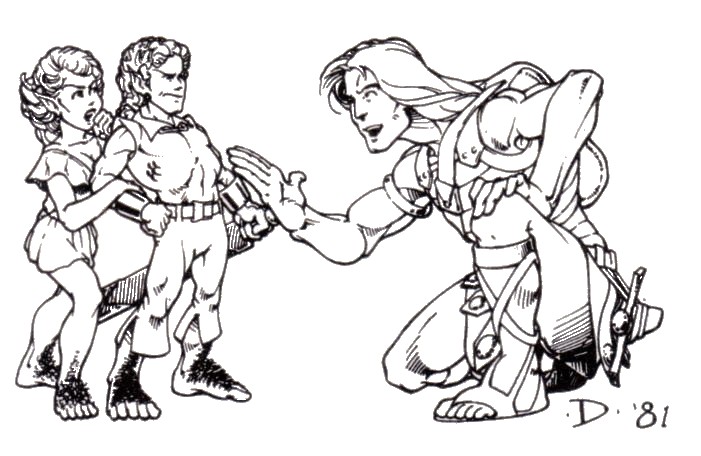
Halflings – I haven’t done much with halflings that’s terribly interesting. I tend to think of them as free farmers, clearing the wilderness and building communities in the shadow of human civilizations. They tend to share dwarven conservative values, and favor order and tranquility over freedom. They are fierce defenders of their homes. (Most of this came from the vibes I got from this great Jeff Dee illustration.)

UNDERWATER

Merfolk – My merfolk are heavily based on the city-states of classical Greece. They tend to live in spots that are a few miles from the coastline, no more than a mile deep, and close to ocean currents which they exploit for trade as well as food. The outer territories are farms (worked by poorer families) and plantations (worked by slaves) of sea floor or floating crops. These homes are woven baskets, usually anchored to the ocean floor. Small communities will be built around a taller hut with an air pocket and chimney to the surface where a communal fire will be kept. The actual cities themselves are usually tall, slender towers fashioned from stone, shell, and glass, with many chambers housing air pockets. At the center of the city will be the temple complex, for religious devotion is always at the center of civic life. Nearby will be the seat of government, either a democratic council theater, fortress of a warlord, or temple-palace of a priest-king. All free mermen are expected to fight in defense of their city, and all free mermaids are expected to devote some of their time to religious duties. They tend to get along poorly with surface dwellers and skirmishes between raiding merfolk and human merchants and fishermen are common. As merfolk use tattoos to mark their slaves, tattooed PCs entering merfolk territory usually run into trouble when dealing with the locals.

Sea Elves – Sea elves dwell in the deeper parts of the ocean, where the sunlight fades to gloaming, or fails entirely. They use magic to light their domed cities, fashioned from magically shaped stone. They are the smiths of the undersea world, using strong relationships with the Elemental Planes to supply the air, fire, and much of the materials needed to craft steel, bronze, and highly prized mithril which does not rust or tarnish, even in the saltiest of seas. They are among the most fey of the elves, having almost no dealings with the surface folk. They trade frequently with the merfolk, and war almost as frequently against the sahuagin.

Selkies – They call themselves the princes of the seas. They live a semi-nomadic existence, usually possessing a summer home and a winter home many leagues apart. They live in the oceans, but their homes are always near the coast, in shallow, clear waters, far from the settlements of surface dwellers. Their herds are fish and they use dry land for forage. They live in large clans and practice communal marriage, where entire clans merge in a single, mass ceremony. When a clan grows too large for its undersea “palace”, it will usually divide into three clans, and two will travel in opposite directions for hundreds of miles before settling down again. Selkie clans tend to be rather rich, as they trade between surface dwellers, usually elves and humans, and the merfolk and sea elves. While they are fey, they tend to have very little to do with other worlds or the realms of fairie.

THE “BAD” GUYS

Goblins – Imagine sentient, sadistic chimpanzees and you’re not too far off from my interpretation of goblins. They value cleverness above all else, and eagerly seek ways to steal from any and all, especially if they can get away with pointing the blame at others. Literacy is reserved for the tribal crones, who rule the tribes in a bloody and precarious balance with male chieftain and his circle of trusted warriors. A strong chieftain can force the crones to support his rule, but if a chieftain stumbles or if times are hard for the tribe, the chieftain can be replaced. The crones usually choose a new chief by reading the entrails of the old, and the reading is considered to be far more accurate if the old chieftain hasn’t finished dying while the reading is taking place.

Orcs – My orcs are heavily influenced by the art of Frekrik K.T. Andersson. Orcs prize brute strength over all other virtues. Almost all orcs fight without armour to prove their strength, and use tattoos to highlight their battle scars. The fiercest charge into battle naked and without weapons to prove their might over the enemy. You can only own what you can keep by strength; theft is not a crime in orcish society, though being overly sneaky and cowardly is. Polygamy is common though most orcs of both sexes prefer to take concubines rather than engage in marriage, which is more about political and economic alliance rather than love or affection. Orcs are so fertile, it is said they can mate with anything. This is not strictly true, but they are able to have children with nearly every mammalian humanoid race.

Gnolls – I love gnolls, and have for quite some time. The females rule the gnollish tribes through intimidation, fear, and politics. Each tribe is dominated by a clique of females in the prime of their years. Hunting and raiding are the responsibilities of the younger females, and uppity girls or the daughters of hated rivals frequently meet with unfortunate “hunting accidents”. Males constantly compete for the patronage of powerful females, proving their worth through their skills. Smithing is the most valued skill, though weaving, leatherworking, and pottery are also highly valued. Countering the supremacy of the female cliques are the red-cloaked bards, warrior-poets who retain the lore of the gnolls. It is they who decide how a gnoll is remembered after death, and it is this remembrance which decides a gnoll’s station in the afterlife.

Trolls – The gangly, scrawny troll of old school AD&D never clicked for me. My trolls are massive, craggy monsters, dangerous fey (and thus related to the elves) who ward the places where the Prime Material and fairie leak into one another. They tend to possess ancient and chthonian wisdom.

Concerned

I thought long, and very hard, before writing this. And I thought harder before posting it.

Let me start by saying that I don’t have an axe to grind or a bone to pick with WotC. I don’t hate them, I don’t think they’ve “ruined” D&D or destroyed my childhood or anything silly like that. Quite the contrary; I wish them the best, because the health of my favorite hobby depends in a very real and obvious way on the health and success of WotC. While I’m not their biggest fan and I don’t buy a lot of their products, I do pay attention to what they produce. Even when I wasn’t playing 3.x D&D, I flipped through Dragon and skimmed their web pages. They are, in short, influential in my preferred pastime.

So what follows is not an attack. Rather, it’s the concerns of, if not a friend, at the very least a respectful neighbor.

I think WotC is ill.

The signs are everywhere. Just today, James Maliszewski asks of the 4e Monster Manual:

What's with all the recycled art? I'm frankly a bit surprised to see so many illustrations I recognize from the 3e era. 4e was clearly a big project for WotC and one they've invested a lot of money in producing and promoting, so why does it re-use art?

And it’s not just the recycled art. You can see it in the page layout as well. Yeah, it’s easy to read, but sloppy. Did they just not have time to clean up the vast tracks of blank space and orphans? Or are they a clumsy attempt to bulk out the book, so it fills up the number of expected pages? Seriously, if Steve Jackson or Chris Pramas put out a book that looked like the 4e PHB, they’d cringe every time they had to open it. They would have felt ill as the boxes shipped to the retailers. The 4e core books, the results of years of development, the flagship products of the biggest name in RPGs, are not pretty books. They look clumsy, they are poorly laid out, they are poorly organized. Where are the alphabetized listings of spells and powers? Why do we have to flip madly about to learn what [W] means? What's up with the PHB's index? Why were skill challenges so broken? I’ve heard that WotC has claimed that the books shipped with an older version of the skill challenge rules, and not the final, proper rules. Giving WotC the benefit of the doubt on this, how did something so large manage to slip by everybody?

And what are we to make of the clumsy marketing campaign? Or the endless revisions to how 3rd party licensing was going to be handled? Or that the official D&D web page, badly in need of redesign, is still dominated by a spiky metal motif echoing the covers of the 3rd edition books nearly two months after the debut of 4e?

And then there’s the arrival of a new company president just as WotC was entering the crescendo towards release of 4e. Was that really the best time to change the top management position? The death of Gleemax proves that this wasn’t just changing out name plates on the door; the new boss has very different ideas and attitudes towards where the company should be going than the old boss did. This, actually, gives me reason to hope. Mr. Leeds might be exactly what WotC needs to shake this funk they seem to be in.

Tuesday, August 05, 2008

Fight On! Gets a Web Page

Fight On!, the "premier fanzine for the old-school renaissance", now has a web page of its very own. Not much there yet, but it's a great, clean start.

Monday, August 04, 2008

Getting Out of the Tavern

Ripper X has a great post on places you can go in your games to gather information other than the cliché tavern:

The Market is a valuable source of info and work. Everybody has to eat, and these bright streets are the true hub and heart of any city, as is a well. Water is collected daily, all one had to do is hang out in this area and you will see everyone that lives in the area.

There are lots of great ideas in this post. I'd be cautious about how you use them, though. While it's good to shake things up, the nice thing about clichés is that they make everyone's life easier. If the players know they can get information quickly at the tavern, they can more quickly get to the meat of the adventure. And if by "meat" you mean "exploring a hole in the earth, kicking down doors, and bustin' heads" then it might be best if you stick with the tavern.

If, however, information gathering is closer to the heart of your adventures, as it is with Ripper X's, getting the PCs to cast a wider net makes good sense. Helping players decide where they might best search is still important, since you want to get the best use of your gaming time. "The Special Glow" post at Amagi Games has a number of good ideas on this topic.

Of course, just knowing where to look is only the beginning. Some of places mentioned in the post can be a challenge just to get into:

Another civil place where one can discuss things in private, as well as obtain the peace required for ruling a corrupt public is a garden. Gardens are kept behind walls and again, one must be a member to enjoy the splendor of them.

The PCs know Lady Gloria walks through the Three Swans garden every day after lunch. But how do they gain entry to the well-guarded and magically warded place? Answering such questions is how information gathering becomes adventure.

Dangerous Enchantments

Congrats to Kevin Brennan for winning James Maliszewski’s first Grognard’s Challenge. The magic item Mr. Brennan invented, the devil’s eye, out-old-schools the magic items of Arneson, Gygax, etc. :

It's the kind of item that reminds you that magic isn't something to be trifled with and that every boon it grants might come with a price. More to the point, there's an actual temptation to use this item, because the boon it offers is a good and useful one. It's a screw job that players will seriously consider using rather than just a game mechanic designed to emulate a screw job (like cursed swords).

Mr. Raggi gives it very high praise as well:

Cool... aside from basic potions and scrolls, none of the magic items in my current campaign (not that the PCs have seen a single one after three sessions), or in my upcoming (at some point :P) adventures, are wholly beneficial.

A great way to keep people on their toes and prevent players from even wanting to be decked out like a Christmas tree.

Yeah, it does that as well, but as Mr. Maliszewski points out, magic that refuses to simply do as it’s told has strong traditional roots in the literature, and this goes beyond pulp. Yes, there are echoes of Moorecock’s Stormbringer and Silke’s interpretation of the Death Dealer’s horned helmet, but an even closer parallel can be drawn to Tolkien’s palentirs, the Ring of the Nibelung, or the favor of the Greek gods.

This is one area where most games, pen-and-paper RPGs and, most especially, computer RPGs alike, almost all stumble, and in the exact same way. By making magic predictable, reliable, and easily controllable, they drain all the color from it. Fireballs not only harm just your enemies, they don’t cause fires to break out or melt the treasure the monsters were carrying. Stored magical power doesn’t leak or cause unexpected effects. Magic is far more reliable and boring than technology; your computer might blue-screen, your light bulbs might pop, and your car may be melting the polar icecaps, but your wand of lightning bolts only ever does 6d6 points of damage to your intended targets.

Battling the complacency this creates was part of why I created residual effects for spells in my Moldvay/Cook/LL hack. Tailoring these sorts of dangers can go far to bridge the power gap between magic using and mundane classes. They can slow the power creep that comes from the Christmas tree effect. Most importantly, they make magic something that is used with thought and careful consideration. In short, it makes magic magical again.

UPDATE: Jeff riffs on this same theme.

Saturday, August 02, 2008

Necromancer Games Chooses not to Use the GSL... Yet!

There's been some hullaballoo about Necromancer Games deciding not to publish under the GSL. Clark Peterson has been a huge supporter and booster for some form of easy license for 3rd party publishing of D&D 4e products. So yeah, a vote of no confidence from Necromancer Games is a big deal. But it's best to read what Mr. Peterson has actually said before leaping to any conclusions:

So bottom line it for me--what are you going to do? We are working with Wizards to clarify and/or change the license. If that works, we will release 4E material. If there are no changes, I dont see us adopting the GSL (absent some significant official clarification of terms of the GSL). We will support Pathfinder. But we will not just release OGL content from this point forward until Pathfinder is viable and we can support it.

The italicized emphasis is mine. Clark hasn't given up on the GSL. He might be willing to negotiate a separate license with WotC, like Goodman Games appears to have done. And he's hopeful about doing stuff with Pathfinder, but much depends there on Paizo following through on the promise of the premise. Being in this kind of holding pattern can't be comfortable for the folks at Necromancer Games, but sometimes the best thing you can do is nothing.

The Phoenix Barony is Free!

David "Grubman" Bezio's setting for Labyrinth Lord, the Phoenix Barony, is now free for download at Lulu:

Focusing on the fun stuff, and keeping the boring stuff brief, this setting is designed for playing in, not making you feel like you are in history class. You get adequate concise information on the geography, history, politics, and religion of the area. You also get a map and full Gazetteer of all the major land features and settlements, filled with plenty of adventure hooks and inspirational ideas. Finally you get a complete list of all the major NPCs in the barony, along with full Labyrinth Lord stat blocks. With enough information to get you going, but not so much as to be overbearing, there is plenty of room for the game master and players to move around, and make this setting their own.

Not only is the new, streamlined version of the setting book there, but you can also pick up a pair of Labyrinth Lord adventures, The Tathor Gazetteer which describes in greater detail the northeast quarter of the Phoenix Barony, and a player's guide to the Phoenix Barony:

Let’s face it; you love your setting more than your players. They generally just want to get together and play the game, not listen to you drone on and on about the history and backdrop of the adventure. This one page document gives the players enough information to get a feel for the setting without beating them to death with boring crap! Print this up, or email it to them before you play, and when you get together you can get right to the monster slaying!

A single page seems just right to me. I'll be doing my best to limit my setting info for my Moldvay/Cook/Labyrinth Lord hack to a single page (and, I'm equally certain, failing miserably to meet that goal).

Thursday, July 31, 2008

4e Delivers

Or so it seems, on one of the most important elements I think RPGs need to nail right out of the box. I'm speaking of efficiency:

4E has IMHO the lowest barrier to a good night of gaming. As a father of two, and a full time researcher, I have barely enough time to game as it is. Our game nights are packed now that we playing 4E. I probably won’t forget the 2nd game night using the new rules: 3 hours = 3 combat encounters and 3 ‘non-combat’ encounters = 6 things done. All the players shined both in combat and out, and everyone had an awesome time.

This is why WotC really needs to get their digital tabletop right. Combined with a game that makes it easy to pack a lot of fun in a limited amount of time, making it easy to get together with friends is a killer synergy. If they can then help cultivate better DMs and better players through the communities that develop around DDI, they can possibly inject a lot of life into the hobby.

Wednesday, July 30, 2008

RPGs Other than D&D

Here's where I admit just how mainstream my tastes can run.

James Maliszewski, prodded by the other Brian Murphy, listed his favorite RPGs that are not D&D. Even though it's rather lacking in "indie" goodness, James' list is still far more eclectic than mine:

  1. STAR FRONTIERS - My parents bought me the Knight Hawks box for Christmas, not really understanding how the game was put together. No problem, a few days later I bought myself the Alpha Dawn box for my birthday, though we had to hunt all over town to find a copy. I loved this game in spite of its many flaws, including a very clunky combat system that usually resulted in people beating each other to death with their otherwise useless guns after they'd burned through all their ammo. I still love the aliens, especially the blob-like dralasite, which was a favorite in our games. It also caught me at just the perfect time, when my reading tastes were heavily into Heinlein, H. Beam Piper, and Alan Dean Foster. You can still get a taste of this game through the "digitally remastered" version now available on the web page for The Frontiersman.
  2. GURPS - Nearly as old as D&D and still chugging along fine. I have a love-hate relationships with GURPS. The trick to really enjoying it is choosing just the bits you need and leaving off the rest. I haven't gotten to play this one nearly as much as I'd like.
  3. Shadowrun - This is one of those games that either clicks with you or doesn't, and it's almost entirely your reaction to the setting that will decide the issue. When it came out, it really clicked with my friends, and it was just as popular as D&D with us through the end of my high school days. It's the game that really taught me to pay attention to mechanics, and how the rules can reinforce or interfere with the setting. The first edition of this game did both. I have very cool ideas for this game, and some day I hope to play them out.
  4. Traveller - My exposure to this game was pretty limited. It seemed to have more promise than Star Frontiers in many respects, but was always a near-miss with me. I suppose that's in large part because what I really wanted was...
  5. Fading Suns - Wow! I adore this crazy little game. It's so deep, so rich, the concept at once so simple to grasp and yet so textured in its possibilities and presentation. The mechanics, unfortunately, are as sprawling as possibilities, and were always a hurdle I felt I had to get over. I've got the outline of a sci-fi setting on my hard drive, and it owes more than a little to the ideas in Fading Suns.
  6. True20 - I'd love to mention Blue Rose here as well, but I really haven't gotten to play it enough to list it. But I have gotten to enjoy a bit more True20, and for a while, I was thinking it would be the last RPG I'd ever need. Yeah, it's really that good, and that flexible, a sort of GURPS-lite without making you feel like you're cheating yourself of GURPS' crunchy goodness. I still adore the rules, but it was my dissatisfaction with trying to tweak them for fantasy that has me turning back to Moldvay/Cook.

Tuesday, July 29, 2008

There's a New Sheriff in Town

Via The Gamer Dome we learn that WotC has decided to emphasize their focus on Magic: the Gathering and D&D, and this new direction means the death of Gleemax. I doubt there will be too many tears shed over the demise of the lime green brain-inna-jar. However, I imagine there will be much speculation as to what this means about WotC. It'd be easy to think this means that 4e didn't sell as well as projected, or that the company is in dire straits for one reason or another.

I think this is premature. Keep in mind that WotC got a new president just before 4e was released. New presidents like to put their stamp on a company and shake things up, so everyone knows there's new management, with new ideas, and that things will change. "Refocusing on core competencies" is a hoary old arrow in the quiver of incoming presidents and the like.

Home is Where You Hang Your Hat of Disguise

More good stuff from Amagi Games, this time on PC "bases" or homes:

The home base, secret hideout, wizardly towers, fortresses in the woods; in fictional setting, many of the archetypes that roleplaying characters aspire towards are ones that develop and maintain interesting homes. Only a scant few games, however, have explored this territory in any significant depth. So, this article is a bit of a look into things that make a home base desirable, and ways that GMs can then use the (desirable) base to spur engaging action.

Those of you who played "old school" D&D will be familiar with the "end game" of building strongholds, and the sort of fun that can create, already. But there's no need to wait that long. Even if home is just a rented apartment or attic room in the city, or an abandoned barn on the outskirts of the village, can inspire players to "buy in" to the local community, and the campaign as a whole.

There's one little spot where I disagree with Mr. Kornelsen:

Try not to encourage detail that will never be used; spending loads of time creating things without a ‘return’ is annoying to many players.

Now, in Levi's defense, he's speaking directly of details that provide some sort of "home turf" advantage in conflicts. But in my experience, players love to map out their homes in loving detail and lavish them with all sorts of aesthetic improvements. I'd certainly not discourage this sort of behavior, especially if everyone understands up front that most, if not all, of these won't have any mechanical influence on the game.

Thursday, July 24, 2008

Covering DRAGON

There have been a lot of neat retrospectives on D&D art just lately, but my favorite is sirlarkins' discussion of his favorite covers of Dragon:

The covers of Dragon were, for me, an early and constant source of inspiration. Dragon, for a time, featured some of the best fantasy art on its covers every month. My retrospective will of course be largely influenced by the period in which I was an active reader and subscriber (circa 1989 to 1995) but as it turns out most of my favorite pieces are from before that era, grown out of familiarty acquired after purchasing the Art of Dragon Magazine many, many winters ago.

I started, and stopped, reading Dragon in a slightly earlier frame of time than sirlarkins, but there's a lot of overlap between my favorites and his. I also find I have a lot of agreement with his comments on the art of Elmore, Easley, Caldwell, and Holloway.

Wednesday, July 23, 2008

Fight On! #2

Check out the table of contents.

Did you see what's on page 28? Huh, huh, didja, didja? Now you know you gotta buy it!

"But trollguy," I hear you say. "Why should I buy the magazine when you've got that for free right here?"

Well, in addition to that giant list of articles by luminaries from across the grognardosphere, there may be some additional magical goodness in the Fight On! version of the article.

What's This Game About:: 4e

Odyssey has a very interesting insight on monitoring the ebb-and-flow of 4e combat:

I've noticed, running 4e, that PC hit point totals don't really matter. On a round by round basis, yeah -- if they're bloodied, or if they're low enough that a monster can take them down in one hit, that matters. But just paying attention to their hit point totals doesn't let me know how they're doing, what the pace of the fight is, or how close they are to defeat.

It's a trap I could see myself falling into if I tried to run a 4e game. "What?!? You're out of healing surges? Oh, um, yeah, I guess this is gonna be a short adventure then..." It makes my brain itch to find a way to ditch hit points entirely, and instead give the entire team some form of resilience score based on healing surges and what-not, further melting the individual character into the gestalt of the team.

The Look of Adventure

Been keeping up with Amagi Games? I haven't been keeping up with much of anyone just lately, but I've still been keeping an eye on Mr. Kornelsen's great little blog of neat ideas. There's been a lot added since I talked about the site last, but "The Special Glow" is a great article on how to draw attention to things in your games without blatantly tricking them out with neon signs and day-glow stickers marking them as "QUEST IMPORTANT!!1!!one!!!":

The Preferred Material: Borrowing directly from video games, here, where ‘the bits you can mess with’ are often in a slightly different color… It’s possible for a given species of foe, or culture, to add to or modify locations primarily using some preferred material or materials. If the group looks down a hallway and sees that little obsidian spikes with gold bits have been pinned to the walls, this might tip them off that the hallway has been modified by the Shalaut, that terrible race of lizard-things.

Lots more where that came from, discussing not just inanimate objects but also characters and bits of information. I love the Amagi Games is shaking out to be a place to go for useful advice on issues that GMs routinely face in RPGs.

UPDATE: And be sure to check out this little interview with Levi at At Will.

Sunflowers on Europa

Freeman Dyson talks about the possibilities of life on Europa and, even more promising, on the much smaller objects of the Kuiper Belt and Oort Cloud.

Monday, July 14, 2008

Hope These Folks Remember to Bring Their 10-foot Poles

A secret series of caverns and tunnels are to be explored beneath a pyramid in Mexico:

At the end of this month, they are to investigate a man-made tunnel and cave system underneath the pyramid – the third biggest in the world – to test theories that it was used for rituals including human sacrifice.

"We think it had a ritual purpose. Offerings were placed at the very end of the tunnel as part of the pyramid's construction process," said Alejandro Sarabia, Teotihuacan's director of archaeology.

He will lead a team of Mexican, American and Japanese experts into a 295 ft long, 8 ft high tunnel some 20 ft below the pyramid.

"We want to find out why the Teotihuacan people sealed it and when," Mr Sarabia said. "Excavating the cave could give us some clues about what happened at Teotihuacan, about the fate of the city."

Has anybody checked the level on this adventure? It can really suck when you're expecting kobolds and end up fighting cuatls.

Thursday, July 10, 2008

Playing Without a (GSL) Net

James Edward Raggi IV, he of Lamentations of the Flame Princess, has some thoughts on the 4e version of Kingdoms of Kalamar. This latest version of Kenzer & Company's campaign setting is, as always, compatible with the world's most popular RPG. But they don't even bother with that fig leaf:

A 4e product for sale right now. Saying "For Use with Fourth Edition Dungeons and Dragons" right on the cover...

Not using the GSL.

This was a predictable outcome of the GSL. However, I doubt we'll be seeing a lot of this sort of stuff. Mr. Raggi ponders whether this example makes the who simulacra thing redundant. Possibly, but only if you've got a copyright lawyer handy and you're fairly certain Hasbro won't sue you. Keep in mind that Hasbro doesn't have to win the lawsuit. They just have to inflict enough financial hurt that you decide never to be crosswise with them again.

But Kenzer can probably get away with it, and we may see a few other companies poke their toes in this water as well. But I don't expect to see many, forget most, 4e material released in this manner. And I don't expect we'll see any simulacra follow this example.

ElfQuest Gets a Movie?!?

I've been a fan of Elfquest since the 5th grade. Had the books hidden in my room so my folks wouldn't flip through them and find the, er, less clothed bits.

For those of you who don't know the history, the Pini's created Elfquest after seeing that animated Lord of the Rings movie, and vowed to do fantasy animation right. Unfortunately, they couldn't afford to fund an animated movie. But they could self-publish some comic books. In fact, they are often credited with spearheading the big self-publishing craze of independent comics.

Anyway, the point is, Elfquest was always supposed to be a movie, but things always seemed to fall through. Now, it appears, Warners is serious about it. I'm damned curious to see how they plan to approach it. It's the sort of project that doesn't fit comfortably into your usual genre system. That said, after Jackson's LotR trilogy, del Toro's "Pan's Labyrinth", and the good buzz I've heard in advance of "Hellboy II", maybe someone will actually do this project justice. However, we don't know how heavily the Pini's are involved, or much about who will be working on the project. But it should have trolls in it, so you know it'll be good! ;)

UPDATE: Duh! More stuff at the Elfquest page:

Our director Rawson Thurber (yes, the great great grandson of the James Thurber) is just an amazingly brilliant and wonderful young Leonardo Di Caprio look-alike - the perfect director for this film. He and his sister grew up reading EQ (can quote chapter and verse) and he has always had a deep passion for it. Now he's on the A-list! Who knew?!? Anyway, after many false starts, Rawson's just what we needed to finally push this project over the top.

There's almost nothing to say about the movie itself, yet. It will probably be a combination of CGI and live action. It will probably take about two years to make. Rawson is writing the script and producing as well as directing (a la Guillermo del Toro on Hellboy). Richard and I will be acting as consultants all the way through.


I'm shocked it won't be animation, but not that shocked. Animation that's anything but Pixar is a tough sell these days. So now we can all go crazy playing the casting game as we try to decide who should play Cutter and Skywise and the rest.

"...imagine a magic missile crushing the darkness, forever."

Heh...

Ok, I'm still playing catch-up on all the great blogs out there. (Have you seen all the cool blogs Mr. Maliszewski's added to his blogroll? I was reading some of them already, but not all. There are some hidden treasures there.) Jeff's report on his experiences with 4e line up a lot with my expectations, especially this:

The most interesting thing I've noticed about 4e so far is how powergaming the system seems to work. Some people will try to tell you that the simplified character creation makes powergaming impossible. Those people lack vision. The munchkining of the game obviously lurks in synergizing among your teammates. The era of the overpowered "character build" may be over, but I predict that the smart munchkins will be all over "team optimization" like stink on poop.

Yeah, I've been talking that up for a while now. I think by Christmas you'll be hearing how every group needs a "striker-striker-warlord fireteam" or some such. I'm really looking forward to seeing how that sort of thing shakes out. Often in games as complex as D&D, the unintended bits are cooler than what the designers consciously put into the game.

Tuesday, July 08, 2008

It LIVES!!!

Barely.

Sorry for being absent so long. I've been really under the weather, and haven't even been reading the intrawebs much since I posted last.

That being the case, I'm sure there's already been a lot said and posted about this great guide by Mythmere on how to play old school RPGs. I think he nails it, but that probably doesn't surprise regular readers, as he discusses the central importance of the GM crafting the game for a particular group and resource management.

It's also making me wonder if I'd prefer a game with more of a combat focus, where we don't worry about how many torches the PCs are lugging around, and focus instead on "meaningful" combats full of dramatic importance. I dunno, maybe. I kinda fall down here because I keep wanting games like this to mimic reality as I know it a bit better than they do. But then, I'm the guy who has a trouble letting go and embracing the silly, slapstick fun of Paranoia.