Wednesday, August 07, 2013

The Aesthetics of Numenera

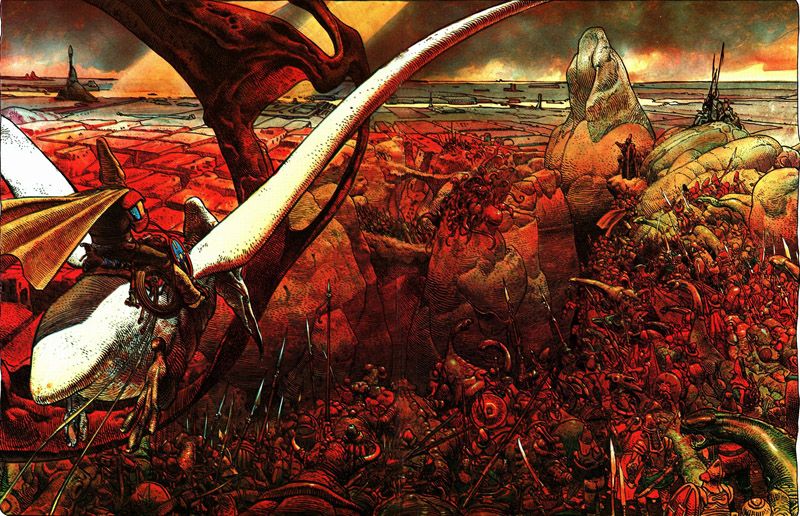
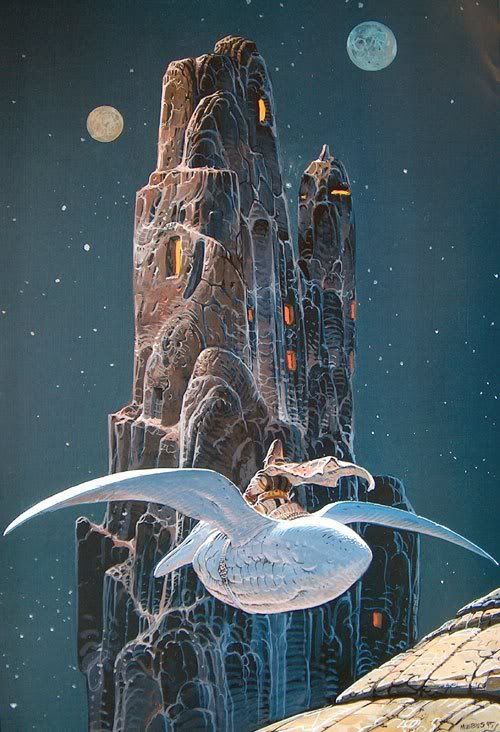
I was a backer on the Numenera Kickstarter largely because it promised a game that combined “outside-of-the-box gameplay such as that found in Planescape, Dark Space, or Chaositech, the far-future stories of Gene Wolfe, Michael Moorcock, or Jack Vance, or mind-blowing visuals like those found in the work of French artist Moebius”. I'm a huge fan of that science-fantasy Heavy Metal thing, so this looked right up my alley.

Because this is Monte Cook, the core book clocks in at a hefty 400+ pages. These include all the rules, a bestiary, maps, and setting info, so I'm not going to ding him too hard for that. I've not finished reading through the book yet, so I'm a bit hesitant to start chewing on the rules or even the setting too much. What have I read, however, strongly feels like this, and this, and this with a bit of this thrown in for good measure. Which, quite frankly, makes me rather happy.

As an important for-instance, let's take a look at PCs. By now, you've probably heard about Numenera's Mad Lib's, fill-in-the-blank character creation that results in you being able to describe your PC as a blankety blank who blanks. The middle blank is your type (aka class) of which there are three: glaive (aka fighter), nano (aka magic-user) and jack (which is a mix of the other two and/or skill-hound). So far, pretty basic.

The first blankety is your descriptor and it's words like “stealthy” or “intelligent” or “rugged.” Unlike a game like Fudge where that would be left fairly vague and give you bonuses when what you're doing involves your adjective, Numenera spells out when and what sort of modifiers you get, plus additional bonuses like gear and contacts that come with it, as well as the occasional handicap.

When you get to the last blanks, your character's focus, you're suddenly in superhero and “Masters of the Universe” territory. Like the descriptor, you pick your focus from a list of firmly-defined options. These include “bears a halo of fire,” “controls gravity,” “murders,” and “wields two weapons at once.” It's your character's schtick and, like Beastman's ability to control animals or Shadowcat's ability to go immaterial (both of which have analogs in the list of foci), it's going to go far in defining what your character does and perhaps even who they are. Especially since you're only allowed each focus once per group.

With 29 foci and three types, you can create 87 different templates to build your character around (though, granted, not all foci and types are good matches). Toss in your descriptor and you've got a lot of room to play in and create unique characters with. But the art that begins the chapter on character creation feels kinda generic:

Don't get me wrong, technically it's quite competent. Each individual is, in fact, individual with the nice use of the metal circles to tie them all together, but they feel terribly much like stereotypes: the haughty star-jock warrior, the haughty can-kick-your-ass daredevil babe, and the haughty tosses-energy-blasts ascetic mystic. I know exactly what their voices sound like, what their catch-phrases are, and what they can do in a fight, which is good for potential PC art, but it's less the (considerable) skill of the artist as how much they lean on stereotypes.

Now, maybe it's because of I've been spoiled by James Edward Raggi IV (NSFW) and Zak Smith (also NSFW), but when you make a game about Earth a billion years in the future, I expect art that's compelling and strange. And yes, it's a terribly not-fair comparison, but this is strange and compelling. This feels very much been-there-done-that. (And anyone who thinks that having the guys showing more skin than the gals will give them a pass on art like this (NSFW) or the torture piece are deluding themselves.) You're about a quarter of the way through the book, on page 105, when you finally encounter Keith Thompson's delightfully macabre Scribe and finally find art that lives up to the promise of the setting.

Before that, it's a lot of rather uninspiring digital art with heavy brush strokes of the sort that rules Deviant Art right now. The tough, angry warrior woman whose arm has been replaced by a weapon, Witchblade-style. The moody landscapes with the giant rocks and things floating in the air above it. You've seen it before.

Granted, when your setting is this strange (and the strange is there, it just takes a while to get to it) you need to give the players something familiar to latch on to, to identify with. This familiarity makes it comfortable, and possibly inviting. It makes it easy to imagine what sorts of things you can expect to find in this very stranger world, and who your character is going to be. Numenera is very careful about easing you into the strange. Again, character creation is a good example of this. Hey, your character's a glaive, but that's just a fancy word for fighter. You know what a fighter is. Nothing odd here, right? He's also graceful. Good balance, great hand-eye coordination. So a fighter who's good at dodging and landing just the right blow. You've seen his type before. He's wiry and quick and...

Oh, did I mention he has the power to travel “a long distance from one location to another almost instantaneously, carried by a bolt of lightning”?

Wait, what?

So I absolutely understand, and can even commend, the desire to offer readers something comfortable and familiar with the art. I just wish more of it felt compelling. There's some neat stuff in the art, but nothing that quite rises to the level of the imagination seen in the ideas in the book. And when your setting is this strange, you really need the art to carry a lot of the communication load.

Don't get me wrong, there's some neat art in this. Keith Thompson provides some excellent strangeness, as has already been shown. And some of the artists, folks like Samuel Arya, Helge Balzer, Guido Kuip, Brynn Metheny (who does some great creature design), Kieran Yanner (who did the cover), Mark Tarrisse, Cory Trego-Erdner, and Adrian Wilkins, can (and many do here) produce some really great atmospheric and moody art. I just can't help but feel that, for much of the book, the art design was restrained to keep things from getting too weird.

This might be a matter of taste as well. For a project like this, I would have aimed more for mood and maybe a bit less towards the you-are-there style I normally enjoy so much. There's some great black-and-white work that really seems to capture the flavor of the text, women in tall headdresses riding vicious lizards and such. My hope is that, with such a great stable of artists already involved in the project, Mr. Cook will let them really spread their wings and give us the bizarre and intriguing setting his words describe in future products.

Wednesday, July 31, 2013

In the Grim Reality of Future Warrior, There are Only Choices to be Made

Over on his Art of the Genre blog, Mr. Taylor ponders crafting new mechanics vs. re-framing off-the-shelf solutions:
In today’s RPG marketplace, with the advent of OGL, wouldn’t it make more sense to simply use an existing engine from something like Pathfinder, Savage Worlds, or Fate? Wouldn’t a proven system with a nice track record, and designed by folks with vast amounts of gaming design experience, be a better way to go than trying to cobble your own mechanic together?
Rules and mechanics matter. What do you want your players (not the characters, the players) to do in your game? Spend lots of out-of-game time designing characters that they then unleash in a handful of set-piece battles per session? Then Pathfinder’s probably the way to go. If the players are going to be organizing raids in which their characters lead groups of NPCs in disparate (and possibly desperate) missions, Savage Worlds is clearly the way to go. On the third hand, Fate would be an excellent choice for a rules-light, fast paced game that rarely gets bogged down in either tactical or rules-interaction minutiae.

Designers need to keep in mind that rolling dice is not playing the game. Rolling dice is where the play stops and everyone waits to see how random chance will rearrange the situation, at which point the players can start making decisions again. It’s this deciding that is the real meat of playing the game. That’s where the fun comes from. So what sorts of decisions do you want your players to be making? Design your mechanics to support (but not supplant) those decisions and you’re off to the races.

Thursday, June 13, 2013

Tentacle-monsters Beware! Free RPG Day is Nigh!

Don't forget that this Saturday is FREE RPG DAY!  Yaaaaaaaay! *does the Kermit flail*

Among the goodies on tap are a new LotFP adventure, a Swords & Wizardry adventure by Frog God Games, a Dungeon Crawl Classics adventure by Goodman Games, a Castle & Crusades adventure from Troll Lord and a Tunnels & Trolls adventure from Flying Buffalo.  Lots of yummy gaming goodness to go around.  Click here to find a store near you.

Friday, May 31, 2013

Jack Vance Has Passed Away

And I'm so out of it, I didn't notice until today.

We are, of course, speaking of the author who inspired the "Vancian magic" of D&D.  He's best known for his Dying Earth stories which took place in the latter years of Earth's existence, when the sun was red and swollen, a realm in which technology was so advanced, baroque, and strange that it really was indistinguishable from magic.

The Brits seem to have a gift for writing obituaries and the Guardian has a good one for Vance.

Tuesday, May 28, 2013

DIY Goes to the Cloud

On Saturday at Comicpalooza, Skirmisher Publishing had a panel in which they promised to announce the “biggest thing in gaming for 2013!”  So what did they announce?

Quite possibly the biggest thing of 2013.  And maybe the two years on either side of it, if they can iron out the rough spots.

Basically, Bookforge is a web page for selling gaming content in the smallest usable increments: classes, feats, skills, encounters, monsters, weapons, spells, rooms, etc. via micropayments (dimes, nickels, etc.).  Instead of buying an entire book for US $30+, you can buy the class and two feats you’ll actually use for US 75¢.  

What sort of content will be up there?  They’re starting with the entire OGL SRD (which will be available for free).  In addition to the OGL, you can also find content from Pathfinder’s SRD.  There are options to search under 4e, Labyrinth Lord and Mutant Future, but those don’t appear to turn up any content as of this writing.  They’re also planning on including 5e Next, Savage Worlds, Fudge, d6 and Fate.  And they’ll put up everything they’ve published and have the appropriate rights for.  The goal is to have 100 authors and a million pieces of content by the end of the year.  

The content will be sortable by type, author, keywords, theme words (the example they mentioned was “power attacks”), genre, rule system, and the book it was originally published in.  They thought the last was important because they didn’t want you to accidentally buy something you already had on a bookshelf.  

You’ll likely still want to spend the pennies on it since you’ll be able to export collections of content in pdf form as sourcebooks.  The idea is clearly that you’ll create a homemade sourcebook for your campaign based on the content you pick and send it to your players so they have it to create characters with.  They also made mention of a dungeon generator that would work based on the options you picked, and that they were contemplating a character builder as well, though no ETAs on either just yet.

When you buy this content, you’ll have the option to record your own notes on it.  Some will come with art, others might come with notes from the author as well.  They’re talking about adding some clip art as well that you can buy to add to your sourcebooks.  

They will be accepting additional content.  They won’t put anything up until they’ve edited it and I forgot to ask what sort of turnaround they expected on the editing process.  The author’s cut will be something in the neighborhood of 20%.  They’re also promising complete transparency on sales and searches with the authors.  

So that’s it in a nutshell.  Frankly, if 5e Next is as flexible and modular as they’ve been claiming, this may be the killer ap that pushes it over the top.  Imagine being able to cobble together your race-as-class from Basic, monsters from the 2e Monstrous Manual, spells from The Book of Vile Darkness, and your favorite house rules from around the web, all bolted to a framework that embraces all of them without choking on crazy variety.  If WotC delivers that framework, Bookforge is the perfect compliment to it.

As of this writing, the interface is a bit bare-bones and clunky.  A search for "spidergoat" didn’t turn up anything and a search for "class" turns up a lot of feats and skills.  Searching "sleep" pulls up a lot of OGL and Pathfinder content but nothing under Labyrinth Lord or 4e yet.  I’m not sure how much of the content is actually up and how much of the trouble is my inexperience with the system.  In any case, there’s a lot of promise there, and if you’re playing any 3.x game, it’s clearly a valuable resource already.


Bookforge is described as being still in beta.  A video was shot of the announcement, but I haven't seen it posted yet.  I'll link to it when it goes live.

Tuesday, April 30, 2013

Playing with Play-by-Post Mechanics

Oddysey and I were chatting last night about play-by-post gaming. Her recent adventures in learning to code has her intrigued by the idea of creating GM tools and that got me contemplating the potentials for PbP gaming.

The negatives of PbP gaming are fairly obvious, and largely revolve around time: it’s incredibly slow, and you often end up waiting on people to respond (sometimes people who won’t ever respond again, curse them). So, if you were crafting mechanics optimized for PbP, you’d want something that took this into account and minimized it as much as possible. This leads us to an intriguing conundrum.

To play a game is to make choices. And yet, it’s the points of decision, where you have to wait for someone’s response, that create all the delays and unpleasantness. Obviously you don’t want to remove all choice; do that and you don’t have a game anymore. And even removing some choice can be considered a bad thing.

After talking all around Robin Hood’s barn last night, Oddysey summed things up very succinctly: not all choice is created equal. What we really want is meaningful choice.

Lots of choices in gaming are less than meaningful, or are so basic that they’re not really any choice at all. So, obviously, any time we need to stop to ask what the players want to do, we want to make sure they’re making a meaningful choice.

 Oddysey then suggested that a stakes mechanic (something akin, I assume she was thinking, to Dogs in the Vineyard) might be a good way to achieve that. I’m thinking a handful of parallel stakes mechanics. Think M:tG, where you have a handful of resource pools (maybe blue mana and black mana) and then you have to decide which you want to deplete based on a whole range of potential outcomes. And give each pool a few different ways it can be used.

The thing I like about this most is that it can be used to optimize one of PbP’s strong points: complicated mechanics. Since you literally have hours (if not days) between moves, there’s no need to keep the mechanics simple and quick. Want a combat system that modifies damage based on the attacker’s weapon and stance, and the defender’s armour, astrological sign, and what they had for breakfast? PbP can do it!

Granted, you need to keep it at least somewhat reasonable, to the point where the players can make logical and reasonably accurate guesstimates about success when they’re setting their stakes. But the possibilities are still quite broad there.

 I’m curious if anyone’s seen any good PbP theory posts or commentary out there. Please point the way!

Art by Hippolyte Bellange.

Friday, April 12, 2013

Book Review: Tales of the Emerald Serpent

Scott Taylor openly acknowledges that, yes, Tales of the Emerald Serpent is a collection of short stories absolutely inspired by Robert Asprin’s Thieves World project. Like Asprin’s collections, the stories are sword-and-sorcery centered around a town of cut-throats, tricksters, callous oligarchs and the poor innocents trapped into living next door to them. Unlike the earlier Thieves World collections, this one is a lot tighter, with the stories referencing each other and, in some cases, woven together. Much of it feels like a fantasy version of 24, only with each story being that day from a different character’s perspective.

Also, unlike Thieves World’s Sanctuary, Tales of the Emerald Serpent’s city of Taux is much more of a character in and of itself. The ancient city, clearly inspired by Aztec and Mayan culture, is populated by ghosts, nearly every brick and stone inhabited by the specters of its previous citizens who were suddenly slain in a mysterious magical disaster. Many of the stories center around these ghosts or are influenced by the ever-present threat that the citizens of Taux are both blase about and constantly aware of.

The book includes nine stories, many by well-known authors. They range from the straight-up caper-style story (reminiscent of Fafhrd and the Grey Mouser) Three Souls for Sale by Mike Tousignant to the family drama of Lynn Flewelling’s Namesake. Harry Connolly’s dark The One Thing You Can Never Trust is probably the most disturbing and Twilight Zone-ish of the stories. The artist Todd Lockwood gives us a rollicking and fun tale about a Corsair who meets an old flame and gets drawn into his schemes. Juliet E. McKenna’s Venture is a surprisingly sweet story threaded around the warp of racial tensions in a fantasy world.

Martha Wells’ Revnants feels exactly like the sort of story you’d expect from the author of City of Bones, mingling heroic fantasy with cultural archeology. It’s a good story, but the ending feels a touch abrupt, as does Rob Mancebo’s Footsteps of Blood, both leaving the door wide open for sequels or longer treatments.

And then there’s Scott Taylor’s Charlatan, which does a masterful job of weaving nearly all the stories together. Almost every other tale gets a passing nod in his story of a devious trickster challenged to a duel he cannot possibly win. It’s great fun, even if it’s a bit abrupt in the climax (though understandably so).

There’s not a bad story in the bunch and my favorite is Julie Czerneda’s Water Remembers, which gives us a glimpse at those who dwell among the wizards of the Star Tower as well as the ways in which the haunting of an entire city can lead to surprising transformations among what would otherwise be rather mundane trades crafts.

If you’re looking for some new good old sword-and-sorcery derring-do and skullduggery, Tales of the Emerald Serpent is absolutely worth your time and treasure. The characters are intriguing and unique, their adventures feel both fresh and familiar, and there’s a fun mix of danger, greed, heart, and humor. Here’s hoping we get additional glimpses into the days and nights of Taux soon.

Tuesday, March 19, 2013

"Being an author is all about having readership.”

There's been a lot of talk over the years about how RPG businesses are based around selling books, which is a decidedly different business than selling either gaming content or gaming experiences. In addition to the potential disconnect between what the companies are selling and what the players want to buy, there is also the current chaos that is the book publishing industry, madly in flux right now. Laura and Tracy Hickman (yes, those Hickmans) think they've figured out what works now, and what works is basically turning the old publishing model literally upside-down:
“It’s no longer about being published … it’s about being read,” Tracy told us. “It’s all about the audience today; acquiring direct contact with the reader, maintaining and growing that relationship. Anyone can get ‘published’ today. Being an author is all about having readership.”
The new model, disturbingly enough, appears to be based around loss-leaders, rather like what you see in the insurance business. Or, a perhaps better metaphor for gaming and fiction, the illicit narcotics business: "The first hit is free." This is great for readers and fans; we get a bit of fun free stuff, and then can decide which content is good enough to support with actual purchases after we've seen some of the content.

Interestingly, this is clearly the model WotC is following. With their huge, open playtest, they're not just getting feedback on the rules, but are also getting broad dissemination of the game. Lots of folks will see it, read it, and play it, and create buzz so that when the books finally appear on shelves, people will buy them instead of simply playing the free copies of the playtest docs that will almost certainly still be floating about the intrawebs. Also interestingly, I think this can work very well for the Kickstarter model as well. You give away the basic content, then based on reaction to that you can launch a Kickstarter to cash in on the interest and get the ball rolling for fancier, dead-tree books, boxed sets, whatever, with more bells and whistles like intro adventures and the like.

Sunday, March 10, 2013

Review: Beneath the Sky

Right up front, yes, Dan Thompson is a friend of mine.  So it’s a relief to be able to recommend Beneath the Sky to others.

Normally this isn’t the sort of thing I read.  I prefer my sci-fi a bit more swashbucklery, and while Beneath the Sky isn’t exactly hard sci-fi, its focus on both the tragedies and rewards of a first-contact situation very much have the feel of a more cerebral read.  Which isn’t to say the book is utterly devoid of derring-do (we even get an attack by space pirates), but only that the perils and opportunities of the first-contact situation remain the principal focus.

Just over a millenium ago, a religious sect called the Masonites set out to found a colony in a distant solar system.  Travelling aboard a generational colony ship (that is, one in which the colonists live for multiple generations as they travel to their destination), they expect to reach their New Providence in another 600 years.  

Of course, things back on Earth haven’t exactly sat still in the meantime.  Humanity has mastered FTL travel and settled many worlds, including the one chosen by the Masonites to be their New Providence.  The colonists’ co-religionists were principal actors in dramatic historical events.  And neither the greater mass of humanity nor the Masonite colonists are aware of what’s been happening with the others during most of that time.  

The stage is set, then, for a series of dramatic events and accidents when a survey ship makes contact with the Masonite colonists.  What follows is both tragic and happy, and Thompson does a masterful job of weaving the two emotional reactions together, creating a surprising tapestry that is, in the end, both sad and satisfying.  He’s also an extremely efficient writer, almost too much so; while all the important threads are neatly finished, I wouldn’t have minded lingering a bit on a few of them at the end.  

If you enjoy Elizabeth Moon’s Vatta books, or Weber’s Honor Harrington universe (but wish they included a more “blue collar” point of view) you’ll like Beneath the Sky.  For myself, I certainly won’t wait so long before reading Dan’s next book.

Saturday, February 16, 2013

Terraformed Mars

From The Atlantic (yeah, I know) a not-too-terribly scientific look at what a terraformed Mars might look like.  Great pics:

The article ends by noting, "Looks like home, maybe a bit, just with a foreign geography."  Except it doesn't, really.  A terraformed Mars is going to have one giant super-continent.  Even if you assume any bit of land that touches another bit of land constitute one continent (making North and South America a single continent, as well as Eurasia and Africa) Earth still has four distinct land masses.  It also appears that a watery Mars is closer to a 50/50 split of surface area being water or land, as opposed to Earth's 70/30 split. 

I can't imagine that doesn't result in some really odd weather.  I do think the artist got it right that one half of that continent is really green (perhaps even waterlogged, like the Amazon) and the other half is pretty dry and barren; a watery Mars isn't necessarily going to be a green Mars.  I could also see a wet Mars experiencing something like an epic version of our monsoon pattern weather

Friday, February 01, 2013

Hexographer Hex-a-fies Anything!

Those of you looking to convert the more modern, suitable-for-framing style artsy world maps into traditional, suitable-for-hex-crawlin' maps might want to give this new feature in Hexographer a look:
Hexographer just got a new feature: Converting a map (or really any PNG image) into a hex map! This is designed to make it a little easier to create a hex map based on another map you’ve created or scanned.
And now I'm intrigued by the possibilities of hex-a-fying things that were not intended to be maps originally.

Thursday, January 03, 2013

Dead Iron Review: Werewolves of the Old (and Grim and Tight-lipped) West

Dead Iron was recommended to me by a friend who'd very much enjoyed this series and others by Devon Monk.  The book is workmanlike and entertaining, but hardly enthralling.

Our hero, Cedar Hunt, has been cursed with lycanthropy.  He's interesting enough, though his tortured mien slips into angsty every now and then, and is only saved from whiny by his tight-lipped, Old West tough-guy personae.  Mae Lindson bears the double-scarlet letters of being both a witch and the gringa half of a racially mixed marriage.  She's widowed pretty early on in the book (before the end of chapter 2), and spends most of the book wrapped in raging grief and the thirst for vengeance.  Her husband is slightly more approachable as a character in spite of being dead, in large part because he refuses to admit that "until death do us part" means your marriage ends when your heart stops beating.  Rose Small is an orphaned child with a mysterious past even she doesn't suspect, and which is little explored in this book.  Still, her determined optimism, open-mindedness, and innocence makes her the most empathetic and interesting or our main characters.  They are aided by a trio of subterranean "Welsh" miners and steam-punk tinkerers called the Madder brothers, who provide logistical support, firepower, and much-needed comic relief, though they themselves fall prey to the tight-and-stiff-lipped Old West tough-guy thing themselves. 

They are opposed by the excessively ostentatious Shard LeFel, royal exile of a magical world-next-door.  Under the guise of a railroad tycoon, LeFel has been working to build an enchanted door that will allow him to return home.  He just needs to murder three specific people in order to open that door. 

(As an interesting aside, LeFel is written more like a tragic hero than a villain, facing and overcoming obstacles and setbacks at every turn.  Except for his eagerness to murder and manipulate, he'd be easy to mistake for a hero whose goals just happen to oppose those of our main characters.) 

The action takes place in the small town of Hallelujah, populated by the most backwards, suspicious, small-minded sheeple-hicks you're likely to ever encounter this side of Hester Prynne's Boston.  I'm not shocking or spoiling anything for you when I mention that LeFel whips up the townsfolk into a torch-waving mob that marches on Mae Lindson's home, am I?  Didn't think so.

LeFel's minions are largely made up of the Strange, and they darn near make up for any shortcomings in the story.  Malevolent spirits driven by disturbing appetites, they seek easy entry into the American continent, and the dead iron rails of LeFel's transcontinental railroad are just the sort of gateway that they need.  In the meantime, they require the sorcerous-steampunk amalgamation bodies LeFel can provide in order to have any serious presence in the human world, and they use these bodies to further LeFel's interests, though not always eagerly. 

I haven't decided if I'm going to pick up the second book in this series.  I just don't feel the burning need to know what happens next, as I do with Kim Harrison's books, nor do I find the world quite as intriguing as I do Sarah Hoyt's current foray into multi-world steampunk-and-sorcery (though I'll readily admit Monk's work is far more steampunky, with it's steam-powered mecha and multi-utility brass-and-crystal shooting goggles.  Yes, Virginia, in Monk's work, the goggles, they do do something!).  That all said, the setting and the Strange are intriguing, and I'm curious to see what sort of trouble Rose finds for herself, so I imagine I'll pick up book two eventually. 

Wednesday, November 28, 2012

Stick a 4ork in It

Remember how I said earlier this week how WotC seems to have a little love for everyone?  Well, maybe not quite everyone, as it turns out...

One of my purchases at GenCon this past year was a new D&D book, Menzoberranzan: City of Intrigue.  I got it because I'm a sucker for fantasy cities.  I've picked up two Pathfinder adventures just because one took place in a drow city and the other was set in the City of Brass (the latter being a bit of a disappointment; almost all of the adventure takes place in a single palace of the city).  I have that DRAGON magazine that features more detailed write-ups for Vault of the Drow's Erelhei-Cinlu.  So picking up a 4e book about Menzoberranzan wasn't much of a stretch for me.  I figured I'd mine it for ideas to use in my own campaigns.

Imagine my shock when I dug it out of my stack of GenCon stuff the other day to discover that it's not a 4e book. 

This is not an old book.  It's brand new: August 2012.  And, printed on the back, the last sentence of the cover blurb is: “This product is compatible with all editions of the Dungeons & Dragons Roleplaying Game...”

Curious, I went back to see what's come out for 4e this last year.  The most recent book appears to be The Dungeon Survival Handbook published in May.  What's slated for 2013?  Well, clearly the 2e core books.  What else?

The first RPG publication for 2013 is a reprint of 1e's Unearthed Arcana .  After that comes hardbound collections of the S-series dungeons (Tomb of Horrors, White Plume Mountain, Expedition to the Barrier Peaks, and The Lost Caverns of Tsojcanth) followed by a hardbound collection of the A-series (the Slave Lord adventures) plus a new low-level adventure that, 'sets the stage for events that unfold throughout the remainder of the "A" series.'

And, as far as RPG products goes, that's it.  So the future of D&D, at least for the first half of 2013, is its past. 

Tuesday, November 27, 2012

A Little Love for Everyone

Moe Tousignant pointed out on G+ that there appear to be plans afoot to republish the 2e PHB.  2e doesn't get a lot of love on the intrawebs, but it's probably the system I had the most fun with.  (Ok, that's not entirely true.  My college games, and those that grew out of them, were driven by 2e PHBs and 1e's DMG, Manual of the Planes, a handful of D&D books, and, in later years, the Book of Vile Darkness.  But you get my point.)

2e got a lot wrong, including decoupling EXP from gp and a lot that can be traced to the ideas that resulted in James Ward's "Angry Mother Syndrome" editorial in DRAGON #154.  2e also got a lot right, however.  Among them were specialty priests and arranging clerical spells into spheres of influence (and, in general, I love what 2e did with clerics) and awesome settings like Dark Sun, Birthright, and Planescape. 

The best thing to come out of 2e, in my estimation, was the Monstrous Manual.  Ok, yes, the whole demons/devils/baatezu/whatever nonsense was lame, and some of the art was mediocre.  However, it had some of the best write-ups for monsters ever.  It's the one that gave us all the great "and the gizzard can be used in potions of pudding-breathing" type details that eventually inspired Noisms' excellent "Let's Read the 2nd Edition Monsterous Manual" thread on RPG.net, one of the most epic threads ever to grace that site.  The result was an amazing collection of campaign and adventure ideas for every single critter in the book!  (The link goes to his pdf collection of the ideas, not the thread at RPG.net.)

Luckily, it appears that the Monstrous Manual is also slated for re-release.  If you play any old-school game I heartily recommend you pick it up; other than possibly translating AC from descending to ascending, the only other thing you'd need to worry about is a mild case of hit point inflation.  And even if you don't use the stats, as Noisms showed, there's a wealth of inspirational material in that book.

If you haven't yet, I'd also heartily recommend picking up a copy of the 1e DMG.  Yes, it's chock-full of Gygaxianisms; yes, its poorly organized.  But it's also the best resource for running a fantasy RPG of any edition or rules I've ever read.  From lists of the magical properties of gems or the healing properties of herbs, to random tables for generating and stocking dungeons, to explanations of government types and noble titles, the book is just bursting with useful stuff I want when I'm designing campaigns, creating adventures, and running sessions.  But, as they used to say on Reading Rainbow, don't take my word for it.

Sunday, November 25, 2012

Troll5myth Plays

The local RPGA bunch at Dragon's Lair decided to forgo their usual 4e shenanigans to try out some 5e, or “Next” as the kids are calling it these days.  I was lucky enough to score a seat at the table and got to play a pre-gen monk (and ex-sailor) whom I promptly dubbed Stalking Platypus.  We poked around in the goblin tunnels of the Caves of Chaos, killing nearly all of them and their ogre friend as well. 

As one player put it near the end of the day, if you've only known 4e, 5e feels like a completely new game.  Some of them said it felt a lot like 1e.  In my estimation, it feels more like 1e as recreated by big fans of 3.5 with a dash of 4.  On the one hand, it is a lot simpler to play and create a character than it was in 4e.  On the other, everyone has something on their character sheet to invoke every turn, whether it's special powers, spells, or specialties.  Some of these are governed by a fancy mechanic called expertise.  You get so many expertise dice (at first level, it's 1d4 for everyone, I think) and what you can do with them is dictated by your class.  My monk could launch a “flurry of blows” allowing an extra attack per expertise dice, and rolling those dice for damage instead of my normal open-handed attack (which was a d6+4).  I could also spend my expertise die on bonus movement instead of the extra attack, and if I'd had more than one die, I could have split between the two.  These abilities felt like the feats of 3e or the special maneuvers of 4e (though there were few crazy shift-around-the-map powers), but were presented in a way that was more akin to the old special abilities of 1e, like the paladin's warhorse or the dwarf's ability to detect sloping passages.

Otherwise, it feels a lot like WotC-era D&D: roll a d20 plus stat bonuses versus a target number as the core mechanic.  There are a lot fewer dissociated mechanics this time around; my monk could only use his ki ability once per day, but as ki is at least semi-magical, the once-per-day fits the fairy tale logic of such a thing so it didn't throw me off at all. 

It's still damned hard to kill a PC.  The dissociated healing surges have been replaced by a healer's kit, a 20-use item that can be bought at stores and allows characters to roll their hit dice to see how many hit points they regain.  When my monk was down to 1 hit point, a 10 minute rest and use of the healer's kit allowed me to roll his hit dice (a single d8 at first level) and restore 3 hit points, bringing him to 4.  Hitting 0 means you've been KOed and you must pass a CON check every turn thereafter or take another d6 damage from bleeding and shock.  If your negative hit points is greater than your CON score plus level, you die.  In spite of facing an ogre who easily dished out 8 points of damage in single blow, nobody was ever in serious danger of such a fate, and any magical healing brings you to at least 0 hit points.

In short, the wonky stuff of 4e has been dropped, some of the “kewl powerz” of 3e have been retained in an extremely streamlined fashion, and the resource management of 1e is back.  So far, I haven't seen anything to pull me away from Moldvay/Cook/Labyrinth Lord/LotFP, but on the other hand, if someone told me they were starting up a 5e campaign, I'd be far more interested in joining up than I would be for a 4e game. 

Tuesday, October 30, 2012

I Felt a Great Disturbance in the Force...

"... as if a million nerds suddenly cried out in terror..."

Lots and lots of angst out there about Lucas selling Star Wars to Disney.  For some (very blunt) perspective on all of this, you can't do worse than read the words of John Scalzi on the subject.  Frankly, I agree: this is what's best for everyone at this point.

As for those folks who worry about Disney filling Star Wars with Jar-jars, keep in mind that Disney isn't just Mickey Mouse.  I don't have an ear inside the Mouse House, but I strongly suspect Disney has a plan for Star Wars, and it's not primarily little kids.  Remember “Prince of Persia” and “John Carter?”  Both were from Disney and both were about replacing the highly lucrative, but increasingly tired, “Pirates of the Caribbean” franchise. 

Disney's looking for an action-adventure-romance series they can target to the young-adult and nerd audiences, which will have enough legs for at least a trilogy.  Can you think of a better property than Star Wars to fit that bill? 

This probably drives the last nail into any Barsoom series' coffin; why pour money into ur-Star Wars when you have actual Star Wars?  A 2015 release means they can pick up the epic baton just as “The Hobbit” is putting it down.  Expect to start hearing a lot about this somewhere around a year from now.

Sunday, September 30, 2012

Dredd Review: Beauty and Brutality

In the '80s and '90s, I only had glancing familiarity with the British sci-fi/fantasy scene. I mostly knew it from the Fighting Fantasy books, the Fiend Folio, Warhammer, and the British adventures published by TSR. To my eye, there seemed to be a punk-infused, worn-down, decadent and tragic nihilism laced through it all. I saw it in spades when I finally got my hands on some of the stuff published in 2000 AD. I saw it in Slaine, I saw it in Halo Jones. But it was Judge Dredd that seemed to be its purest expression.

The Stallone flick was, alas, more silly than anything else, an attempt to cram Dredd into the action tropes of Hollywood at the time. And while I sometimes mourn the loss of some of those tropes, Dredd wasn't made to fit them. Luckily, the new movie doesn't try.

There's a lot to love about this flick. The atmosphere is perhaps a touch too present day (thanks primarily to the costuming of the average citizens and the vehicles on the streets) but that vanishes once the Judges get stuck in, deep in a 1 kilometer tall archology, laying waste to perps and assassins. And it's exactly what the trailers promise: two Judges, cut off and alone, versus an entire building of thugs and toughs with all manner of weaponry and sadistic creativity.

Make no mistake about it: this is one of the most brutal movies I've seen in a while that was neither horror nor directed by Tarantino. Innocent passers-by and perps are smashed by speeding vehicles (leaving a blood splatter on the spiderwebbed windshield where their skull struck), mowed down by massed rotary cannon fire, set aflame, or have their faces ripped apart by bullets (shown in intimate slow-motion).

 The slow-motion is a running theme in the movie. The bad guys are selling a new drug that makes time appear to move at 1% its normal speed and makes every surface shimmer and gleam where the light hits it. The moments where we see through the eyes of those using the drug are some of the most brutal and gorgeous captured on film. And absolutely lovely in 3D. Film makers are clearly starting to get a handle on the tech. This is the second film I've seen this year that makes good use of it. And honestly, I'm not sure 3D is fully up to the promise of this film; it's going to look amazing when remastered for a full-on holographic experience.

Karl Urban joins the justly-celebrated Hugo Weaving as an actor who's willing to do what it takes to bring a character to life. Just as Weaving did in “V for Vendetta,” Urban never once reveals his face in this movie. Dredd never takes off his helmet. His relationship with the cute blonde Judge trainee is purely platonic mentorship. In fact, she's one of only two judges who are seen without helmets on.

The soundtrack is pulsing, dark, and brooding, a sort of grungy techno-beat. Imagine if you took the better parts of the Green Lantern soundtrack and, well, grunged them. It fits extremely well for Judge Dredd.

The plot is simple, but slips in a few twists, playing with our expectations, and nicely ratcheting up the tension throughout. There's nothing fancy here; the movie is a straight-forward sci-fi action flick, and never tries to be anything else.

If you're looking for a bit of the ol' ultra-violence, I can heartily recommend this movie, and I further recommend you catch this one on the big screen and in 3D.

Saturday, August 18, 2012

Part the First-Point-Five

Some noteworthy addendums:

 First, yes, Mike Mearls said they were going to be releasing old back catalog in electronic format.  I don't recall his exact words, but the implication was that they were planning to release everything.  No word on what exact formats would be used, how they'd be priced, etc.  I suspect response to the release of the AD&D core books with new covers may have helped this along, though it's clearly an enticement for OSR types, as well as those who've gone to Paizo (since I'm sure they'll be releasing some 3.5 stuff as well). 

Second, a huge chunk of the presentation was Ed Greenwood, in the dramatic sort of voice I imagine in my head when I read the back-cover blurbs on paperback novels, talking about the Forgotten Realms and six planned novels that will prepare the Realms for 5e.  Novels are still a bright spot on D&D's balance sheet, clearly, and as we left the keynote we were gifted with a poster that included character sketches for the covers of the novels. 

More on what happened Friday as I recover enough to write it up.  Good panels and a great night of gaming with Tavis Allison, tinkering with ACKS mass-combat rules.

Oh, and an encounter with Larry Elmore...

Thursday, August 16, 2012

A Troll Goes to GenCon XLV: Part the First

Walked my darn feet off, but very glad I came this year.  There’s a heck of a lot going on.

I made it to a panel titled “D&D Digital Discussion” and while they talked about what they’re doing with DDO and the upcoming iteration of Neverwinter Nights (an MMO that, yes, also includes player-created content), the highlight of the panel was chatting with Jon Schindehette.  He’s largely responsible for the move away from the, um, unpleasant style of art direction that dominated 4e previous, especially the covers.  He talked about how they’ve opened things up for a wider range of art, expanding the possibilities so that the art better reflects the content of the book.  So a work with a more humorous topic might have more cartoony art.  I couldn’t help but think of the cover Gabe of Penny Arcade did for the Player’s Strategy Guide, which seemed a good fit since the book appeared to gather together all sorts of advice and strategies that had been floating around on the ‘net.  (And if you haven't been following his blog, The ArtOrder, do so.  Lots of great art to see there.)

After that was “D&D Next: Creating the Core”.  Not a whole lot here that was new and earth-shattering.  They’re taking the playtesting process seriously, they’re working slowly, and they’re willing to scrap an idea and start from scratch if it doesn’t appear to be working (as they’ve already done with the fighter).  They’re still wedded to their simple-core-plus-modules idea.  Alas, my attempts to get Shields Shall be Splintered as part of the official rules were rebuffed.  Curses!  I may have to fall back on my crack team of troll ninjas after all...

That evening, they had “The Future of D&D” at the Rooftop Ballroom of Indiana.  The venue was perfect: a large open room with pro lighting, video, and audio facilities, and a Spanish town-square motif.  Cut-out heroes, halflings, and an owlbear lurked in windows and open spaces.  The smoke machines were probably a bit much, though.

They warmed up the crowd with tunes from The Sword (Austin represent!), Ozzie, and Led Zeppelin.  The audience waited patiently, since the show wasn’t at its originally scheduled location and it was raining.  By the time things got rolling, they had a full house.

Somewhat surprisingly, things started off with Peter Adkinson.  Apparently, this was the first GenCon keynote address, and he clearly hopes to make it a regular thing.  He introduced Greg Leeds, President of WotC, and he introduced Kevin Kulp before leaving the stage.  Kulp introduced Mike Mearls, Jon Schindehette (whose official title is, I think, Creative Director for D&D), and Ed Greenwood.

What followed was both entertaining and mildly uncomfortable.  Part of that, I think, was the fact that D&Ds fans have, to a lesser or greater extent, a mildly adversarial relationship with WotC.  More, I think, was due to the crowd simply not understanding the rhythms of events like this, or being invested in any way in its success.  Obvious applause lines were passed over in silence, while Leeds was clearly taken by surprise by some spontaneous applause for Gygax and Arneson.  In any event, the crowd was ready to be less than impressed by the scripted marketing dog-and-pony show they knew they were getting, but also willing to give props where they were due.  

There was a lot of talk about how “the fans control the brand” of D&D and how trying to have the designers tell people how to play D&D was the wrong tack to take.  (This could be seen as a repudiation of 4e’s design philosophy and, quite frankly, this was among the most anti-4e language I’d yet seen from WotC, though they refrained from naming names.)  Mearls waxed greatly about allowing people to make the game their own at the table.  (For instance, should magic-users use Vancian magic, spell points, or some combination of the two?  Their answer was, “Yes,” and so we get a wizard class, a sorcerer class, and a warlock class.)

That seemed to contrast sharply with Schindehette’s talk about building “the biggest bible ever for the setting of D&D.”  Things started making more sense when Greenwood started speaking about the Forgotten Realms in 5e and how it’s going to be transformed in a set of six novels.  Apparently, the Realms are going to be the first official setting released for 5e, and while they never used the phrase “default setting” that’s the general vibe I got from them.  

One bit of surprise news was the estimate that the playtest might last two years.  Mearls insisted they were not in a hurry to end the playtest, and in the “D&D Next: Creating the Core” he also hit on the notion that they want to get it right the first time, and they’re willing to invest the time and effort necessary to do that.  It’ll be interesting to see how that plays out, but with Magic doing so well right now, perhaps they can afford to take things slowly.

Tomorrow, I’m scheduled to attend the following panels: “The Art of the Art of RPGs”, “The Art of Pathfinder”, and “Fund Your Game Project with Kickstarter”.  I’m also hoping to get some more time in the dealer hall; I barely scratched the surface on that one today.  If you’re at GenCon and you’d like to get together over a brew or a meal, please drop me an email or a comment here.  And if there’s something you’d like to hear more about, let me know.

First bit of art from Cryptic Studios. The photos were generously provided by Elizabeth and Greg M.

Tuesday, August 07, 2012

Book Review: City of Bones

I’m a big fan of a kinda-genre of literature I jokingly refer to as “anthropology-porn”. Whether it’s Colleen McCullough’s intimate portrayal of life at the end of the Roman Republic, or Walter M. Miller, Jr’s musings on the clash between faith and politics in a world struggling back from nuclear destruction, I love me some wallowing in the daily lives and exotic mores of places that were or could be in a universe next door to our own. My favorite Elric stories are those in which we catch (frustratingly brief) glimpses of Melnibonean culture and Jacqueline Carrey’s exercise in alternative theologies are the icing on the cake of her exceptionally intriguing world-building.

So Martha Wells is, of course, one of my favorites. Just recently, I managed to get my hands on a copy of her second novel, City of Bones. It does not disappoint. The world described has been ravaged by an ancient cataclysm. The potent magics of the pre-cataclysm societies are a pale shadow of what they once were, and dangerous to use. Still, there’s wealth to be reaped from the cast-off rubbish and shattered treasures of the past.

Khat is an expert in finding and evaluating the relics of the ancient world, able to read some of the forgotten languages and discern forgeries. His partner is an impoverished scholar working to acquire enough cash to buy a place in the scholarly community. Unfortunately, both are foreigners in the city of Charisat, a town with a fairly thick streak of xenophobia in its culture. Even worse for Khat, he’s not even really human, but a race bioengineered by the wizards who’d survived the cataclysm in order to produce people who were adapted to live in a world ravaged by fire and poor in water.

Wells gives us a portrait of a culture clearly fashioned by its past. There are traces of what must have been before the cataclysm, surrounded by what has clearly been designed to allow humanity to survive in their ravaged world. And she does it gracefully; there are no blobs of tedious exposition or long lectures. Instead, the world is revealed in little things: how the characters treat one another, the architecture and the real-estate market, the value placed on water and all things pertaining to it.

This is the thing I really love about Wells’ work; her fantastical worlds are not trapped in amber, snapshots of a mere moment, but living and breathing and evolving and growing (or dying) places. We get that in spades in City of Bones, wrapped around mysteries that weave together current politics with the ancient past.

My main gripes about the book are on the outside, not the inside. The title, “City of Bones,” lead me to believe this was a book principally about archeology, in which the characters would be sitting in dusty holes in the ground painstakingly revealing skeletons and pottery shards to piece together clues about ancient events. It’s actually a book about intrigue, politics, theft, greed, and murder in which ancient events echo into the present. Most of the book takes place in Charisat, and Khat spends a lot more time scaling walls and ducking down shadowy alleys than he does out in the wilderness, and the book is stronger for it.

The back cover blurb is even worse, invoking a sort of phantasmagorical faux-1,001 Nights feel, with its mention of genies and “silken courtesans and beggars”. Other than taking place in a desert and a very light sprinkling of Egyptian myth, there’s nothing here for the orientalist. The book feels closer in tone to the pulp stories that informed the Warhammer 40k universe, with its blurring of technology and magic, and its order of ancient sorcerer-warriors struggling to hold the line against a seemingly unstoppable tide of entropy.

In fact, I’d heartily recommend you don’t read the back-cover blurb as it does a decent job of spoiling one of the central mysteries of the book. If you hunger for fantastical stories that don’t assume the bog-standard Tolkien-esque tropes of medieval Europe, you’ll best enjoy City of Bones by simply immersing yourself in what it is, and the world Wells has created.

Friday, July 13, 2012

RPGWithMe

This looks intriguing:


I'll probably wait until they've got real-time gaming working, but I'll be keeping an eye on them. Currently, MapTools works, but it's clunky and not terribly stable. I'd pay $5 per month for stability and ease-of-use.

Saturday, June 30, 2012

Women in Entertainment: Glass Ceilings and Floors


Disclaimer: I'm on some meds that have a me a bit out-of-sorts just currently. So pardon me if this doesn't make a lick of sense.

Over at Observations of the Fox, Mr. Wenman bemoans the lack of female-lead nerdtastic action/adventureentertainment and toy tie-ins. Being a not-quite-powerful-and-influential member of the blogosphere, I have some friends who would desperately like to be movers-and-shakers in the Hollywood scene. And they fairly consistently point to a glass ceiling/glass floor dichotomy in how women are treated in popular entertainment. For while, yes, Arwen must now wield a sword and be the one who carries Frodo in the chase to the ford, and the engineer or hot-shot pilot must now be a tough-as-nails or ice-princess woman, the leads must still be male. The successful woman must still be defined by her relationship to a guy. If two female characters are alone and chatting on the screen, they must be talking about a guy.

And this isn't likely to change. As movies go international (if there's ever a “John Carter” sequel, it'll be because of the international audience), as the tastes of the American public continue to diverge and broaden, the fabled Taste Makers have become befuddled Taste Chasers. What does the American public want? Nobody seems to know, and that's not even tackling the Russian public or the Chinese public, or the French public or... So is it any wonder that the people who are risking their own cash swerve towards conservative, tried-and-true options at every decision gate?

There is some grounds for hope. We will get sequels to “The Hunger Games” and there's a chance that Joss Whedon might get a freebie from the studios after “The Avengers.” I don't buy toys and I don't understand that market, but it does seem to me that the gender bifurcation there is a defensive crouch as well. How does that market even work without the solid, five-hour block of Saturday morning cartoons they had when I was a kid? Is everything movie tie-ins now? LEGO certainly seems to have gone that route.

Hollywood is trying to give us decent sci-fi (and is almost succeeding; “Prometheus” I am so looking at you), which is more than I expected from them. Maybe they'll drag the toy manufacturers with them? In the meantime, however, the day when there's one of these in every home can't come fast enough.


Thursday, June 21, 2012

Spending Money in Pitsh


I use a cash-for-EXP system in my Doom & Tea Parties game currently. Spend a single gold piece on anything except hiring hirelings, anything at all, and you get 1 experience point.

Getting to the mid levels means dropping some serious coinage. In the Cook Expert book, a fighter needs 16,000 EXP to achieve 5th level. That's a series chunk of change, and the fighter's on the low end of the scale.

This has created a situation where my players actively look for opportunities to spend money. Equipment for hirelings, extra rations, identifying treasure, treasure maps, buying a round for everyone at the Oarsman's Rest, it's all fair game. However, it can be a challenge at times, so here follows some more practical options for spending money:

MAGIC

There are some potions available on the open market. Healing potions are pretty important to the current crew since they don't have a cleric among them. It is possible to commission the crafting of a potion not generally available in Pitsh, but the price is considerable, generally clocking in around 200 gp for the simplest to make.

It's sometimes possible for sorcerers, elves, and pixies to buy new spells, though its extremely rare for these to be available. And most would rather trade spells for spells.

MAINTANENCE

The PCs already own a ship and rent an apartment. Generally speaking, every year, they can spend 10% of the original purchase cost of any piece of property to maintain it at its peak condition (in the case of ships, this means scraping the hull of barnacles, replacing the rigging and sails, and stuff like that). This will generally take a week's time for every 200 gp spent.

The same can be done for mundane personal gear like clothing, armour, weapons, ropes, and the like, but in general it's easier to replace rather than repair. Most magical gear doesn't require this sort of upkeep, though individual pieces may have their own special needs.

As time goes on and the PCs become more (in)famous, they'll need to worry about their property in town while they are away. All sorts of protections are available, from the mundane (better locks and bars on the windows) to the magical. Guards and guardian monsters are also possibilities.

FAME

The PCs have already made something of a splash in town as good employers (they only ever so rarely lose a hireling on an adventure these days). Spending coin to attract new employees (rowers and sailors for their ship as well as retainers) attracts attention and gets you talked about. But it's entirely possible to take this to the next level.

Pitsh is a new city, growing on the ruins of an older one. As it grows, it requires all manner of public works, from expanding the city walls to paving the streets. Keeping the sewers clear is vital as the city exists in a tropical zone and sees rain almost daily. Various services, from the magical to the mundane, are required to keep disease from spreading through the population.

More focused gifts and donations can result in improving a character's relationship with any particular group. The three temples to the gods within in the city and the temple of Tiamat outside the city will all gladly accept donations from individuals (though at this time none of them are hurting financially). There's a loose association of merchants and ship captains in town, as well as other trade groups, some fairly ad hoc (the farming community outside the walls, for instance) and some more organized (the Guild of Non-affiliated Scribes, for instance).

ROMANCE

Spending coin on presents, fancy meals, fine clothing, minstrels, etc. in amorous pursuits can chew through coffers fairly quickly. Maintaining a mistress (all the PCs, though not all the players, are currently male) can be even more expensive. Of course, if you can't win love, you can always buy it...

SLAVES

They cost coin to purchase, coin to house, and coin to feed. However, they can do a lot for a PC, including spending coin doing and managing the options mentioned already while the PCs are away. Of course, these sorts of things can also be done by hiring free folk, but they don't come with the guarantees of loyalty that are the hallmark of the stock of the Shkeenites.

INVESTMENT

I'm thinking of using something similar to the investment rules from Lamentations of the Flame Princess.  They look pretty gambly to me, which would be just fine.  I also need to peruse the rules for these sorts of things in Adventurer Conquerer King.

Wednesday, June 13, 2012

Prometheus Review: I've Got a Bad Feeling About This...

The good news: movies based on comic books keep getting better and better. I loved “The Avengers” and the audience I saw it with clearly loved it as well.

 The bad news: sci-fi movies are getting dumber. Well-read audiences are not, apparently, inspiring well-written scripts. I've already expressed my lack of respect for the “Avatar” script. So when I say that “Prometheus” is better, but only barely, that should be understood as damning with faint praise.

Visually, it's gorgeous, and, like “Avatar” is probably worth seeing in 3D if that's not too expensive in your neck of the woods. But understand, going in, that you're about to watch a film which includes scintillating (and revealing) dialogue like, “This is a scientific expedition; no guns.” This is a movie where someone dies because they apparently forget they can turn left or right. This is a movie where a guy with a PhD in biology, in a dangerous environment, decides to pet an alien creature he can't see most of. Where the guy who's directing the hovering drones mapping out the alien complex gets lost. Where emotionless androids enjoy classic cinema.

 As others have noted, the entire third act hinges on everyone acting in the best interests of the plot-beats instead of like self-interested (or even compassionate) human beings. I'm leery about declaring the movie has an overt Pro Life chip on its shoulder only because I have a hard time believing Hollywood would purposefully make a Pro Life movie. And yet, the only way to make sense of the last act is to say all things moved in service to heavy-handed allegory.

 That said, some of the acting is excellent, the scenery and props look great, and the body-horror is pleasantly spine-shivering. I can see myself watching this one again, but I'd only own it if the remaining films in the series (the ending invites, nay, demands at least one sequel) are compelling.  

PS - Yes, I know, actors hate to work in helmets and masks, but seriously? My respect for Hugo Weaving continues to skyrocket.