Saturday, April 19, 2008

GSL vs. the Genie

I suspected that WotC wanted to stuff the OGL genie back in the bottle, but I didn't think they were this desperate. It appears that the new GSL for 4th edition D&D comes with a clause that prohibits companies who are using the GSL from also using the OGL in any product they currently sell. If that's correct, and I'm not entirely certain it is, it would mean Paizo would have to completely abandon the Pathfinder RPG if they ever want to publish 4th edition products. It would mean Green Ronin must completely shut down Mutants & Masterminds and True20 if they ever want to publish a 4e version of Freeport.

This, I imagine, is gonna fly like a lead brick. It means companies already invested in 3rd edition will adopt a wait-and-see attitude toward 4th edition. You might see third-party support for 4th edition by Christmas '08, but unless WotC can't keep the game on the shelves, you probably won't see much of anything before GenCon '09.

Let me rephrase that: you won't see much from established companies with a track-record. New companies might sprout like dandelions. WotC had better hope so, anyway, because there's no way Paizo or Green Ronin are going to support 4e now. Nor is support likely from Wolfgang Bauer's Open Design project or Kobold Quarterly. There's a chance it means no support from Nicolas Logue's Sinister Adventures, though admittedly they don't have as much invested in 3e and might be willing to just abandon it if 4e looks strong.

But 4e has got to look strong. Otherwise, they'll have a ton of amateur content rolling in, but nothing from the designers who gave so much support for 3rd edition. If 4e stumbles, there won't be support from outside companies to help buoy it up. In fact, we're likely to once again see a glut of bad material from third-party publishers since most of the talent is so heavily invested in 3rd edition at this time.

I honestly can't understand the thinking here. If they were worried about competition against 4e from third party publishers, well, now they've guaranteed it. This will only entrench companies like Paizo and Green Ronin in their OGL products. It will make shifting over to 4e much harder for Mongoose, Wolfgang Bauer, and Sinister Adventures. If they'd invited everyone to straddle the fence, they might have seen some support for 4e at launch. Now, these companies will be invested in competing product, and will have even less incentive to convert their products and their customers over to 4th edition. It just boggles my mind.

UPDATE: Here's the post from Clark Peterson of Necromancer Games that seems to clarify the issue. Note, however, that even Mr. Peterson hasn't seen the GSL, and isn't entirely certain he's got the true and lively word. I predict a long weekend of teeth-gnashing and garment-rending.

ANOTHER UPDATE: Nicolas "Sinister Adventures" Logue weighs in:

I know I'm just a new kid on the block, and don't count for much just yet, but this provision definitely saddens me as a publisher.

I developed Sinister Adventures to put all the BS of edition in the back seat and offer quality adventures for ALL systems (3.5, True 20, C&C, Pathfinder RPG, and yes...4E). Now I find that if I want to support one of these, I can't support the others. It definitely means I won't be supporting 4E in the near future as a lot of my customers have expressed how happy they are about the multi-system approach I'm using. Bummer...I dig on a lot of what 4E offers, and I won't be able to bring it to my adventures under the All or Nothing Ultimatum GSL.

Nick

P.S. It should be expressed: I'm not pissed at Wizards, just bummed about this. Hopefully I'll get to freelance for them again sometime soon now that the GSL is figured out.


WHAT, NO PRAMAS UPDATE? Don't be silly; of course there's a Pramas update! Unfortunately, he can neither confirm nor deny, and is hoping to find out if this is or isn't correct soon. However, since it's Saturday, it's likely nobody will hear anything definitive before Monday.

AN UPDATE TO REPORT ON THE IMPENDING LACK OF UPDATES: Scott Rouse of WotC says:

Ladies and Gents,

I am not going to say anything else until I have the final license in my hot little hands.

I am reading the thread, absorbing all the opinions, rants, speculations, thoughts, and musings. I have chimed in on a couple posts but beyond that, sitting here on Saturday morning, with out the license in front of me, I am quickly skating into the realm of speculation and I don't not want to unnecessarily add gas to the fire that may or may not be there. Until I see the final language in the licenses I am going avoid claiming that the language will say x or y...

I am at GAMA next week. On Thursday I am back in the office and on Friday I hope to have the license in my hand. Many of us will spend a week or so combing over it, again and again, making sure we are totally happy with it, only then will we send it out to folks like Clark, Chris, Erik, Russ, and the other publishers we are talking with.

So nothing appears to be quite final yet, though they think they're in their final review of the license. More news to come, but probably not until the week following next. Let the mad speculatin' commence! ;)

Thursday, April 17, 2008

WotC Talks GSL

At long last, some details finally emerge:

Wizards of the Coast is pleased to announce that third-party publishers will be allowed to publish products compatible with the Dungeons & Dragons 4th Edition game system under the new Dungeons & Dragons 4E Game System License (D&D 4E GSL). This royalty-free license will replace the former d20 System Trademark License (STL), and will have a System Reference Document (SRD) available for referencing permissible content.

The D&D 4E GSL will allow third-party publishers to create roleplaying game products in fantasy settings with the D&D 4th Edition rules, and publishers who register with WotC will be granted the right to use a version of the D&D logo that denotes the product as compatible with the D&D 4th Edition Roleplaying Game, in accordance with WotC’s terms and conditions. The effective start date for sales of D&D 4E GSL publications will be October 1, 2008.

The license associated SRD will be available on June 6, 2008, at no cost. A small group of publishers received advanced notice and will receive these documents prior to June 6, at no cost, in order to prepare for publication of compatible materials by the effective start date. If you haven’t already been contacted by WotC, you will be able to access the documents on the Wizards website beginning on June 6, 2008.

Wizards is also working on the details of a second royalty-free license, the d20 Game System License (d20 GSL). This license will allow third-party publishers to create roleplaying game products in non-fantasy settings with the 4E rules. The exact details for the d20 GSL will be released as they become available.

So what have we got here? First, the $5,000 dollar fee for early adopters is gone, probably because a lot of the time that money was supposed to buy you has vanished. It also looks like it's very easy to slap an honest-to-God D&D logo on your book if it's a fantasy game supplement. No details yet on just what, exactly, the rules on that will be, but I'd be surprised if there's not some sort of "decency" requirements that make something like "The Book of Erotic Fantasy" unlikely.

It'll be interesting to see how WotC defines "fantasy". Certainly, Blue Rose and Conan are too fantasy to allow under the new license. But what about True20? Or Shadowrun? Wrangling over whether or not Testament is fantasy isn't likely, but the arguments would be fun to read.

It'll be interesting to see how much this changes things. This looks like a fairly flexible license so far, though we don't have all the details yet. Still, it'll be interesting to see if any of the publishers who'd been planning to stick with the OGL swing over to 4e now that this is in place.

UPDATE: James
Maliszewski is skeptical:
So, basically, lots of people are getting excited about ... nothing. We must remember that WotC has already said that GSL will be released "soon" on several occasions, stretching all the way back to last Fall. Each time they failed to deliver anything and each time they returned to the scene they said something different than what they had said previously.


ANOTHER UPDATE: EN World reports that they were among those who received the mentioned email from WotC that reported this earlier. The email includes a Q&A, however, since they are bound by NDA, they are not able to publish it at this time.

Outsider Gets Page 51!

After a long hiatus, the Outsider webcomic is back with page 51. The last panel promises something gorgeous for page 52.

Is You is, or is You ain’t, my 4e Baby?

If you go here, you’ll find info on devils in 4th edition D&D. As the succubus is not exactly known for her loyalty, it’s hardly a surprise that she’s gone over to the other side, having abandoned the demons and joined Hell’s Team. Actually, the 4e designers have said they wanted to clean up the devil/demon divide. They’ve opted to make demons more bestial destroyers and berserkers. The devils are the more human, suave seducers and beguilers. That being the case, making the succubus a devil is a no-brainer.

So far, I’ve got no problems with that. I’m not sure it was necessary, but cleaning up the devil/demon divide is a nice thing, since before there was no real theme to either bunch, and by looks alone it was impossible to tell who was on which side.

However, I’m having a bit of an issue with her powers. The 4e designers have stated that they wanted to get rid of things like level drain, which, admittedly, could be real book-keeping hassles. Since a level-draining kiss used to be the succubus’ “big gun” ability, that meant it needed to be redesigned. Here’s how it works now:


(m) Charming Kiss (standard; at-will) * Charm
+14 vs. AC; on a hit, the succubus makes a secondary attack against the same target.
Secondary Attack: +12 vs. Will; the target cannot attack the succubus, and if the target is adjacent to the succubus when the succubus is targeted by a melee or a ranged attack, the target interposes itself and becomes the target of the attack instead. The effects last until the succubus or one of its allies attacks the target or until the succubus dies.

If the target is still under the effect of this power at the end of the encounter, the succubus can sustain the effect indefinitely by kissing the target once per day. The succubus can affect only one target at a time with its charming kiss.


Ok, looks pretty straightforward, right? If you get whammied by a succubus’ kiss, you try to “catch” any swords or arrows that are flying in her direction with your face. Pretty cool power. But what else does it do?

Well, that’s the end of the description. And just from that, it appears that’s all the power does. The victim can’t attack the succubus, and will interpose himself against any attacks sent her way. But what about the long-term effects? Is the victim charmed? Or does the victim just find himself unable to let harm be done to her? If he hears about someone else planning to attack her, must he do something to stop it? What if she wants him to take up a life of crime? Or steal from his former comrades? Or sacrifice his children?

Doesn’t say. The description of the succubus herself hints, but doesn’t offer much more in the way of details:


When exposed for what it is, a succubus can be a deadly foe. It can manipulate the emotions of mortal adversaries, turning them against each other or making them slavishly loyal to it with a mere kiss.


Ok, that implies that free will goes out the window and the victim must do whatever the succubus commands. But here we’re looking at what wargamers call “fluff” or “flavor text”. This is the background, the context of the creature, and it may or may not be supported by the rules. A unit in a wargame like Warhammer 40,000 might be described as the best a planet has to offer, and made up of “battle-tested” veterans, but if it has a poor leadership score, the unit will break and flee when pushed, no matter what the flavor text says.

The problem is, we’ve got a description that’s geared almost utterly to combat encounters. We don’t know what, if anything, beyond a dispelling of the magic might free a character who has found himself ensnared by a succubus. There might be rules listed elsewhere that cover this sort of thing, under the description of charming magics perhaps, but they’re not here, and no page number is given as reference.

In 1st edition AD&D, the succubus’ powers were identical to the charm and suggestion spells. The spell descriptions made it clear to player and DM just what sort of action might give a character another chance to try to shake the succubus’ control. The descriptions also gave you an opportunity to differentiate your character; an unscrupulous character might have no chance to resist when a succubus tells him to steal something, while a law-abiding and virtuous character would get another saving throw, possibly with a bonus.

(This, by the way, was one of the ways we differentiated two characters of the same class. Some characters would rush into a burning building to save a trapped kitten. Others would take advantage of the distraction to burgle from nearby houses. And, as you can see from what I wrote above about the charm spell, how you played your character did, in fact, make a mechanical difference.)

Now, I’ll admit, I could be making a mountain out of a molehill here. Maybe there are rules somewhere else that explain how to handle PCs that have fallen under a succubus’ control. It’s entirely possible that some elegant solution is described, maybe in the Dungeon Masters Guide, for example, that allows for everyone to enjoy the game even when a few of the PCs are now working for the enemy. I dunno. But what I do see is a tad more vague than I’d like, and not very new-player friendly. It’s already started a bit of an argument over at RPG.net about what, exactly the rules mean and how they should be used. Hopefully, these sorts of issues will be covered. This is the sort of thing that could really ruin a game, especially for novice players who might not yet have the right instincts regarding how to balance the needs of the players who require both a real challenge and the ability to make choices in order to have fun. Frankly, issues like this tie the brains of us old grognards into knots, sometimes.

Being vague can be a blessing, and having lots of room to play around and tailor things to the style you and your group prefer is a good thing. But one of the benefits of playing with rules should be a decrease in the number of “I-shot-you-nuh-uh-you-missed” arguments. Anytime you take control of a character away from the player, you have to tread carefully. If everyone knows what to expect, and knows what is, and isn’t, allowed on both sides of the DM’s screen, there’s much less chance of arguments and hurt feelings. Such situations are prefect places for more robust, firm rules that everyone can use to keep the game moving smoothly.

Tuesday, April 15, 2008

Space: 1899

This is cute, though it's disturbing how well it works:


Via Rebels of Mars. Go for the latest on bringing Barsoom to the silver screen. Stay for the Space Babes.

Read a Book! Or Maybe a Magazine.

As folks grow weary of the incessant 4th edition discussions, RPG.net is beginning to spawn all sorts of neat new threads. In addition to the previously mentioned one reading through every print copy of Dragon Magazine, there's a new one doing the same thing for Dungeon, and even one for White Dwarf! (Brian "The Silver Key" Murphy, be sure to check it out.)

The latest edition is The Grey Elf reading through the core books of 1st edition AD&D, starting with the DMG.

Use of Miniature Figures With the Game: Ah, now we get to the root of one of the biggest bones of contention between "grognards" and fans of post-3e D&D. Is AD&D a miniatures game at heart? Has it always been designed for the use of miniatures as an important (if not integral) element of the rules? Does it assume the use of such, and is combat complicated if they are not present? This section reiterates what appears in most AD&D books: miniatures are helpful and add color to the game but are not necessary for play. The rest of the book bears this out: whenever an instance requiring movement, mapping, tactics, etc., arises, the book includes what to do if you are using miniatures, but this always comes as an addition to the basic rules, which do not assume or require miniatures. This is in sharp contrast to the current edition of D&D, which specifically states in the text that miniatures are assumed and that if you don't use them, you're not going to get the "full D&D experience." The rationale for the use of the " sign is explained in the Player's Handbook, and we will address that when we get there, but it suffices to say that hit has little to do with actual scale on the tabletop, though such is taken into account.


Lots of interesting tidbits so far. Definitely a thread worth following.

EDIT: The thread just gets more and more interesting:

Were you there?

I was.

GARY.
NEVER.
USED.
MINIATURES!
Yikes! ;D Ok, ok, I think we got the message.

Sunday, April 13, 2008

Licensing True20

The good folks at Green Ronin have published the rules for licensing True20 for your gaming projects. It's a royalty-free license that only applies to traditional, pen-and-paper RPG products.

This isn't a big surprise; Green Ronin's been hinting this was the plan for a while. It's kind of a surprise considering Chris Pramas' generally downbeat view of d20's OGL. Still, the thought process behind this is easy to understand. True20 has long been the little game system that could. Green Ronin never intended to publish it separately from the Blue Rose RPG. But the reaction of fans was pretty strong, and that fan-based enthusiasm has just pushed the product far beyond what anybody expected. Players have adopted it as their own in a way folks don't normally react to products, and many of the True20 fanbase feel a strong, personal stake in the system. It's since risen to be one of the more popular branches from the d20 tree, garnering support from outfits like Paizo.

With the bulk of that support being fan-based, and Green Ronin preparing to launch their "Song of Ice and Fire" RPG, an easy to understand and use license is the prefect thing for letting the fans take the bit between their teeth and really run with True20, to see just what sort of legs both the community of fans and the system itself really have. I know a number of smaller RPG publishers, feeling locked out of the launch of 4th edition, are looking to True20 to help fill the gap until they can publish current D&D material again. The new True20 license looks to add fuel to that fire. 2008 could turn out to be the break-out year for the shy little RPG that fans pushed into the limelight.

UPDATE: Mr. Pramas talks more about OGLs and their uses here.

Playing 4e at Dragon's Lair

One of the joys of living in central Texas is Dragon's Lair, a very expertly run comics and gaming shop. Apparently, this afternoon, there was a 4e demo run at the Austin location. I wasn't there, but smathis of RPG.net was. And he had a lot to say about it. Here's just a taste:

I also learned:
  • The new Monster write-ups are a lot easier to deal with. Though the printouts looked to be in, like, 7pt font, Brian was able to manage all the opponents in the combats well with minimal hassle over the resource management. I used to run varied encounters with multiple opponents when I ran 3e. Watching Brian closely, I can say that it looked no more difficult in 4e than 3e. Maybe even a little easier.
  • Conditions are a bear to keep up with. The onus will fall on either the player or the DM. In our game, it was the player. But someone has to keep on top of them because they can get a little unwieldy. Maybe the "Conditions Tracker" will be 4e's version of 1e's guy mapping with the graph paper?
  • The combats lasted longer in rounds but took about as long as I remember 3e combats taking.
  • First level is more fun than it's ever been in any edition of D&D. It was quite clear to me that our PCs were buffer than any other edition's 1st level PC.
  • But it was also clear that the beasties were buffer too. The city guards downed a member of the party in the first encounter. That pretty well underlined how tough our opponents could be. I mean, they were the city guard.


(As an aside, I find this very amusing. Back in my 1st edition AD&D days, my friends and I were also big fans of the first five Ultima games. The city and castle guards on those games were notoriously tough hombres, and nearly impossible to kill. Even when you got to high level, trying to kill them took forever! So saying something was "Ultima guard tough" meant it was really, really tough. The city and palace guards in our games were commonly mid to high-level warriors, clerics, and magic-users, too. Anyway, back to smathis...)


  • Monsters felt a lot different in 4e. Fighting the city guard was very different than fighting Hobgoblins and that was very different than fighting a Shadar-Kai. It was nice that the monsters actually fought with different inherent strategies, making them each feel unique.
  • PCs were all pretty useful and interesting. I don't think there was any PC that was just wasting space. I had perhaps the most sub-optimal PC in the bunch. I mean, my size ganked most of my Paladin abilities. My short sword had all my big Paladin smite stuff doing 8-9 points max damage (Short Sword still == 1d6). So I could really feel my race kind of working against my class in a way. Still, I had fun with him -- even though I would neveh, eveh, eveh, EVAH play this character in a real game. I always had something interesting to do (even when it only did 3 pts of damage) and I felt like I contributed a good deal.
  • 4e seemed to emphasize teamwork to me more than 3e. Having the classes built towards certain roles in combat, we played off each other more than most D&D groups I've been with. In previous editions, teamwork amounted to the Cleric buffing the Fighter, the Wizard laying back and somebody distracting the monsters while the Rogue sneak attacked. In this game, we had players organizing their attacks -- like the Ranger and the Warlock playing off each other's abilities to lay the smack down on opponents. And everyone had a value in combat. As a result, no one was playing Chaotic Stupid. It felt pretty obvious that if we turned on each other, that we'd get seriously screwed down the road. I don't know if this was a design goal but it's definitely something I picked up on.
  • I find playing on a grid really tedious -- more of a reminder than an actual learning. Give me GM fiat anyday.

On that note about grids, he says 4th edition might actually be easer to play without a grid than 3rd edition was. He also points to this comment by one of the designers of 4th edition on this topic.

What I find most interesting, however, is his take on skill use, and how Forge-y is. There seem to be a lot of little nods to indie game design in 4th edition. Frankly, I'm rather glad that James Maliszewski hasn't read most of the posts smathis links to, especially this one or this one. If he had read them, I'm sure we would have heard his head exploding all they way south of the Guadalupe River. ;D

Read 'em if you want to see just how far from traditional D&D the new designers' sensibilities lie. Kinda eye-opening, and does explain a lot about what we're looking at when we read about 4th edition. For some folks, I imagine this will be the dawning of a new love with the grand old classic. For others, they won't recognize the classic for all its new clothes and odd behavior.

Friday, April 11, 2008

Make Mine Metal

So we've got a Pulp D&D project in the works. What about a Metal D&D project?

I think there's plenty of room for icey Nordic wastelands filled with viking giant-slayers to the north, giant-cat-riding amazon and dinosaur-infested jungles to the south, and the crumbling ruins of a forgotten empire ruled by the last in the line of a dynasty of mad god-kings in the east...I'm picturing a collection of petty kingdoms in the center, with constant battles waged between psychopathic warlords. Bandits and humanoids plague the once great roads that have fallen into disrepair, and a few struggling communities dot the landscape, each ruled with an iron fist by one of a rogue's gallery of necromancers, demon-cults, dragons, vampires, and whatever else I can think of. And to the west is the great sea, underwhich lie the ruins of an ancient civilization who's artifacts are still happened upon from time to time in the most secluded parts of the world...talismans that drive men mad with power and bring the entire world to the brink of destruction...

I sooooo wanna play in this campaign. Even if it is 4th edition. ;)

Sunday, April 06, 2008

Blood and Protons for Arioch!

Are we on the verge of opening up the multiverse? Might we all soon get the chance to be a sailor on the Seas of Fate like Elric?

Crazy as it sounds, there's a scientist in Hawaii who fears it may just be so:

More intriguing are the quantum possibilities, raised by Doctor Arkani-Hamed, who told a nervous New York Times reporter that 'because of the dice-throwing nature of quantum physics, there was some probability of almost anything happening'.

The Collider, he mused, "might make dragons that might eat us up."


Quantum dragons?!? Whatever will we do? The Geeks at the Brisbane Times have the proper, gamer response to such an event:


I however, remain bullish on the quantum dragon question. I doubt there is a dragon problem that couldn't be addressed by the liberal application of heat seeking missiles.


Booyah! Ok, setting aside for now the cool vision of Raptor jetfighters versus quantomfire-breathing dragons, the more intriguing possibility is the opening of a gateway to, well, infinite worlds:

An exciting side issue to Wagner's lawsuit, is the possibility raised by other less... uh, flamboyant... scientists that the collider might be a first step to opening up a grand highway to other universes. Granted, some of them would be hostile, because the laws of nature which make life possible here might be written entirely differently on the other side of the portal. Or, the universal clockwork might tick in the same way, but human history could have turned out very differently, a favourite example being a universe where the Nazi's won the Second World War.

Potentially, an infinite variety of such worlds could exist, and sure, you wouldn't want to go blundering into a universe populated by supernazis, but how cool would it be to grab up a whole bunch of alternate Earths which were entirely empty of people; the same planet, but unoccupied by troublesome tenants.


The possibilities are potentially endless. And if there really is an infinite number of them, that means there's nothing to prevent each of us getting our own private world.

And you thought the housing market was in trouble before!

Friday, April 04, 2008

Evil DM Productions is Online!

Speaking of the Evil DM, the web page for his RPG production company is up and running. It's still a work in progress, so check it out, then head over to his blog and offer any helpful criticisms you might have.

Best of luck, Evil DM!

Busted Confession

Shelly Mazzanoble, being the lucky sort she is, has gotten to play around with the Character Visualizer at WotC. The Character Visualizer is a tool that lets you create a computer portrait of your D&D character. You can then use this portrait to create a virtual miniature for use on their digital tabletop, or just use it as a snapshot so people can see what your character actually looks like.

It's not yet ready for prime time, and the final results will probably look like refugees from Second Life, so I doubt Storn is in any danger of being replaced by a robot any time soon. Still, I'll bet it's a lot of fun to play with, and I suspect the Evil DM will have a hard time, er, resisting certain temptations:

New DM clicks on the female human, and we both snap backward and gasp like grandmas at a Snoop Dog concert. "Nice . . . orbs," I say.

"This is the alpha version, don't forget," he says. "Soon we'll have a bust slider. That way, men will be able to depict the female characters they want, and women will be able to depict the female characters they want."

"This girl needs a visit to Dr. 90210 before she does a face-plant onto your keyboard."

New DM turns every shade on the top row in a Crayola 64-pack, and honestly, I'm also uncomfortable with him seeing human Tabitha like this.

"They're fake," I tell New DM. "You know that, right?"

"Whatever you say," he says. "Can we move on?

Yeah, I'm seeing like entire months of Wednesday babes coming out of this.* ;D

*I tease, of course. The Evil DM clearly prefers his Wednesday beauties to be flesh-and-blood. :)

Mona in Fear

The guys at Fear the Boot do great interviews, and their latest is with Erik Mona of Paizo. He talks about Paizo's plans for the next few years, working on Dungeon and Dragon Magazines, and confirms my suspicions that the delay of the GSL was an important contributing factor in the decision to create the Pathfinder RPG. It's an excellent and entertaining interview all around.

Thursday, April 03, 2008

Dragon Magazine: Taking it From the Top

Over at RPGnet, (un)reason has chosen to read through every issue of Dragon magazine in the old archives CD set, and possibly most, if not all, of the ones that came after:

So this is where I'll post my reactions and comments to each issue as I go through them. I'll try and mention any important points, and the topics they cover in each issue.

It's a very cool project. (un)reason is doing one per day, and has posted the first six issues of The Strategic Review, the proto-newsletter thingy that eventually blossomed into the Dragon Magazine of yore.

Wednesday, April 02, 2008

Keeping up with the Pathfinder RPG

Over at RPG.net, they've posted a summary and review of the first alpha release for the Pathfinder RPG. It offers a nice summary of the proposed rule changes. The review is less than positive. However, I suspect the reviewer wasn't too keen on the whole idea to begin with.

Whither D&D?

Over at his new blog, Grognardia, James Maliszewski has posted his thoughts inspired by an MSNBC piece on Dungeons & Dragons and the computer games it has inspired. Mr. Maliszewski starts off by reminding us that the rise of D&D in the public consciousness was a fluke. Like other oddities of those days, such as KISS and the Rubik’s cube, events beyond the control of mere ad agencies and marketeers conspired to turn the bizarre into pop culture phenomenons.

He then goes on to explain how computer games now give “the vast majority of people who, in the past, might have turned to D&D for their fantasy escapism what they want but without the fuss of complicated rules or funny dice or even having to find some friends with whom to play the game at all.” Again, he’ll get no disagreement from me on that point. Computer games give you all the trappings of fantasy, packaged around a rather narrow focus of activity that I imagine is very inviting to a large number of people, certainly larger than the group of folks who prefer more varied and demanding hobbies.

In fact, I’m not certain I at all disagree with what Mr. Maliszewski has to say. I might just be quibbling here over a matter of emphasis. However, when he concludes by saying his “only concern is that, in their quest to regain something that can never be regained, D&D's current custodians will sell the game's soul and history for a bunch of magic beans,” he appears to be arguing that attempts to market D&D beyond it’s current circle of fans are at best pointless, and potentially harmful.

Frankly, I disagree. I do not feel that the fate of RPGs is set, and that the hobby can expect nothing better than to go the way of “model railroad building or playing bridge”. In fact, I’d counter that there are vast, untapped markets out there full of people who would love to play RPGs, only they haven’t been given the proper invitation or introduction to the hobby.

It is, of course, cliché to mention women as an untapped market for RPGs. There’s good reason for this. The hobby is still heavily, predominantly male, in spite of the fact that women seem to buy and read more escapist fantasy than men do. Even if we’re to limit ourselves to a discussion of D&D, the continued popularity of authors like Mercedes Lackey, Anne Bishop, and Jacqueline Carrey would seem to indicate that there is a market for women who enjoy their escapism with a healthy helping of high fantasy tropes.

Speaking of clichés, there are also a great number of cliché excuses offered for why more women aren’t playing RPGs. I consider most of them to be bunk and nonsense. (Seriously, if you think slapping a scantily clad, size-zero supermodel wannabe in a pose that just oozes sex on your cover dissuades women from buying your product, then you are willfully ignoring reality.) The more I look into this, the more I’m convinced that the problem isn’t the hobby, but how it’s perceived by the world. RPGs are the domain, so says the popular wisdom, of young boys and middle-aged men who refuse to grow up. There are real “permission barriers” between women and RPGs. It’s not that women look at gaming and then reject it as not for them. Rather, women don’t even consider gaming as something they would do in the first place. So long as that is the case, even a flood of games like Blue Rose won’t alter things. Nothing short of a full-scale campaign to get Hollywood to change the way it depicts RPGs and their fans is likely to work. This is why Ryan Dancey feels that the first thing we need to do to save roleplaying games is to jettison the name “roleplaying”.

Ignoring women as a potential market is a traditional failing of the hobby. That WotC might do so as they launch D&D’s fourth edition is hardly a surprise, and might even be a smart move in the short run. (However, I also have to say that Confessions of a Part-time Sorceress might be a move in the right direction.) What’s more disturbing is the apparent abandonment of the traditional golden years of D&D play: ten to fifteen-year-olds.

Now I know a lot of you are going to be confused by this. What on earth is the Trollsmyth going on about? Of course D&D is going to be aimed at the young gamers. It always is. And you can look at the art, or how they’re simplifying this rule or that system, to prove it. All of that may be true, but honestly I’m not seeing it. Or, rather, what I truly fear is that the folks making D&D 4.0 might think they’re making a game that will appeal to young teenagers, but really have no idea if they’re doing it right or not. Have they done the market research to know what that generation wants? Do they know what appeals to them? What do they think of when they talk about fantasy, or dragons, or wizards?

The art is one of the reasons I ask this. Wayne Reynolds is, as I’ve already stated, an accomplished artist. If I was marketing a game to appeal to people who already play D&D, Mr. Reynolds would be at the top of my list. But that’s exactly where I see a potential problem. Does he have the same sort of appeal to ten-year-olds? I think the cover he’s done for the 4th edition DMG looks great. I love the subtle nod to the Otus cover of Cook’s Expert D&D. But will third and fourth graders or junior high kids feel the same way about it? They won’t get the visual link to a game published back in ’81. Does that cover look like adventure and imagination to them? Again, I have no idea. But if those covers had been vetted by proper marketing research, I would have expected something a bit more revolutionary in design, rather than the more predictable, evolutionary choice of Reynolds.

And then there are the books and rules themselves. According to Amazon, the PHB clocks in at 320 pages. Add in the DMG and MM, with 224 and 288 pages respectively, and you’re talking about a serious load of reading somebody needs to do before you can play the game. Now, I’ll be the first to admit, there’s nothing to stop an interested 3rd grader from reading books that large. I tackled The Hobbit sometime around that age, and the kids who grew up reading Harry Potter are no strangers to hefty books. But that’s a lot of dull, dry text to get through to play a game. Maybe it makes sense to require that level of commitment to the game right off the bat. Maybe it creates a certain sense of buy-in for the reader. Perhaps part of the fun is feeling that you’ve mastered these thick tomes and their arcane material. But I’m one of those who got started with Moldvay Basic, and at a mere 64 pages of rules, spells, monsters, and magic items, it was plenty complex for me. The game was a snap to learn, and it wasn’t hard to get somebody who knew nothing about the game through creating their first character and right into tackling their first dungeon. As an adult, my brain screams in agony at the thought of trying to walk an utter neophyte through the lists of skills and feats necessary to create a 3rd edition character. I know it can be done. I know people who have done it. But that’s a much higher hurdle to clear than what I went through helping my younger brother and our neighbors roll up our very first characters. So are we really seeing a game that’s been crafted to pull in a whole new generation of gamers? Or are we merely seeing evolutionary tweaks designed to appeal to a certain segment of the current gamer population?

I worry about this because I think RPGs may already have missed their best shot at a Renaissance in popularity. Was any generation better primed to love D&D than the one that grew up reading Harry Potter, made Eragon and The Golden Compass best sellers, and who packed the movie theaters to watch Jackson’s LotR flicks? If that’s true, then what happened to them? Even if we assume all but a handful hundred of the girls would ignore D&D, even if we assume the vast majority of the boys would find their fantasy needs satisfied by computer games, where are the rest of them? They should be sweeping through the hobby like a rising tide, their interests and influences having a profound effect on the games being produced, the art being chosen, and the topics discussed on the message boards. Where are they? Am I just blind that I don’t see them all over RPG.net, or ENWorld, or the Paizo boards? They could all be hiding at WotC’s boards, maybe. I don’t go there very often. It could be unconscious selectivity on my part that only sees twenty-and-thirty-somethings on the boards, talking about games, and making games. And maybe I’m just looking too hard, and Exalted and Pathfinder are exactly what this new generation of gamers wants. I’m willing to be corrected on this score. But all I see is a bulge of middle-aged gamers passing through the hobby, with a tail on either end. And if that, in fact, is the reality of RPGs, that’s troublesome.


EDIT: Welcome readers of the Silver Key! You might also be interested in why I won't be playing 4th edition, and why you might want to.

Tuesday, April 01, 2008

Playtesting and High Level Economies in D&D

Since I don’t play 3.5 D&D, I find most of the discussion about the Pathfinder RPG to be a bit too arcane to follow. But this one is fun, if you ignore the trolls who comes to dominate the discussion in the latter half.

The basic premise is one that probably every DM who runs high-level campaigns has had to face: once the players get access to certain spells, primarily transformation spells, but also planer travel ones, they PCs have effectively limitless wealth. In 2nd edition, the primary culprit was a priest spell called blessed abundance. In 3.5, there’s any number of spells that can wreak havoc on economies.

So what to do? Frank Trollman’s very sensible response is to basically say that gold can’t buy anything that you can’t use wish to create, and dictates a return to the 15k gp limit on the wish spell. After all, what is gold worth to a dao who literally builds his home out of the stuff?

Frankly, the entire issue rubs me the wrong way, and is one of the things that puts me off the current version of D&D. I once ran a purposefully high-magic campaign, and ended up instating a similar system where gold became worthless for trade between interplaner movers and shakers. It worked for that game. But it’s not the sort of game I want to play these days.

That said, the first post by Frank, the one that starts off the thread, is interesting stuff. I think he overstates the frequency of peasant revolts. Grinding poverty was the norm, and most folks just accepted it as their lot in life. In addition, it’s hard to mount much of a revolution when you are in grinding poverty, because you’re usually too worn out to do much about it. Revolution is more commonly a privilege of people with time on their hands and full bellies.

Nevertheless, his comments about the turnip, gold, and wish economies are really interesting and worth rolling around in the back of your mind for a bit. Don’t spend too much time on the rest of the thread, however. The trolls quickly take it over.

Monday, March 31, 2008

The D&D Reformation

My contention is that, while we've lost touch with the roots of our hobby, those roots are still there, waiting for us to connect to them again. Likewise, I'm not uncritical of the genuine flaws and shortcomings of early D&D. There are reasons subsequent editions evolved as they did and it's partly in response to these very flaws and shortcomings. I often don't like the response but I won't deny that there are issues that need addressing. So, I guess I would say that I don't see pulp fantasy D&D as "nostalgia project" because my goal here is more than just reliving or even recreating the past. Sure, it's animated by a love for a past long gone -- and in that literal sense, I suppose there's nostalgia at work -- but it doesn't stop there. My feeling is that D&D is the origin of our hobby and our hobby is sick; the only way to cure the sickness at the heart of roleplaying is to cure D&D and so I am.

Thus are reformations born. Sensing that things seem to have gone wrong somewhere along the line, people cast their eyes back to the storied past, in an attempt to “reboot” with a purer version, unsullied by the barnacles and accretions of time.

There seems to be a lot of this going on. Whether it’s Dr. Rotwang’s realization that “random” doesn’t have to mean incoherent, or Jeff Rients embrace of “Retro Stupid” games, more and more people seem to be investigating the old ways D&D used to be played, and finding that it’s not quite the schizophrenic disaster they’d always assumed it was. There are, in fact, nuggets of real gold that appear to have been lost along the way, just waiting for the right hand to save them from the grime and give them careful shape and new luster.

Clearly, the impending release of yet another edition of D&D has inspired a lot of this thinking. The death of Gary Gygax and other industry greats is also, I imagine, lending a certain spur to thoughts, reminding us that the past is not something that will preserve itself.

James Maliszewski, author of the recently published Thousand Suns sci-fi roleplaying game, has chosen to take this to the next logical step. He’s attempting to craft a new version of D&D based on a more perfect embrace of the original intents and inspirations. This isn’t a recreation of a specific version of D&D, such as Labyrinth Lord or OSRIC. Instead, he’s trying to get at the core of what made the original versions of the game such a smash success, and reground the game in the sources that inspired the original creators. Thus, he’s not so much looking to excise things that Gygax, Arneson, and others got "wrong," but instead taking what they did and pushing those ideas further. He’s embraced the incoherence of some of those ideas, pointing out how they force fans to personally invest in them by creating their own rationalizations. He’s even found imaginative ways to create new fun in hoary old chestnuts like Vancian magic.

In the modern equivalent of nailing his ninety-five thesis to the church door, Mr. Maliszewski has created a blog devoted to this project. It’s going to be a mixture of the hobby’s and pulp literature’s history, game design, and personal ranting. It promises to be a hell of a lot of fun.

Saturday, March 29, 2008

A Critique of Wayne Reynolds' Art

There are some folks out there who think I don’t like Mr. Reynolds’ art. Some assume this because I like to tweak 3.x-philes by pointing out his skill at making “furry” art. Others look to my appreciation of Elmore, Otus, and Parkinson, and assume that I must therefore denigrate Reynolds.

A lot of this appears to be based on how deeply the art of Wayne Reynolds has become associated with D&D’s 3.5th edition. For whatever reason, when people think about current D&D, they imagine Mr. Reynolds’ work. And well they should, because Mr. Reynolds is a master at his craft.

But it’s a lot harder to write a critique of Mr. Reynolds’ art than it is for other artists who have put their stamp on D&D. The others have a very firm, easily recognizable, and rarely changing signature style. The work of Erol Otus has its bizarre, fever-dream feel. Larry Elmore is the chief practitioner of the you-are-there school.

But among the many things that make Wayne Reynolds’ work unique is his mutability as an artist. Simply put, Mr. Reynolds adjusts his style conform to the needs of his clients. To show you what I mean, let’s take a look at some warriors he’s painted. This first was for WotC. She’s clearly an exemplar of what has become known as the “dungeon punk” style. Note the insanely spikey armour, that would seem to be as great a threat to the wearer as it would be to her opponents. Also notice the shield and sword, which seem heavy, ornate, and unwieldy. It’s hard to imagine anyone actually trying to fight in that get-up, but it’s certainly eye-catching, and fits perfectly the feel WotC has gone for with their D&D 3.5 products.

Now, let’s take a look at something different. This depicts a historical clash between Asian and eastern European warriors. Notice how much smaller the weapons are, how the armour and shields are clearly functional. Notice also how much more you feel drawn into the picture. The first picture is cool-on-display. This second has a much stronger you-are-there vibe. I believe it was done for Osprey’s series of military history books, so you’d expect them to stress historical accuracy and the ability to put the reader into the action. Again, Mr. Reynolds’ delivers, though the challenge is quite different.

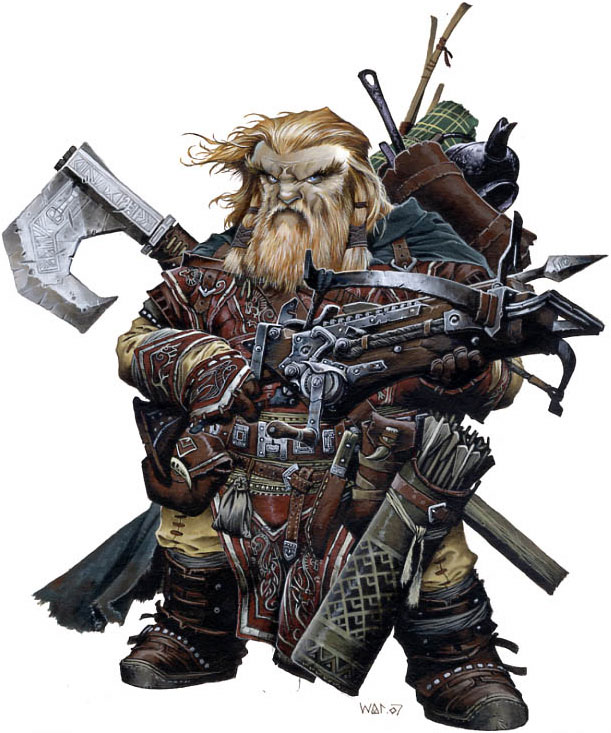
Finally, here’s a dwarven warrior created as one of Paizo’s “iconic characters” for their Pathfinder series. The first thing you’ll notice is all the gear the poor guy is loaded down with. What sort of moron, you might say, would burden themselves with that much junk before venturing into a dungeon… that is, until you looked down at your own favorite D&D character sheet.


Oh yeah. Pot, meet kettle. Big time. ;)


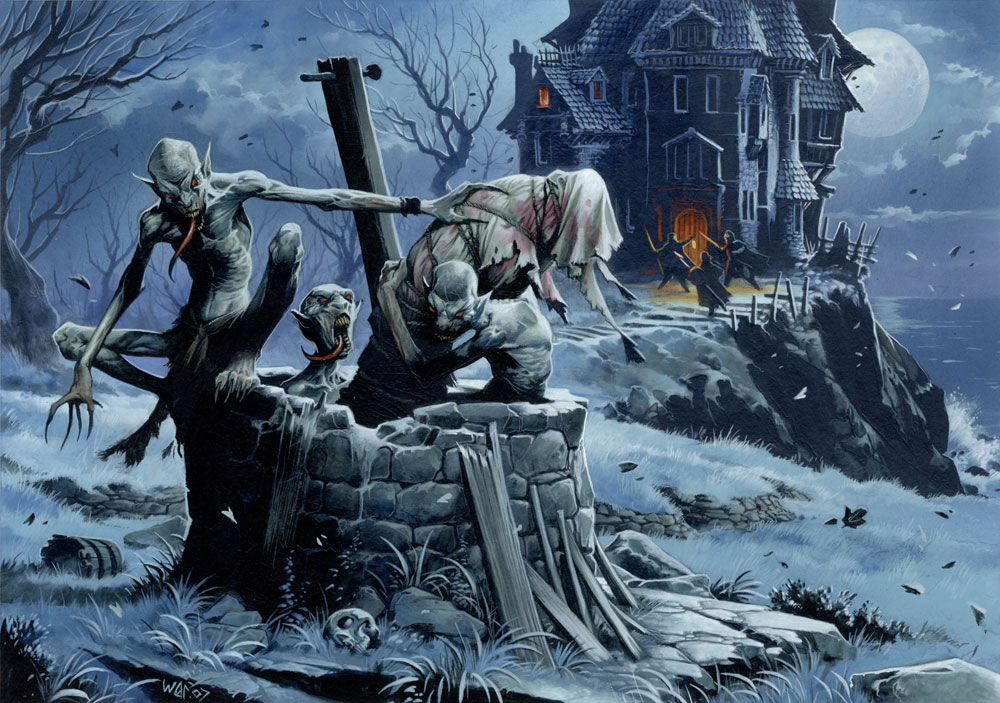
It’s an interesting stylistic choice. I’m not sure who should get the credit, whether it belongs to Mr. Reynolds, or Sarah Robinson, the art director at Paizo. It’s not the anime-esque ultra-cool of artists like Wen-M. It’s also not exactly the you-are-there realism of Elmore and Parkinson. Instead, Mr. Reynolds is illustrating our RPG adventures. Sometimes, they’re heroic. Sometimes, they’re creepy. Other times, they can be a little silly.

I can’t think of another artist who has better captured the feel of our games as much as Wayne Reynolds has. Whether it’s the heroes strapped down with a hundred-and-one little odds-and-ends, or the black humor of the gaming table, or the joy that comes with struggling against what seem to be titanic odds, Mr. Reynolds has, for me, captured those slices of gaming life better than any other artist. Where Larry Elmore’s art illustrated what we were striving for in our gaming, I think Wayne Reynolds shows us what our games are actually like.

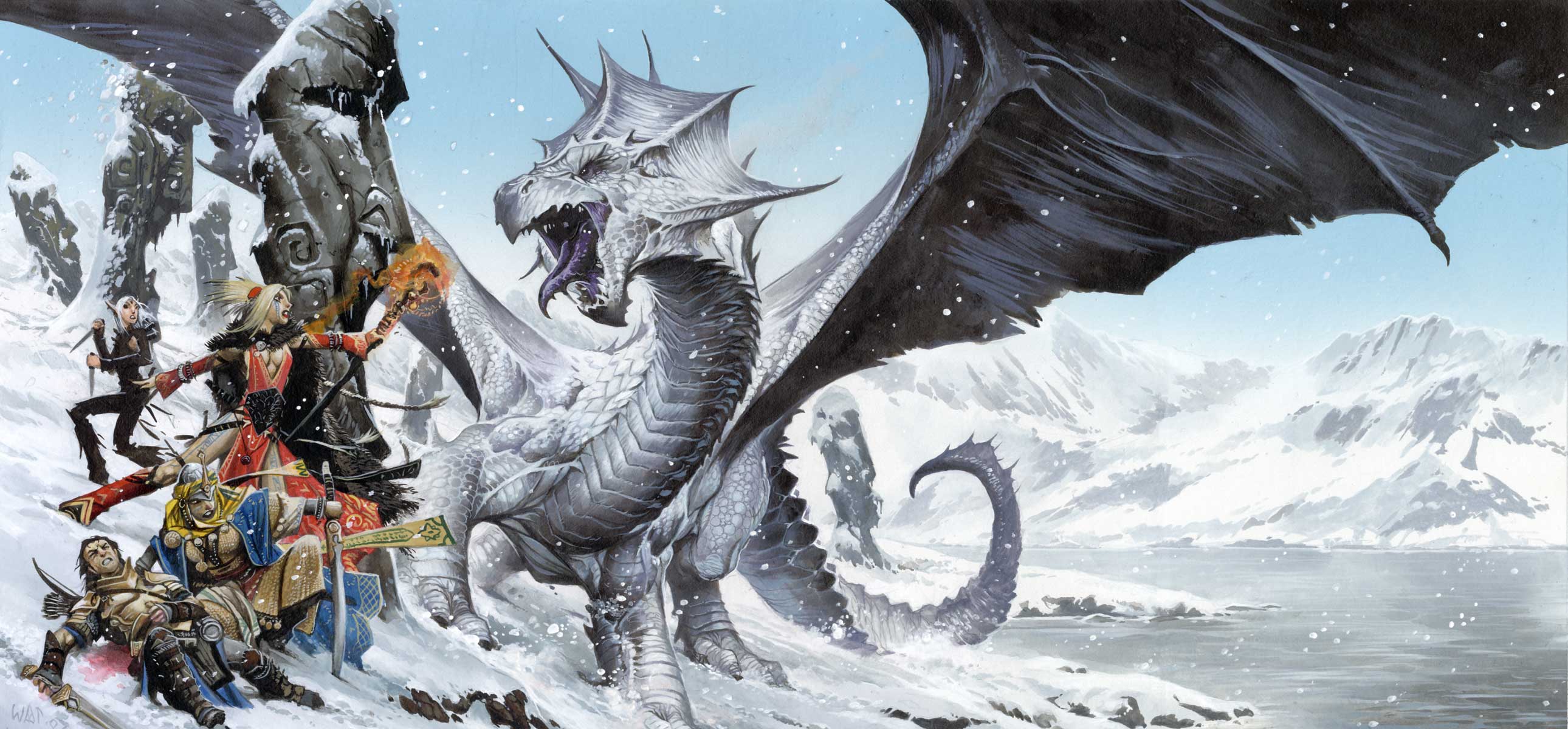
As such, it’s excusable when his anatomy seems a bit off, or the details seem a touch hazy around the edges. In his fantasy art, Mr. Reynolds appears less interested in capturing a world-that-never-was than in providing you, the viewer, with a visceral experience. Nothing exemplifies this better than his wall-of-action pieces. This is the stuff of childhood daydreams, where a hundred things are going on at once, gravity is a suggestion, and plausibility depends entirely on how much sugar you had in your breakfast cereal. This is what fans of D&D’s 3rd edition artwork mean when they say the new art is full of action and energy, where the art of older editions seems static, lifeless, and placid. Again, for these, Mr. Reynolds shifts his style, drawing on the techniques of comic book art. The silhouettes are iconic, the poses are full of action and momentum. We see not the moment of impact, but the follow-through afterwards that gives the impact its sense of energy. The weapons and armour are fantastical, without much thought given to such matters as how they could be crafted, or how they work. The focus is clearly on giving each figure a unique personality, expressed in that character’s choice of accouterments. Again, this stylistic choice reflects how we play D&D, with our focus on equipment as a way to empower and differentiate our characters from others of the same class and race.

I’m not one of those who thinks Mr. Reynolds can do no wrong. His cover for Green Ronin’s Black Company RPG is a mess, the sense of perspective so off that I can make myself feel a bit motion sick if I look at it too long. But I do get excited when I hear he’s got a new piece coming out. More than anything else, I find his art inspires me to think up new ideas for my gaming, whether it be unusual places to adventure, new foes to fight, or unusual challenges to overcome. Frankly, there’s no more important talent an RPG artist can have than that.

Thursday, March 27, 2008

Everything New is Old Again

So like everyone else, I've been inspired by the back-and-forth on D&D's 4th edition to poke at making my own fantasy heartbreaker. Part of my effort involved reworking combat. I was thinking about damage by class, while your choice in weapons dictated armour penetration. This was inspired by thoughts that I articulated recently over at RPG.net.

Anyway, checking Jeff's Gameblog today, I came across this:

"Why would you ever wield a two-handed sword if it was just as deadly as a dagger?" is the inevitable question. Any OD&D ref using the weapon-versus-armor chart and weapon speed rules in Chainmail can handily answer that question...


I knew that 1st edition AD&D had a weapon-versus-armour chart that nobody, not even Gygax, apparently, ever used. But I had no idea that was the default back as far as Chainmail.

I've been walking in a giant circle, so large I thought it was a straight line, that had been trod down decades ago. This, boys and girls, is why it's important to know what has come before.

Friday, March 21, 2008

Pramas on Pathfinder

Chris Pramas of Green Ronin Games, has this to say on the announcement of the Pathfinder RPG:

I'm sure that some fans will think this is a foolish move on Paizo's part. How do you fight against the 800 lb. gorilla after all? Here's the thing: they don't have to. If Paizo can peel off even 20,000 current D&D fans and make them Pathfinder fans, that's a great business for a company of Paizo's size. WotC is likely going to lose at least that number of fans anyway, so at the end of the day I doubt it'll really affect 4E. I can easily envision 4E and Pathfinder both being successful for their parent companies.


He also makes mention of this decision sending "shock waves... throughout the world of third-party publishing." That's the part that has me sitting on the edge of my seat. 3.x really isn't my game of choice. The bifurcation of D&D doesn't really affect me directly, but there will certainly be consequences for my gaming. The survival of professional 3rd edition publishing will be a chink in D&D's aura of invincibility, which it managed to regain with the publication of 3rd edition. It means more "mainstream" games on the market, each making its own little waves, trying new things, and keeping things fresh and exciting in our hobby. It also means Paizo will be unfettered to a greater extent, able to take more risks and explore new directions. They've already announced their foray into organized gaming with the Pathfinder RPG. What else will 2008 and the following years bring us?

UPDATE: Welcome, readers of Jeff's Gameblog! I've got more on the Pathfinder RPG announcement here. Thanks for the link, Jeff. :)

Thursday, March 20, 2008

Make Love, Not War - The 4.0 Way!

Have I been too hard on D&D 4.0? No, it's still chock full of annoying game-isms that I'd be happier off without. But Rodney Thompson has posted a nice, long discussion of non-combat mechanics in D&D that does put a smile on my face:

We showed off skill challenges in the Escape from Sembia event at D&DXP. Basically, it boiled down to this: the heroes needed to escape from some Sembian guards, prompting a chase sequence. The heroes then had the option of using a variety of skills to escape from the guards, and the encounter was built using the non-combat encounters guidelines in the DMG. Basically, the players could use any skill they liked, so long as they had a good explanation for it, and the encounter gave rules on adjudicating those checks based on the likelihood that the attempt would be feasible. For example, one player I read about used his History skill to remember an old sewer grate from some ancient plans of the city, where he was able to had. Obvious skill choices allowed players to hide, climb on top of buildings, disguise themselves as passers-by, etc. Now, before I get jumped on, yes, these are all things you could do before. However, unless a skill check was specifically called out in the adventure, most adventures leaned back on the hard-coded skill DCs and results in the skills chapter. The difference isn't that you can do these things in 4th Edition, but that the default assumption in 4th Edition is that players should and will find creative solutions to problems, and the rules are designed not only to allow the DM to fairly adjudicate those assumptions but also to reward players for doing so.


Nice, eh? Again, notice the excessive hand-holding, though newcomers to the game will, I'm certain, appreciate the effort. Anything that nudges the game away from the stereotype of "kill anything that moves and take its stuff" is a plus in my book.

I just wish they'd included something like this in 3.x. Combined with the lack of game-isms, it would have made D&D an excellent system for running the sorts of games I prefer. Instead, I had to wait for True20 to really get the sort of mechanical support I wanted from the d20 system. Still, better late than never, and the new generation of gamers are going to have this sort of RPing supported by the rules, rather than implied between the lines. WotC deserves a big thumbs up for this.

Wednesday, March 19, 2008

The 2008 Fantasy RPG Wars are ON!!!

The cute goblin “fire brigade” we linked to yesterday is no longer up at Paizo. It has instead been replaced with the boldest move you’ll likely see in the world of professional RPGs this year. Paizo has opted out of D&D 4.0 for their Pathfinder adventures series.

I may be making a bigger deal out of this than it warrants, but to me, this feels like a shift of seismic proportions. Paizo has long had a strong relationship with WotC. When WotC recalled Dragon and Dungeon magazines, Paizo sharpened their focus on their very successful “adventure paths,” linked adventures that create an entire campaign in the vein of the old Temple of Elemental Evil series from the first edition of AD&D. Paizo’s reliable and extremely high levels of quality in terms of writing, the use of rules, layout, and art, combined with their emphasis on adventures of a more polished and “adult” nature, created what appeared to be the perfect partner for WotC during the launch of D&D 4.0. WotC, with their name recognition, “social networking” and Web 2.0 initiatives, and marketing muscle, could have focused on creating a new generation of players, while Paizo focused on the 3.x “grognards”, luring them into the 4.0 fold with high-quality product aimed at a playstyle marked by lots of disposable income but almost no time to create the complex worlds older gamers desire.

But now that’s clearly not to be, and WotC has nobody but themselves to blame. Seriously, by now, we should be hearing how the Paizo and WotC staffers are playtesting their products together to ensure a seamless launch of a new generation of Pathfinder adventures, tailored to maximize the benefits of the new 4.0 rules set. We should be hearing how WotC is considering adding Pathfinder-focused options and tile sets for D&D Insider. Instead, in spite of the new edition having been announced to the public in August, the details of the new Game System License, that would allow third-party companies to produce adventures and rules compatible with the new edition of D&D, still have not been released. In order to learn anything about the new rules, Paizo employees had to attend the D&D Experience convention last month. In short, their first good look at the game system was the public unveiling. And in spite of that, they still haven’t seen the GSL, and still haven’t been offered a chance to really dig into the new rules to see how they work.

Considering Paizo’s business model, did they really have any other choice? Unable to even see the rules in time to create a Pathfinder series anytime near the launch of 4.0, or possibly even within the first half of 2009, Paizo was going to be stuck riding the 3.x horse after the launch of 4.0 regardless. Making lemonade out of these lemons by creating their own version of D&D 3.75, called the Pathfinder RPG, is only the logical next step.

I’m going to take a moment to tell you what I’m not saying in this post: I am not saying that Paizo’s Pathfinder RPG is a potential D&D killer, or even a D&D 4.0 killer. The only folks with the clout and power in the RPG market to deal D&D a mortal blow are WotC themselves. Unfortunately, that statement is not as facetious as it might seem. They’re eagerness to part with certain tropes of traditional D&D, both cosmetic and mechanical, has alienated a certain segment of their players. This has only been exacerbated by clumsy (some have even gone so far as to call it insulting) marketing. Changing the OGL to the GSL last month, a full half-year after they’d announced that 4.0 was in the works, coupled with their inability to actually produce a written license agreement that people could sign on to after declaring they’d charge “early adopters” $5,000 for the privilege, indicates that WotC is still uncertain what, exactly, they want their new license agreement to do. The digital versions of Dragon and Dungeon have failed to live up even to the standards of their print versions, forget the potential of the online medium. They are certainly not the best sources of information on the upcoming 4th edition: ENWorld retains that crown, largely unchallenged. Even worse, without Dragon and Dungeon magazine in newsstands and book stores, any D&D players who don’t frequent gaming web pages might not even be aware yet that a new edition is coming out later this year!

In short, everything seems to point towards hesitation, uncertainty, and confusion over at WotC. We don’t see a company forging ahead into the future, creating a new and exciting gaming experience for its customers. Instead, we see strong dead-tree periodicals replaced by anemic web pages, marketing derided as clumsy and sometimes even insulting, and a lack of action that has already transformed one potentially strong partner into a full-on competitor.


WotC can, of course, still turn things around. As the books go to print, I fully expect more resources to be devoted to D&D Insider, and there’s no reason why it couldn’t come to outshine both Dungeon and Dragon magazines. D&D remains the three-hundred-pound gorilla in the market. A sturdy, fun game could wipe away any lingering bad feelings between fans and WotC, and render the assistance of third-party publishers largely redundant. The promise of a streamlined gaming experience and flexible, powerful online tools has the potential to bring back lots of folks who have felt they couldn’t be involved in RPGs anymore, while a new edition is the perfect time to bring in a whole new generation of players.

Time will tell if WotC is up to both the challenges and the opportunities that 2008 offers.

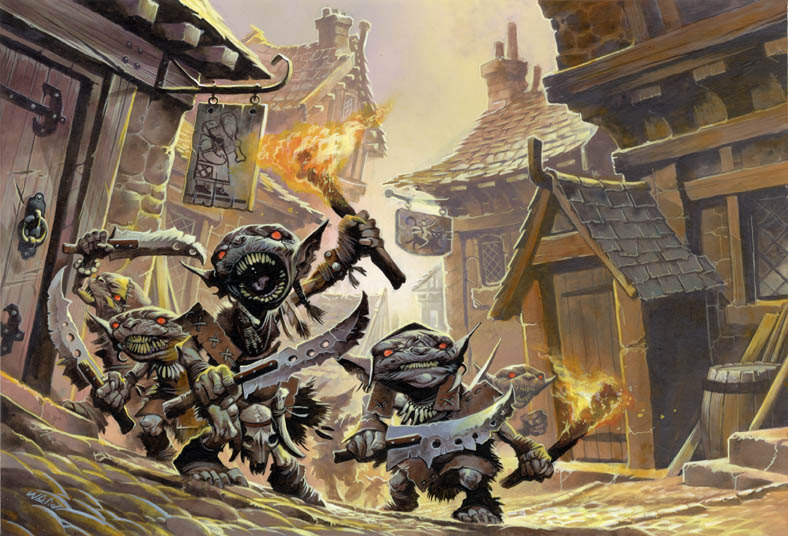
In the meantime, there’s a lot of reason to be bullish about Paizo and what they are up to. They’ve already released the first document of their “alpha” version of the Pathfinder RPG. As to be expected, it’s a lovely document, expertly laid out, easy to read, and fun. (Putting Wayne Reynolds’ cute rampaging goblins at the top of the chapter describing how the playtesting would be done was a stroke of genius.) They’re encouraging their players to get involved now, which means by the time 4.0 is finally released, players will already have three months of Pathfinder under their belts. Their completely open playtesting process also allows them to leverage one of Paizo’s core strengths - their loyal and knowledgeable fan base - and stands in marked contrast to the tight-lipped behavior of WotC. With Wayne Reynolds also doing their cover art, Paizo’s books will look at least as good as WotC’s. Working with an existing framework of rules, and inviting an Army of David’s to playtest for them, Paizo is also less likely to publish a broken or unpolished game. And with their partnership with Necromancer Games, Paizo keeps one foot in the new edition. After all, if 4.0 does turn out to be a supremely popular and superior game, they can always convert Pathfinder over in 2010.

RPG.net already has a quick review of the first release of the Pathfinder RPG’s alpha-test rules. So far, things look promising.

Tuesday, March 18, 2008

Strangeness at Paizo

So if you try to hit anything on the Paizo web page today, you get this.

Does it mean anything, beyond maybe a server crash or reset? I doubt it, but who knows?

Wednesday, March 12, 2008

The Pros and Cons of IRC-style Gaming

IRC stands for Internet Relay Chat, and for quite some time was the way to communicate with your friends on the net. It's a live-chat bulletin-board type system, where what everyone types shows up immediately on the screen for all to read. The possibilities for RPGs should be obvious.

Over at the Fear the Boot forums, Yaotl was curious how well this sort of thing works. Blindeye's response is worth posting in its entirety:

OpenRPG you say? I've used miRC for 10 years to roleplay. But here's the pros and cons to chatroom roleplaying:

Pro: Each line of description and dialogue will be more well thought out.

Con: Everything takes twice as long to do thanks to non-instantaneous internet transferring and the time it takes to type a message rather than speak it. Also... Typos.

Pro: Dice programming mean rolling goes really quickly

Con: Not being able to see your group's sheets, or having to keep track of them yourself can be confusing.

Pro: OOC can take place in a separate chat room entirely, clearly separating IC and OOC and keeping things more immersive.

Con: Real Life can disrupt it more easily, as can computer error. "brbs" and "afks" come in, random disconnects can be frustrating, and all sorts of things that you don't have at the physical table.

Pro: You don't need to worry about having people close by, all they need is a computer.

Con: Game attendance seems a little less for certain. You're just crossing your fingers that everyone shows up.

Pro: You can log the entire sessions really easily, and review it later, or be able to go back and check things from previous sessions.

Con: Descriptions can be harder to get across, it's not as easy to quickly doodle what a room looks like, or use your hands to illustrate things. There are ways around this, but it requires file sharing, and a bit more legwork. No Grids to run off of, no miniatures or anything. It all needs to be communicated through text.


I think that's all I'll get into. I don't know what OpenRPG is capable of... I'll have to look it up. this is all based on mIRC alone.


OpenRPG is a great little program that has built-in dice rollers and white-board/table-top-style miniatures support. And it's free, so you really can't beat that.

For myself, I prefer some of the more common IRC programs, and find many of the bells and whistles of OpenRPG to be distracting. But that's just me.

And if typing isn't for you, there's always Skype, which allows you to talk over the internet, without the fees of long-distance phone calls and all of that. Why Skype isn't replacing most people's land-lines for long-distance telephone communication is beyond me.

In any event, distance is no longer an issue when it comes to getting the old group together for a few hours of RPG fun.

Casanova, His Times, and Your Game

Balbinus posted this at RPG.net back on '03. The thread has recently been subject to a bit of necromancy. Still, I think his original post is worth quoting, in total:

I'm presently reading The Story of my Life by Giacomo Casanova.

For those in the back row, Casanova was an Eighteenth century Venetian who was famous for his romantic exploits, thus giving rise to the term casanova.

Anyway, the book is tremendously well written. Extremely witty and erudite. It's also in places very surprising.

Sex per se forms a relatively small part of the book, despite what people might imagine. But social attitudes of the time are well depicted, if sometimes unconsciously. Some of those attitudes relate to sex in ways which are unexpected (this is heading to a gaming point, don't worry).

Casanova speaks on a couple of occasions about homosexuality, usually in the context of an anecdote where some guy has made a pass at him or he is mentioning that someone is gay. Casanova's view seems to be that homosexuality is not a moral issue, that is to say he sees nothing wrong with it. Indeed, he explicitly condemns the practices of countries which make it illegal or which pour scorn upon homosexuals. He sees such bigotry as essentially barbaric.

The only time Casanova has an issue with someone being gay is when a guy hits on him repeatedly and won't take no for an answer. He isn't bothered by the suggestion he might indulge, he knows his tastes don't run that way, he is rather bothered by the fact he is being pestered by someone he perceives as behaving rudely in not accepting defeat gracefully.

If he were fictional a modern reader would imagine that contemporary PC attitudes were being put onto the character. But this is a memoir written by Casanova himself. The surprising fact then is that an Eighteenth century rake was in fact more tolerant of homosexuality than most people today. Not what most would expect I think.

In another part of the book Casanova sleeps with two sisters on consecutive nights. One aged 11 and the other 12. Casanova is plainly no paedophile, he simply draws no great distinction between a girl of 11 and one of 21. Nor does anyone else in the book draw much distinction, including the girl's mother who knows about the affair. Casanova expresses surprise that a girl that young is interested, but once he knows she is there is no issue that she might be too young. The idea seems literally alien, it simply doesn't even arise.

Now, back then of course modern notions of childhood and adolescence simply didn't exist. You were either a child or an adult and as far as Casanova and everyone else was concerned if she was old enough to be interested she was clearly an adult for those purposes.

This is to modern sensibilities incredibly alien. An 11 year old today is seen as clearly being a child. That someone would make no distinction between her and a 21 or 31 year old makes no sense to the modern mind. He would in fact be arrested.

What struck me with this was quite how different his culture was, even in very basic things. There is no concept of the adolescent, most people know that but the practical implications of that fact are rarely so explicitly set out. In some things he is more modern than we are, in others he behaves in ways most people today view as not just morally repugnant but possibly even as a form of mental illness.

This is just 200 years ago and we're dealing with a Westerner.

Most games essentially have cultures which are America Lite, perhaps The West Lite if you prefer. There are cosmetic changes, people are loyal to a king instead of democracy, to many gods rather than just one, but fundamental moral assumptions of the modern day tend to still hold good. You don't sleep with 12 year olds in a fantasy game and homosexuality is rarely if ever mentioned.

Some try to depart from this. But generally most don't even bother.

Which leads to the issue of what we miss out by not even trying to put ourselves in another culture's heads. Heroic Greek rpgs rarely address the topic of Greek homosexuality. Western games usually try not to include racial attitudes of the day (often by the simple expedient of basically dropping all black people from the game). But these cultures aren't a huge stretch. I've summarised major differences in Casanova's attitudes from contemporary ones in one internet post, it's not impossible to put yourself in his head.

My impression is that most gamers like only cosmetic differences, elves aren't really alien, they're just Americans with pointy ears. But surely one of the great possibilities of roleplaying is exploring what it would be like to live in another time, another place. What's the point if when we go there everyone is just like us?

The short answer is, of course, that players can really only handle so much change from what they know. You can build on that slowly, but even then, you're going to lose some people. Even in the best group I ever played with, my college group, some of the players just couldn't get it through their heads that elves were polygamists who considered most of the human customs of marriage bizarre and deviant. The further you deviate from standard, the harder you have to work to reinforce these alterations in your setting, and the more frequently you must remind your players of them.

Still, I always push as far as I feel I can safely go, and then a tiny bit further. It makes my games memorable, and adds a hint of the fantastic to the worlds we play in.

Friday, March 07, 2008

Free Inversion

Catherine Asaro's Primary Inversion is the latest offering over at the Baen Free Library.

Wednesday, March 05, 2008

A Ronin Reviews D&D 4.0

Via the Velvet Dicebag comes word that Chris Pramas of Green Ronin, the classiest guys in RPGs, has posted his thoughts on D&D 4.0. He has a lot to say, and most of it is thought-provoking. Just to prove it, here are some actual thoughts:

I really felt that 3.5 was just more complicated than it needed to be and I hoped that 4E would simplify things. While it does fix many of the ongoing issues with 3.5, my feeling after today's session is that it's just complicated in a different way. It's not something I think experienced gamers will have a huge amount of trouble with, but it does seem that 4E may be even more unfriendly to new players than 3.5 was. It looks like 4E requires newbs to make too many choices and track too many things to make it truly accessible. Since D&D has always been the entry point for most RPG players, this is my most serious concern.

This is pretty serious stuff. I’ve heard that WotC is planning a beginner’s boxed set. Hopefully, they’ll be able to simplify things enough that new folks don’t have too many issues. Moldvay’s Basic was complex enough for me way back in 2nd grade. That should be the level of complexity they shoot for.

And since the rules seem to have been tailored to provide a very particular experience, I don't think they will make as good of a base for the variety of campaign settings D&D used to see. It's pretty clear that WotC realizes this, which explains why they felt the need to advance the timeline and have an apocalyptic event in the Forgotten Realms. I don't think many of the old campaign settings will transition over without a lot of cutting, spindling, and mutilating.

I’m very curious what he means by this. So far, I haven’t seen anything that would make 4.0 a bad fit for Forgotten Realms, Greyhawk, or even Spelljammer. If you ignore the fluff, you ought to be able to make it fit even Planescape fairly well. But he’s played the game and I haven’t, so maybe he knows something I don’t. And if he does, what does that mean for Paizo and Pathfinder?

What I think WotC is going for here is what Marvel managed to pull off with their Ultimate line of comics: take the core of the IP and redefine it for a new generation. There will certainly be some longtime fans disenfranchised by this move, but I don't think there will be enough of those folks to hurt 4E. (I do think, however, that there will be enough of those for a third party company to carve out a good business for itself catering to them, but that's a topic for another day.)

Heh… Remember, this is the guy who has True20 in his stable, and the soon-to-be-released A Song of Ice and Fire RPG. So it’s not like he doesn’t have a dog in this fight.

That said, I think he’s right. I also think Green Ronin, with its stable of literature-based games and experience converting the settings of novels into settings for RPGs, is well-positioned to lay a claim to the fantasy storytelling terrain that WotC appears to be abandoning. Whether they achieve that through promoting True20 or the system they create for ASoIaF, they’ve got a good head-start on everyone else in the industry. And with the roadblocks that WotC has cast in the way of 3rd party developers so far, Green Ronin might very well find themselves forced to pursue such goals, simply from being shut out of doing anything for D&D 4.0 over the next year.

Viewed from this perspective, WotC’s marketing campaign appears hell-bent on shooting their corporation in both feet. First, by dragging their feet in getting the licensing info out to third-party publishers, they’re almost forcing those companies to compete with the release of 4.0, either by putting out new product that is unrelated to D&D, or, even worse, by continuing to support the older editions. Second, by insisting that older versions of D&D are not fun, they seem determined to drive a wedge between the players who adopt 4.0 and those who stick with older editions.

UPDATE: Mr. Pramas has continued to play with 4e. His after action report here, and my brief take on it here.

Tuesday, March 04, 2008

Gary Gygax, 1938-2008

I'm searching, in vain, right now, to find a quote that fits this moment. I can't find one, really, probably because I never knew the man, never brushed shoulders with him at a crowded convention, or even wrote to him. I can't, of course, deny the impact he's had on my life. Before the Trollwife became the Trollwife, and we were dating over a distance of 300 miles, it was D&D, played over AOL or IRC, that kept us close. This game, and its many imitators, have always been there for us. When times were tough, when sanity hung by a thread and money was tight, we could always turn to our imaginary worlds for comfort, for wisdom, for inspiration, and perspective. Even before I met the woman who would become my wife, friendships were forged in both victory and defeat around dining room tables, or around the campfire.

So while I can't speak of the man, I can let his own words say what his work has meant to me: Enjoy, for this game is what dreams are made of!!

Godspeed, Mr. Gygax.

UPDATE: More here, but be patient. A lot of people are hitting it today.