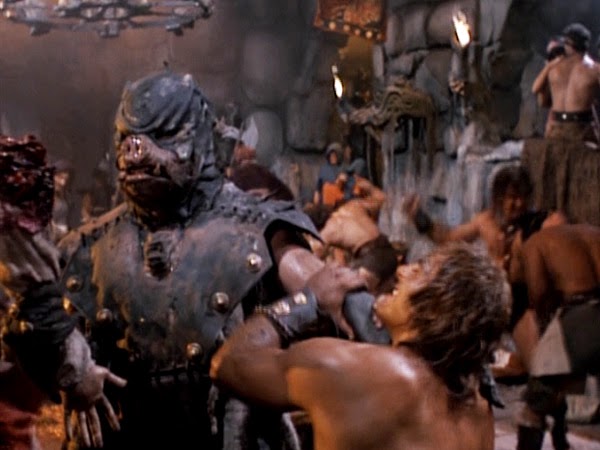
The succubus of 1e AD&D is the stuff of jokes because of the picture. Still, she was a classic femme fatale, able to lure the innocent to their doom with a come-hither gaze, copious charm spells, and a deadly kiss. She suffered from being rather fragile in a toe-to-toe fight (unless she could summon in some help), was yet another good reason for PCs to be constantly paranoid, and, honestly, was eclipsed by the more flexible and dangerous lamia.
When WotC took over,the succubus’ repertoire got broadened. She became the ultimate spy, an expert in such skills as bluffing, intimidation, impersonation, and investigation. Toss in her magical powers and she could become the true power behind the throne, a sort of Grima Wormtongue with more sex appeal.
So, what did WotC do with the succubus in 5e?
Frankly, I’m not sure.
Oh, I have the MM. She (and the incubus) are on pages 284 and 285. The flavor text talks about the succubus infiltrating the dreams of a chosen victim in order to weaken their moral resolve. That might be a fun thing to play, or a neat little side-plot to a more developed adventure (“Why is Brother Anselm always looking so tired these days? And why is he so cranky?”). It’s not, however, the sort of thing D&D adventures are typically made of. Nor is her sleep-invading power defined in any way, so exactly how you thwart it is really up to the DM.
She’s got great Deception and Persuasion skill bonuses (+9) and a good Insight bonus (+5) to back them up. But while those skills are exceptional, they’re hardly supernatural. She can still shift her form. But she’s lost all her magical abilities like suggestion except for her charm power.
Which can only be used on a single person at a time.
And only lasts 24 hours at most.
And then, when it ends, can’t be used again on the same individual for another 24 hours.
A harem of inc/succubi could be a really annoying additional obstacle in a fight; you're here to kill the Grand Warlock, but while you're attempting to put the hurt on him, his whatever-cubi buddies are hanging out in the ethereal, tossing charms and popping into the material world just long enough to drop 5d10+5 points of slobbery kootie damage on someone. But, frankly, is that cooler than a wand of lightning bolts, a flock of pet harpies, or a pair of amorous red slaadi?
To put it bluntly, I’m a bit at a loss as to what I’m supposed to do with this critter. She’d probably be most effective popping in, charming some NPC, then going ethereal while she interrogates her new best friend via her telepathic bond that can bridge planes. Useful, sure, but it would seem you could replace the monster with a nifty spell or two. Like scrying.
Scrying is one of the powers the lamia has, in addition to suggestion. She can also toss geas once per day. Her intoxicating touch, while nowhere near as potent as the old Wisdom-draining one, is a lot more fun and useful than the succubus’ boring kiss (which does nothing but deal damage and can only be used on someone she’s charmed, and even then gives the target another saving throw to break out of the charm).
The only thing that the succubus has over the lamia is the ability to go ethereal. It’s a neat trick that will allow the succubus to escape certain death most of the time (until the PCs get a way to thwart it). Whether that allows for a cool repeating villain or creates an annoying and not-fun headache for the players will depend on careful play by the DM.
As for me, right now I’m tempted to replace every inc/succubus with a lamia. They’re both rated at Challenge 4, the lamia has more neat tricks in her bag, and she’s much more likely to come across as challenging rather than annoying.
Wednesday, February 25, 2015
Monday, February 23, 2015
You're Not Wearing That Tonight, Are You?
Or, 10 Random Facts About Kyma.
Kiel Chenier suggested we share ten “random” facts about our campaigns that make them unique. The campaign that I’m getting the most play in now is my face-to-face 5e game. It’s a (mostly) urban game, taking place in a metropolis that’s heavily inspired by ancient Babylon, medieval Constantinople, and fantasy cities like Sanctuary. The urban random encounter tables I’ve been posting were made for this game.
This was my first attempt at running a 5e game, so a lot of things are fairly bog-standard. I didn’t create any special classes or races, and I made room for all the things that were in the PHB.
However, that still left a lot of space for me to put my own spin on things. Here are ten examples of that:
Kiel Chenier suggested we share ten “random” facts about our campaigns that make them unique. The campaign that I’m getting the most play in now is my face-to-face 5e game. It’s a (mostly) urban game, taking place in a metropolis that’s heavily inspired by ancient Babylon, medieval Constantinople, and fantasy cities like Sanctuary. The urban random encounter tables I’ve been posting were made for this game.
This was my first attempt at running a 5e game, so a lot of things are fairly bog-standard. I didn’t create any special classes or races, and I made room for all the things that were in the PHB.
However, that still left a lot of space for me to put my own spin on things. Here are ten examples of that:
- Orcish Manhood: when a male orc reaches a certain age, he is tried by his clan, found guilty of being a feral beast, and banished. He must then prove his worth to another clan before he’s allowed to join it and fully be accepted as an adult orc. Typically, it’s the females of the tribe who’ve successfully raised sons to the point where they’ve been banished whose approval must be won. Kyma is thus home to a steady population of young orcs looking to win gold, fame, and steel in the city by whatever means necessary. They often end up fighting in the colosseum, acting as thugs to those with money, or forming fraternal gangs in the city’s expansive sewers and catacombs. If orcish females are about, one or more of these “juvenile” males won’t be far away, looking for an opportunity to prove his mettle.
- Warlocks: most citizens of Kyma believe that warlockery is illegal. Technically, this isn’t true. What is illegal is fraternizing and dealing with demons, devils, and other inhabitants of the “Lower Planes.” Those whose powers derive from an Archfey are not in violation of the law. Technically, neither are those who’ve turned to the alien Great Old Ones. However, since most folks can’t really tell the difference between a demon and a Great Old One, the distinction rarely saves a warlock from being burned at the stake. However, the warlocks can easily tell, and those who serve Fiends and those who serve Outsiders revile each other. Violence is common when they can get away with it while not drawing too much attention to themselves.
- Paladins: in 5e, these come in three flavors. On the streets of Kyma, they come in four flavors. Those who take the Oath of the Ancients serve the Fey Powers. They tend to be hedonists with hearts of gold, and if you think Fandral or Volstagg from The Warriors Three, you won’t be far wrong.
- Most paladins who take the Oath of Devotion join the priesthood of Xithras the Defender. When not slaying monsters and routing the undead, they turn themselves to rooting out the warping powers of Transmutation magic. Feeling that the “natural” forms of creatures is sacred, anything that threatens that purity is anathema, even the use of potions fashioned from minotaur milk to enhance fertility. As an organization, they are distrustful of tieflings, seeing them as living examples of the horrors that await anyone who starts down the slippery slope of magical enhancement.
- The Hasheeshins of Skotas the Hidden take the Oath of Vengeance. They seek to pierce the veils of lies and illusions people cloak themselves in via the use of powerful hallucinogens. The line between dream and reality is of vital interest to Hasheeshins, and thus they have a harder time of perceiving it than most. However, where others assume, the Hasheeshin looks deeply, and is more likely to root out hidden truths.
- The paladins of Phaedre, goddess of War and Love, are all women (though not all were born that way). They can swear the oaths of Devotion or Vengeance. All sorts of rumors swirl around their mysterious rituals and practices: that they are cannibals, that they will remain forever young so long as they bathe in the blood of their goddess’ enemies, that any man who slays one of these Warriors of the Red Dawn will sire a daughter who will be his death. Phaedre’s paladins do little to discourage the rumors.
- Calendar: Kyma exists in a sub-tropical zone with monsoon-dominated weather patterns. The calendar I used is a modified version of this one.
- Elves: have words, rituals, and patterns to accommodate a large array of what humans would call romantic relationships, from one-night-stands to lifebonds (until death do them part) and even soulbonds (which persist through this life and into the next). What humans would more easily recognize as marriage does exist, but is usually contracted for a period of years divisible by seven. Tradition favors seven, 49, and 210 years. This is the most common arrangement for the raising of children. The most famous such relationship was between Kyma’s great sultan Zafir and the elven princess Kosmyna. It was a time of strong unity between the humans and the elves. Unfortunately, Zafir was slain during a campaign against the tiefling Sea Princes. When word of his death reached Kyma, the harem exploded in a frenzy of bloodletting and murder. Kosmyna was among the first to die. Kosmyna’s homeland, the coastal city-state Galazos, declared war against Kyma. In spite of gifts and abject apologies from a number of sultans over the decades, Kyma's ships still keep a sharp eye out for vengeful elven corsairs. After all, a marriage that took place 88 years ago may seem like ancient history to most humans, but is within the living memory of all adult elves.
- Fashion Tips for Men: Pants, and pretty much any bifurcated garment, are seen as barbaric in Kyma. A man in trousers is making a statement, being publicly humiliated, or doesn’t know any better.
- Yuppie Street Violence: dominated by middle-class artisans, the Terraces are a bustle of noise and industry during the day and a bustle of noise and revelry (mostly by the artisans’ apprentices) in the night. The streets are mostly clear of crime and gangs from the other parts of the city because the apprentices are quick to defend what they consider their turf (unless they’re busy in guild-vs-guild shenanigans and rumbles). Most of the ruckus dies down by midnight, when the apprentices have either settled into their favorite taverns (the Terraces sport a wide range of them) or moved on to the Night Blooms to spend what coin they’ve managed to scrounge up.
Monday, February 02, 2015
Brandon Liao
Just added a new artist to my art links on the right: Brandon Liao.
His work has a very Numenera-ish feel to me, a sort of '70s-80s-era Saturday-Morning-Cartoons-grown-up feel I find pleasantly inspiring.
You can also see his stuff over at Deviant Art under madspartan013.
His work has a very Numenera-ish feel to me, a sort of '70s-80s-era Saturday-Morning-Cartoons-grown-up feel I find pleasantly inspiring.
You can also see his stuff over at Deviant Art under madspartan013.
Thursday, January 22, 2015
Turning "What did we get?" Into "Here's What You Know."
Angry’s got a pretty good rant (or, rather, how-to) on exposition. Suffice it to say, your best world-showing probably happens in the game, rather than before (though I never fail to sneak in a little via character creation, and D&D 5’s backgrounds are a great opportunity for more of that).
There are some related thoughts on ars ludi about using treasure as a method for providing exposition:
Couple this with the Three Clue Rule and you shouldn’t have much trouble filling out your treasures with interesting stuff. The treasure doesn’t just include a map to the ancient elven forge, but an elven silvered dagger worn by the scholar the map was stolen from bearing his family crest on the pommel, and an ornamental lapis-and-gold bowl engraved with runes commemorating a deal between the forge and a dwarven nation which agreed to supply the forge with mithril in exchange for an even weight of brandy.
Which answers the question Zak brought up when I was trying to find where I’d read the ars ludi quote above:
I’ll admit the Gygaxian Naturalist in me knows exactly why the hobgoblins have a chest full of uncut rubies, but, as Zak points out, it’s really all the same to the players. (Most of the time. My college group was big on the types of gems they were getting and using them in jewelry they designed and commissioned for themselves. But they were an exceptional bunch in many ways.)
With treasure-as-exposition, you get to eat your cake and have it too. Just be sure the exposition gives them something actionable. That is, it’s not just, “Hearken ye back to the days of yore…” and is more, “Hey, I’ll bet these elves could tell us something about the lost forge,” or “Wait a minute… these are all tools for hunting vampires. Do you think these guys knew something we don’t?”
There are some related thoughts on ars ludi about using treasure as a method for providing exposition:
There are lots of times during a game when players are half-listening, or thinking about other things, or maybe just wandering into the kitchen to get a soda. But in the magical post-combat pre-treasure window, everyone’s attention is high, their curiosity is piqued, and they are clamoring to hear what you will say next.
Couple this with the Three Clue Rule and you shouldn’t have much trouble filling out your treasures with interesting stuff. The treasure doesn’t just include a map to the ancient elven forge, but an elven silvered dagger worn by the scholar the map was stolen from bearing his family crest on the pommel, and an ornamental lapis-and-gold bowl engraved with runes commemorating a deal between the forge and a dwarven nation which agreed to supply the forge with mithril in exchange for an even weight of brandy.
Which answers the question Zak brought up when I was trying to find where I’d read the ars ludi quote above:
I just go "…aaaaaad 5200gp worth of random fancy junk". The thing I hate is when it's like "…and 37 copper and 2 tourmalines worht 6000 each and…" like: why are we doing math for no reason and hearing random jewel names?
I’ll admit the Gygaxian Naturalist in me knows exactly why the hobgoblins have a chest full of uncut rubies, but, as Zak points out, it’s really all the same to the players. (Most of the time. My college group was big on the types of gems they were getting and using them in jewelry they designed and commissioned for themselves. But they were an exceptional bunch in many ways.)
With treasure-as-exposition, you get to eat your cake and have it too. Just be sure the exposition gives them something actionable. That is, it’s not just, “Hearken ye back to the days of yore…” and is more, “Hey, I’ll bet these elves could tell us something about the lost forge,” or “Wait a minute… these are all tools for hunting vampires. Do you think these guys knew something we don’t?”
Friday, January 16, 2015
"There's Gonna be a Rumble..."
Mr. Robertson has been contemplating urban adventures lately after flipping through the 1e DMG’s urban random encounters table (you know, the one with the wanderling harlot subtable). As per usual with 1e random tables, there’s no effort spared on encounter balance. Just as in the wilderness where 3rd level PCs could encounter ancient dragons, so too could that wandering harlot be a succubus and that old man could be a high-level wizard. So Mr. Robertson asks:
Well, as long-time readers of this blog know, I’m more than happy to let my players bite off far more than they can chew anytime they feel like it. That said, my current 5e campaign is almost exclusively urban (we’ve been playing since September and I think they’ll have their first real dungeon-delve of the campaign in our next session or the one after). So I do have some recent observations to throw into the ring.
In general, I've found players avoid violence inside cities. The social repercussions are seen as too daunting. Sure, you can kick around that one-legged beggar, but if he's a member of the Beggars Guild, that means facing enforcers from the guild later, large men without necks and a pinch or two of ogre in their background and absolutely no senses of humor.
And this pretty much holds for the entire city: the pencil-necked alchemist could hire an expert duelist to call you out, the sailor just off the boat has his crew backing him up and the urchins travel in packs.
So violence, when it happens, tends to be very focused, very quick, and the PCs have to be all but pushed into it. (Of course, since we're playing 5e, that also means I've had to chunk the EXPs-for-murder mechanic the game is built around).
Now, I did front-load this by tying local knowledge into character creation, using their chosen backgrounds as opportunities to speak of the dangers of the Beggars Guild, the political alliances of the city, and tying the PCs into their own alliances (that are too useful to threaten by acting like jerks).
Another consideration going the other way, however, is the openeness of the urban environment. If they players haven't wandered into a well-planned ambush, they can almost certainly flee in multiple directions. So if they do get in over their heads, they can generally beat a hasty retreat, regroup and figure out who they need to pay off to make this problem go away.
Mr. Robertson adds:
In this case, the NPCs are begging for a fight. If the PCs take the bait (the wood elf barbarian and feral, raised-by-wolves half-elf ranger in my current group absolutely would), what then?
Well, assuming they’re badly outgunned, they’re unlikely to suffer a TPK in a single assault. Even 10th level fighters can rarely do more than 20 points of a damage to a single individual in a single attack, and that’s only if they roll critical. (I think. Important caveat here: I've only played so much 5e and barbarian rage can be pretty scary.) So it’s unlikely even one PC will be KOed after the first round of combat. Even a wizard with no Constitution bonuses or defensive spells up has 14 hit points by 3rd level, and the party’s fighters will have 22 without Constitution bonuses. So they’ll get a single round of fighting at the very least where I can make clear to them the skill of their foes when describing the wounds they take. A smart party would hopefully see what’s happening and take the opportunity to flee, regroup, and plot revenge.
And if they don’t? Well, as Mr. Roberts points out, “The 5e rule where they could elect to make their attacks non-lethal might be helpful as well.” Why did the rakes start the fight? Maybe they just roll the PCs, lifting all their loose coinage and jewelry and leaving them for others (local clerics or the like) to rescue. Were they just trying to make a point to a patron or organization friendly to the PCs? Or do they drag them off for ransom? Sell them to the Temple of Shkeen? With a TPKO, the adventure’s just begun.
While the idea of letting players run into this range of adversaries is appealing to me, I wonder if other people have had success with this? How did you make players aware of the risk involved in the average man they meet with a sword when they could be a 0-level person, or 10th level fighter? If they are not dressed like a Lord, do not have obvious magic items, and are hanging around in a common sort of place do you give any hints to ensure the players don't unwittingly bite off more than they can chew?
Well, as long-time readers of this blog know, I’m more than happy to let my players bite off far more than they can chew anytime they feel like it. That said, my current 5e campaign is almost exclusively urban (we’ve been playing since September and I think they’ll have their first real dungeon-delve of the campaign in our next session or the one after). So I do have some recent observations to throw into the ring.
In general, I've found players avoid violence inside cities. The social repercussions are seen as too daunting. Sure, you can kick around that one-legged beggar, but if he's a member of the Beggars Guild, that means facing enforcers from the guild later, large men without necks and a pinch or two of ogre in their background and absolutely no senses of humor.
And this pretty much holds for the entire city: the pencil-necked alchemist could hire an expert duelist to call you out, the sailor just off the boat has his crew backing him up and the urchins travel in packs.
So violence, when it happens, tends to be very focused, very quick, and the PCs have to be all but pushed into it. (Of course, since we're playing 5e, that also means I've had to chunk the EXPs-for-murder mechanic the game is built around).
Now, I did front-load this by tying local knowledge into character creation, using their chosen backgrounds as opportunities to speak of the dangers of the Beggars Guild, the political alliances of the city, and tying the PCs into their own alliances (that are too useful to threaten by acting like jerks).
Another consideration going the other way, however, is the openeness of the urban environment. If they players haven't wandered into a well-planned ambush, they can almost certainly flee in multiple directions. So if they do get in over their heads, they can generally beat a hasty retreat, regroup and figure out who they need to pay off to make this problem go away.
Mr. Robertson adds:
I was thinking of the 'Rake' encounter from the DMG: 2-5 young gentlemen fighters of 5th to 10th level (d6 +4). The rakes will always be aggressive, rude, and sarcastic.
In this case, the NPCs are begging for a fight. If the PCs take the bait (the wood elf barbarian and feral, raised-by-wolves half-elf ranger in my current group absolutely would), what then?
Well, assuming they’re badly outgunned, they’re unlikely to suffer a TPK in a single assault. Even 10th level fighters can rarely do more than 20 points of a damage to a single individual in a single attack, and that’s only if they roll critical. (I think. Important caveat here: I've only played so much 5e and barbarian rage can be pretty scary.) So it’s unlikely even one PC will be KOed after the first round of combat. Even a wizard with no Constitution bonuses or defensive spells up has 14 hit points by 3rd level, and the party’s fighters will have 22 without Constitution bonuses. So they’ll get a single round of fighting at the very least where I can make clear to them the skill of their foes when describing the wounds they take. A smart party would hopefully see what’s happening and take the opportunity to flee, regroup, and plot revenge.
And if they don’t? Well, as Mr. Roberts points out, “The 5e rule where they could elect to make their attacks non-lethal might be helpful as well.” Why did the rakes start the fight? Maybe they just roll the PCs, lifting all their loose coinage and jewelry and leaving them for others (local clerics or the like) to rescue. Were they just trying to make a point to a patron or organization friendly to the PCs? Or do they drag them off for ransom? Sell them to the Temple of Shkeen? With a TPKO, the adventure’s just begun.
Friday, January 02, 2015
Whither DUNGEON and DRAGON?
I haven’t heard. I have heard scuttlebutt that they’re still trying to figure it out, and I suspect that’s the case. Magazines aren’t the revenue-generation machines they used to be. With the existence of the internet, DRAGON can’t be the social hub and font-of-all-news they were back in the 21st century. Print is expensive to produce and ship; unless you plan to go the Raggi artisanal route (which is kinda the polar opposite of what we expect from a magazine, but in this age of retro-cool maybe it could work) there are better methods for delivering that sort of stuff.
For 3e, WotC farmed out production of the magazines to a third party. This created Paizo. I suspect there’s some resistance inside WotC towards going down that path again. Still, it is in keeping with farming out the production of the Tiamat adventure series to Kobold. So while I see this as terribly unlikely, I don’t see it as beyond the realm of options they’re probably looking at.
The magazines went digital in the era of 4e, serving as loss-leaders and content generators for a digital portal that was supposed to be the hub of 4e play and a strong source of revenue. Alas, about the only part that really worked was the (admittedly indispensable) character generator. With the faceplant that was the Morningstar project, I suspect D&D’s digital future is still being hashed out. If they go digital with the magazines, there’s a very good chance they’ll be attached to whatever online offerings WotC offers behind a paywall. I see this as the most likely option, but that’s assuming WotC doesn’t just throw up their hands and walk away from any sort of digital for-pay products. Their history with that sort of thing isn’t exactly festooned with success.
Which brings me to what I consider to be the most interesting option. Assuming a fairly permissive third-party publication license, DUNGEON and DRAGON could be the methods by which WotC leads and guides that sort of thing. They could serve as a sort of Manual of Style for publishers. They could be used to showcase the sort of work they’d (officially) like to see more of. The magazines could be a vehicle for publishers and designers to get their names out there. In short, they could serve as a sort of guide and ideal and possibly even imprimatur by which WotC could lead third party publishers and their customers towards the best work.
What appeals to me about this is that, as a guide-by-carrot, it won’t shut down the likes of Raggi if they decide to publish something really out there for 5e, but could possibly mitigate some of the tide of utter dross a really open publishing license is likely to unleash. However, I’m not seeing a really good way to directly monetize that sort of thing short of selling ad space (which isn’t a bad thing, mind you, just not a recipe for financial success to date). Maybe they could go the route of digital comics and sell dead-tree collections, or maybe best-of compilations as they did in the 1e days?
For 3e, WotC farmed out production of the magazines to a third party. This created Paizo. I suspect there’s some resistance inside WotC towards going down that path again. Still, it is in keeping with farming out the production of the Tiamat adventure series to Kobold. So while I see this as terribly unlikely, I don’t see it as beyond the realm of options they’re probably looking at.
The magazines went digital in the era of 4e, serving as loss-leaders and content generators for a digital portal that was supposed to be the hub of 4e play and a strong source of revenue. Alas, about the only part that really worked was the (admittedly indispensable) character generator. With the faceplant that was the Morningstar project, I suspect D&D’s digital future is still being hashed out. If they go digital with the magazines, there’s a very good chance they’ll be attached to whatever online offerings WotC offers behind a paywall. I see this as the most likely option, but that’s assuming WotC doesn’t just throw up their hands and walk away from any sort of digital for-pay products. Their history with that sort of thing isn’t exactly festooned with success.
Which brings me to what I consider to be the most interesting option. Assuming a fairly permissive third-party publication license, DUNGEON and DRAGON could be the methods by which WotC leads and guides that sort of thing. They could serve as a sort of Manual of Style for publishers. They could be used to showcase the sort of work they’d (officially) like to see more of. The magazines could be a vehicle for publishers and designers to get their names out there. In short, they could serve as a sort of guide and ideal and possibly even imprimatur by which WotC could lead third party publishers and their customers towards the best work.
What appeals to me about this is that, as a guide-by-carrot, it won’t shut down the likes of Raggi if they decide to publish something really out there for 5e, but could possibly mitigate some of the tide of utter dross a really open publishing license is likely to unleash. However, I’m not seeing a really good way to directly monetize that sort of thing short of selling ad space (which isn’t a bad thing, mind you, just not a recipe for financial success to date). Maybe they could go the route of digital comics and sell dead-tree collections, or maybe best-of compilations as they did in the 1e days?
Labels:
5e,
DRAGON magazine,
DUNGEON magazine,
WotC
Sunday, November 30, 2014
Ok, Yeesh, I'm On It...
Fine, fine, yeah, I'm on it.
But really, what's there to say?
"There has been an awakening. Have you felt it?"
Lots of theorizing about whose voice this is. I want it to be Max von Sydow, who's supposed to be in this movie. I want to see him be the villain and go all Ming-the-Merciless on the Star Wars universe. Why not? After all, there's a direct line between Flash Gordon and Star Wars.
Then we get freaked-out Stormtrooper. My favorite explanation for him is that he got separated from his squad when he ducked behind a dune and did some Tatooine peyote.
But seriously, clearly not a clone of any Fet we've ever met. Is he a crashed Tie-pilot? A Stormtrooper who's gone AWOL? A Republican in disguise? (The Rebels won, right? So shouldn't there be a new republic? If that's the case, shouldn't the folks who used to be Rebels now be Republicans?) (Oh, and no, that's not a political statement, though now that I go back and read that, I can see why they absolutely won't be called Republicans. >.< Just so long as they're not called Rebels because that implies they still have something to rebel against. Unless, of course, they do, but that would feel both extremely lazy on the parts of the writers and undercutting the victory at the end of Jedi.)
And, ever so faintly, at about 0:25, you can hear the sounds of an imperial probe droid, sounding exactly like the one that Han and Chewie killed on Hoth. Is he being hunted by someone?
Cute soccer droid! Seriously, if you needed any indication that international bank was vital to the success of movies, this is it. R2-D2 has been turned into a soccer ball. Though even making worried boop-beep-boop noises doesn't save this from totally undercutting the tension the music is trying to build.
Happy Stormtroopers! So clearly, somebody's not just using the old symbology and Imperial look-and-feel, but has been improving on it as well: new armor, new assault blasters (with noticeably bigger scopes; can these guys hit what they're shooting at?). So either:
Cute scavenger girl! Her goggles, apparently, are fashioned from the lenses of an original-trilogy era Stormtrooper visor. Her ride looks a lot like Luke's at the beginning of New Hope turned on its side. And if you freeze the screen at 0:39, you'll see, strapped to the side of her ride, what looks like a lightsaber on the end of a long pole. The link between samurai and jedi has been made repeatedly. Is this a jedi version of the traditional weapon of the onna-bugeisha, the naginata?
As she takes off, you hear more lovely Star Wars engine sounds. The Star Wars universe has probably one of the most recognizable soundscapes out there, and the new crew appears to be milking it for all its worth.
Have you noticed how long the pauses of black screen are? They're just a touch too long, to induce you to sit forward impatiently while you wait for the next scene.
X-wings! Our pilot looks clean-shaven, but his helmet has those scratches and dings we associate with the Star Wars universe. (Though, arguably, it should look nicer and cleaner because the Rebellion won. Didn't it?) Hot-dogging x-wings coming low over a lake. The only planet we've seen so far that looks like this is Naboo. Why so low? Training exercise? Attempting to come in below someone's radar?
If you look closely, you can tell that these are not duplicates of the x-wings Luke flew. The engines appear to be solid to the body, with the folding wings stretching out from them. Some have suggested these are closer in design to Ralph McQuarrie's concept art.
Oops! AWOL scene from Game of Thrones! Seriously, cloaked dude in a snowy wood? Is winter coming? "The Dark Side... and the Light."
And here we get what's become the most controversial bit of the trailer: the cruciform lightsaber.
Only, I'm not sure this is a lightsaber. Oh, sure, it's a laser-sword of some sort, but notice the sound is off? That it sputters and flickers more? That the blade is longer and thinner? It looks like a cheap knock-off of a lightsaber, honestly.
Since the original series, there's been a huge revival in what folks are calling the Western Martial Arts, mostly involving the swordfighting techniques of Western Europe. It would be cool to see some of that in a Star Wars movie.
That said, a lot of longsword play had you grabbing the blade for leverage, or to bash people with the quillions. While these quillions look pretty deadly, grabbing the blade looks like a good way to lose your fingers. Maybe this crossguard is simply the logical response to the Skywalker penchant for cutting people's hands off?
WOOHOO! The music, the Falcon, the getting-dizzy-in-your-seat barnstorming, the howl-and-rattle of attacking tie fighters. Fans over the age of 30 just got hooked; we're gonna see this thing no matter what else you tell us about it. :p
Seriously, the Falcon looks great, and it's fun to see it rolling and swooping over the sands to launch head-first into the ties.
Que title, que date, fade to black and give us a lightsaber sound. Seriously? Why end with that? Weird...
But there you go. So far, they've proven they've gotten the basics down. If this trailer's any indication, The Force Awakens will look and sound like a Star Wars movie. Well done to everyone involved. I'm very much looking forward to seeing more.
But really, what's there to say?
"There has been an awakening. Have you felt it?"
Lots of theorizing about whose voice this is. I want it to be Max von Sydow, who's supposed to be in this movie. I want to see him be the villain and go all Ming-the-Merciless on the Star Wars universe. Why not? After all, there's a direct line between Flash Gordon and Star Wars.
Then we get freaked-out Stormtrooper. My favorite explanation for him is that he got separated from his squad when he ducked behind a dune and did some Tatooine peyote.
But seriously, clearly not a clone of any Fet we've ever met. Is he a crashed Tie-pilot? A Stormtrooper who's gone AWOL? A Republican in disguise? (The Rebels won, right? So shouldn't there be a new republic? If that's the case, shouldn't the folks who used to be Rebels now be Republicans?) (Oh, and no, that's not a political statement, though now that I go back and read that, I can see why they absolutely won't be called Republicans. >.< Just so long as they're not called Rebels because that implies they still have something to rebel against. Unless, of course, they do, but that would feel both extremely lazy on the parts of the writers and undercutting the victory at the end of Jedi.)
And, ever so faintly, at about 0:25, you can hear the sounds of an imperial probe droid, sounding exactly like the one that Han and Chewie killed on Hoth. Is he being hunted by someone?
Cute soccer droid! Seriously, if you needed any indication that international bank was vital to the success of movies, this is it. R2-D2 has been turned into a soccer ball. Though even making worried boop-beep-boop noises doesn't save this from totally undercutting the tension the music is trying to build.
Happy Stormtroopers! So clearly, somebody's not just using the old symbology and Imperial look-and-feel, but has been improving on it as well: new armor, new assault blasters (with noticeably bigger scopes; can these guys hit what they're shooting at?). So either:
A) the Empire's still alive and well, either in pockets or is actually still calling the shots in most of the galaxy, in spite of the death of Palpatine and the destruction of much of their fleet at the Battle of Endor.
B) or somebody's attempting to resurrect it. This is the less lazy option, honestly, but the more difficult to pull off.
Cute scavenger girl! Her goggles, apparently, are fashioned from the lenses of an original-trilogy era Stormtrooper visor. Her ride looks a lot like Luke's at the beginning of New Hope turned on its side. And if you freeze the screen at 0:39, you'll see, strapped to the side of her ride, what looks like a lightsaber on the end of a long pole. The link between samurai and jedi has been made repeatedly. Is this a jedi version of the traditional weapon of the onna-bugeisha, the naginata?
As she takes off, you hear more lovely Star Wars engine sounds. The Star Wars universe has probably one of the most recognizable soundscapes out there, and the new crew appears to be milking it for all its worth.
Have you noticed how long the pauses of black screen are? They're just a touch too long, to induce you to sit forward impatiently while you wait for the next scene.
X-wings! Our pilot looks clean-shaven, but his helmet has those scratches and dings we associate with the Star Wars universe. (Though, arguably, it should look nicer and cleaner because the Rebellion won. Didn't it?) Hot-dogging x-wings coming low over a lake. The only planet we've seen so far that looks like this is Naboo. Why so low? Training exercise? Attempting to come in below someone's radar?
If you look closely, you can tell that these are not duplicates of the x-wings Luke flew. The engines appear to be solid to the body, with the folding wings stretching out from them. Some have suggested these are closer in design to Ralph McQuarrie's concept art.
Oops! AWOL scene from Game of Thrones! Seriously, cloaked dude in a snowy wood? Is winter coming? "The Dark Side... and the Light."
And here we get what's become the most controversial bit of the trailer: the cruciform lightsaber.
Only, I'm not sure this is a lightsaber. Oh, sure, it's a laser-sword of some sort, but notice the sound is off? That it sputters and flickers more? That the blade is longer and thinner? It looks like a cheap knock-off of a lightsaber, honestly.
Since the original series, there's been a huge revival in what folks are calling the Western Martial Arts, mostly involving the swordfighting techniques of Western Europe. It would be cool to see some of that in a Star Wars movie.
That said, a lot of longsword play had you grabbing the blade for leverage, or to bash people with the quillions. While these quillions look pretty deadly, grabbing the blade looks like a good way to lose your fingers. Maybe this crossguard is simply the logical response to the Skywalker penchant for cutting people's hands off?
WOOHOO! The music, the Falcon, the getting-dizzy-in-your-seat barnstorming, the howl-and-rattle of attacking tie fighters. Fans over the age of 30 just got hooked; we're gonna see this thing no matter what else you tell us about it. :p
Seriously, the Falcon looks great, and it's fun to see it rolling and swooping over the sands to launch head-first into the ties.
Que title, que date, fade to black and give us a lightsaber sound. Seriously? Why end with that? Weird...
But there you go. So far, they've proven they've gotten the basics down. If this trailer's any indication, The Force Awakens will look and sound like a Star Wars movie. Well done to everyone involved. I'm very much looking forward to seeing more.
Saturday, October 18, 2014
The Great Purge
Lo, as was promised in days of yore, it has begun!
If you'll look at my blog list, you'll see it's noticeably shorter. It's not as short as I expected it to be, but some blogs got whacked. Most got whacked because they're not even there anymore, which is annoying, but what can you do? Others because they haven't updated in over a month or...
Well, to be blunt, this is my blog list and represents blogs I find interesting. So with some, they changed their formats or topics. The Nerdy Girl's Game Blog is now Amber By Design. It's a neat crafts & cooking website, but not really the sort of thing I associate with Trollsmyth. With others, I drifted away from them.
Others haven't been updated in years, but they're still here because I still find them useful (like the wonderful Hamsterish Hoard and How to Start a Revolution), or I've linked to them a lot or I find them of historical interest and value (like Grognardia). Such blogs will likely always have a spot on my blog list for so long as they remain up.
Next step: adding new blogs. I'm still soliciting suggestions, so if you don't see one you think you should, let me know!
If you'll look at my blog list, you'll see it's noticeably shorter. It's not as short as I expected it to be, but some blogs got whacked. Most got whacked because they're not even there anymore, which is annoying, but what can you do? Others because they haven't updated in over a month or...
Well, to be blunt, this is my blog list and represents blogs I find interesting. So with some, they changed their formats or topics. The Nerdy Girl's Game Blog is now Amber By Design. It's a neat crafts & cooking website, but not really the sort of thing I associate with Trollsmyth. With others, I drifted away from them.
Others haven't been updated in years, but they're still here because I still find them useful (like the wonderful Hamsterish Hoard and How to Start a Revolution), or I've linked to them a lot or I find them of historical interest and value (like Grognardia). Such blogs will likely always have a spot on my blog list for so long as they remain up.
Next step: adding new blogs. I'm still soliciting suggestions, so if you don't see one you think you should, let me know!
Saturday, October 11, 2014
"He'll Save Every One of Us!"
The RPGPundit, in his infinite wisdom, has chosen to save the OSR from unmitigated disaster. In order to prevent “the enemies” of the OSR from defining it, he has chosen to define it for us, thus locking the OSR in amber, preserving it for all time. His definition is as follows:
Indeed…
So try this experiment yourself: get up from your computer and walk to your kitchen/office breakroom/coffee shop counter. Get yourself a drink. Now, before you return to your computer, recite RPGPundit's definition.
How much were you able to remember?
How many of you were unable to actually finish reading it before it turned into the mwah-mwah-mwah noises of an adult in a Peanuts cartoon?
I understand what RPGPundit is trying to do here. For the lists and tourneys of the message boards he adores so much, I suppose that definition would serve fairly well. (Looks a touch too broad in concept to me, while also assuming there’s a significant mechanical difference between 1e and 2e that I don’t think he’ll get much support on. But meh…)
You want an actually useful definition of the OSR? Here’s one:
Now, RPGPundit is going to hate this definition with a purple passion. It’s absolutely useless in a joust with the likes of Ron Edwards. It does nothing to fence “the swine” from the OSR or prevent them from claiming bits of it as their own. And it easily supports a meme of the OSR as a system in which DMs abuse their players.
But you know what? At a quarter-after-midnight, after a grueling but triumphant 4+ hour DMing session, when you’re talking to someone in the parking lot of your favorite gaming store, you’ll remember it.
And when you lay it down, it’ll actually mean something to the person you told it to. And they’ll be able to tell, instantly, whether or not your game is the sort of game they’d like to join in on.
Because that, ladies and gents, is what it’s all about. That’s how the OSR rose to the victorious heights it enjoys today.
And don’t make any mistake about it, folks. The triumph of the OSR is all around you. You can see it in the re-release of the 1e core books in collectable hardbacks (with a portion of the proceeds going to a Gygax memorial fund). You can see it in WotC using The Caves of Chaos in their public playtesting materials. You can see it in the boxed sets of the Dragon Age and Doctor Who RPGs. You can see it in Monte Cook’s Numenera core book, where he writes:
You can see it in the latest adventure path for the Pathfinder Game (a true rival if the OSR has one) being a loving homage to Expedition to the Barrier Peaks. And most of all, you can see it in the games people are actually playing.
And how did the OSR achieve this triumph? As much respect as I have for the research and historical perspective offered by folks like Maliszewski, the truth is, we did it by doing fun things and getting excited about them. We built our megadungeons and published them on our blogs and shared death-counts (both those of monsters and PCs) as they were explored. We went through every monster in the 2e Monstrous Manual and brainstormed hundreds of awesome, crazy, and silly ideas. We applauded Jeff Reints when he described our style as Retro-stupid and thrilled to the zany joys of Encounter Critical and spidergoats. We started magazines because magazines are cool and we published boxed sets because boxed sets are cool and we hold contests of all sorts and do blind Christmas exchanges and share our settings and get excited about new adventures and kick-starters because these things make our games more fun. We read about the open-table, nomadic PC play styles of the ‘70s and said, “That looks like fun!” and started Flailsnails. We embraced the “lawn crapper” heavy-metal trappings of Raggi. We have no shits to give about Zak and his face-to-face group’s nine-to-five, or what it says about women in gaming or blah-blah-blah because what they do at the table is freaking amazing and cool and is fun.
We are frikken’ gamers who frikken’ game and have a great time doing it.
And that is incredibly contagious.
People want a piece of our action because our action is a great way to spend three to nine hours. We don’t gaze at our navels, fretting about 30 minutes of fun, brain damage, or what our games say about society. We fill our time with fun things, hang out with cool people, and create amazing memories.
Who wouldn’t want to be a part of that? And, having that, who’d want to waste time worrying about what Ron Edwards thinks?
OSR: a design philosophy of creating systems, settings and adventures that fit within the boundaries of old-school mechanics and concepts; that is, either directly utilizing features that were in existence in the period before the advent of 2nd edition AD&D; or features that, in spite of not having historically existed at that time, could have existed in that period without the addition of material or design concepts that are clearly the product of subsequent ideas or later theories.
Indeed…
So try this experiment yourself: get up from your computer and walk to your kitchen/office breakroom/coffee shop counter. Get yourself a drink. Now, before you return to your computer, recite RPGPundit's definition.
How much were you able to remember?
How many of you were unable to actually finish reading it before it turned into the mwah-mwah-mwah noises of an adult in a Peanuts cartoon?
I understand what RPGPundit is trying to do here. For the lists and tourneys of the message boards he adores so much, I suppose that definition would serve fairly well. (Looks a touch too broad in concept to me, while also assuming there’s a significant mechanical difference between 1e and 2e that I don’t think he’ll get much support on. But meh…)
You want an actually useful definition of the OSR? Here’s one:
Rulings, not rules.
Now, RPGPundit is going to hate this definition with a purple passion. It’s absolutely useless in a joust with the likes of Ron Edwards. It does nothing to fence “the swine” from the OSR or prevent them from claiming bits of it as their own. And it easily supports a meme of the OSR as a system in which DMs abuse their players.
But you know what? At a quarter-after-midnight, after a grueling but triumphant 4+ hour DMing session, when you’re talking to someone in the parking lot of your favorite gaming store, you’ll remember it.
And when you lay it down, it’ll actually mean something to the person you told it to. And they’ll be able to tell, instantly, whether or not your game is the sort of game they’d like to join in on.
Because that, ladies and gents, is what it’s all about. That’s how the OSR rose to the victorious heights it enjoys today.
And don’t make any mistake about it, folks. The triumph of the OSR is all around you. You can see it in the re-release of the 1e core books in collectable hardbacks (with a portion of the proceeds going to a Gygax memorial fund). You can see it in WotC using The Caves of Chaos in their public playtesting materials. You can see it in the boxed sets of the Dragon Age and Doctor Who RPGs. You can see it in Monte Cook’s Numenera core book, where he writes:
Numenera is a game about ideas, not rules. The rules are meant to be a framework upon which to hang the tapestry of the story you and the players create.
You can see it in the latest adventure path for the Pathfinder Game (a true rival if the OSR has one) being a loving homage to Expedition to the Barrier Peaks. And most of all, you can see it in the games people are actually playing.
And how did the OSR achieve this triumph? As much respect as I have for the research and historical perspective offered by folks like Maliszewski, the truth is, we did it by doing fun things and getting excited about them. We built our megadungeons and published them on our blogs and shared death-counts (both those of monsters and PCs) as they were explored. We went through every monster in the 2e Monstrous Manual and brainstormed hundreds of awesome, crazy, and silly ideas. We applauded Jeff Reints when he described our style as Retro-stupid and thrilled to the zany joys of Encounter Critical and spidergoats. We started magazines because magazines are cool and we published boxed sets because boxed sets are cool and we hold contests of all sorts and do blind Christmas exchanges and share our settings and get excited about new adventures and kick-starters because these things make our games more fun. We read about the open-table, nomadic PC play styles of the ‘70s and said, “That looks like fun!” and started Flailsnails. We embraced the “lawn crapper” heavy-metal trappings of Raggi. We have no shits to give about Zak and his face-to-face group’s nine-to-five, or what it says about women in gaming or blah-blah-blah because what they do at the table is freaking amazing and cool and is fun.
We are frikken’ gamers who frikken’ game and have a great time doing it.
And that is incredibly contagious.
People want a piece of our action because our action is a great way to spend three to nine hours. We don’t gaze at our navels, fretting about 30 minutes of fun, brain damage, or what our games say about society. We fill our time with fun things, hang out with cool people, and create amazing memories.
Who wouldn’t want to be a part of that? And, having that, who’d want to waste time worrying about what Ron Edwards thinks?
Thursday, October 09, 2014
Dragon Age: Origins First Impressions
Yeah, I’m really that behind in the world of computer RPGs. >.<
That’s mostly because I was spoiled by Ultimas IV and V in my youth. I got to play a game where the NPCs had lives of their own that didn’t revolve around me and my quest. I played a game that didn’t constantly lie to me about how “urgent” a quest was, and then punish me if I avoided side-quests in order to complete the main quest as quickly as possible. I played a game where you actually had real multiple paths to success and taking everything that wasn’t nailed down was recognized as theft.
Damn kids these days need to stay offa my lawn…
Anyway, I’ve heard tons of good stuff about BioWare’s CRPGs and EA is offering DA: Origins for free, so I figured out check it out. I’ve enjoyed BioWare’s other offerings in the past, most especially Neverwinter Nights. But I’ve cooled on the whole genre over the years.
The big issue, honestly, is that combat-as-puzzle doesn’t really hold my interest, especially when it’s real-time. And most especially when…
Ok, so I choose a mage and I do their Harrowing tutorial, which was a neat way to do a tutorial, even if I did have to ask a lot of questions like I’d slept through every class at the Tower. But after that? My next big quest is pest-control: clearing the storage caves of spiders. Ok, they’re giant spiders, but still…
And just to make it worse, I’m also looting the place. In a real, living world, this would be theft, or possibly even embezzlement. In a computer RPG, stealing everything that’s not nailed down, no matter where it is, is Tuesday.
And then there’s the interface. The things I need to know about my characters are far away from them, way off in the corners. I’m not watching the cool combat animations because my eyes are glued to the spell cool-down timers. Even with one character I’m hitting the space-bar multiple times in combat; once I’ve got a large party I’m really going to be wondering why this thing isn’t turn-based.
There’s supposed to be a “tactics” system that’s supposed to jump in when certain conditions are met, but so far it doesn’t appear to be working. I imagine there’s some sort of box I haven’t checked somewhere to do that. Or it does less than I think it does or only works randomly?
So yeah, so far, not terribly impressed. I’m mildly intrigued by the story. Part of that is because I suspect I’m coming at it from a place that’s very different from where I think most players default. Sure, yes, the magi are being treated poorly and oppressed. But neighbor, I’ve walked the streets of Mordheim and I know what happens when the horrors in the universe next door get their pseudopods on a juicy mage to use as a gateway. No, I’m not helping you abscond with your priestess girlfriend, and the reason you’ve not been tapped to experience the Harrowing is because you’ve already failed!
(If you help that guy and don’t end up fighting him as a demon-possessed horror later in the game, the writers should have their knuckles rapped by a fire giant. Seriously!)
That’s mostly because I was spoiled by Ultimas IV and V in my youth. I got to play a game where the NPCs had lives of their own that didn’t revolve around me and my quest. I played a game that didn’t constantly lie to me about how “urgent” a quest was, and then punish me if I avoided side-quests in order to complete the main quest as quickly as possible. I played a game where you actually had real multiple paths to success and taking everything that wasn’t nailed down was recognized as theft.
Damn kids these days need to stay offa my lawn…
Anyway, I’ve heard tons of good stuff about BioWare’s CRPGs and EA is offering DA: Origins for free, so I figured out check it out. I’ve enjoyed BioWare’s other offerings in the past, most especially Neverwinter Nights. But I’ve cooled on the whole genre over the years.
The big issue, honestly, is that combat-as-puzzle doesn’t really hold my interest, especially when it’s real-time. And most especially when…
Ok, so I choose a mage and I do their Harrowing tutorial, which was a neat way to do a tutorial, even if I did have to ask a lot of questions like I’d slept through every class at the Tower. But after that? My next big quest is pest-control: clearing the storage caves of spiders. Ok, they’re giant spiders, but still…
And just to make it worse, I’m also looting the place. In a real, living world, this would be theft, or possibly even embezzlement. In a computer RPG, stealing everything that’s not nailed down, no matter where it is, is Tuesday.
And then there’s the interface. The things I need to know about my characters are far away from them, way off in the corners. I’m not watching the cool combat animations because my eyes are glued to the spell cool-down timers. Even with one character I’m hitting the space-bar multiple times in combat; once I’ve got a large party I’m really going to be wondering why this thing isn’t turn-based.
There’s supposed to be a “tactics” system that’s supposed to jump in when certain conditions are met, but so far it doesn’t appear to be working. I imagine there’s some sort of box I haven’t checked somewhere to do that. Or it does less than I think it does or only works randomly?
So yeah, so far, not terribly impressed. I’m mildly intrigued by the story. Part of that is because I suspect I’m coming at it from a place that’s very different from where I think most players default. Sure, yes, the magi are being treated poorly and oppressed. But neighbor, I’ve walked the streets of Mordheim and I know what happens when the horrors in the universe next door get their pseudopods on a juicy mage to use as a gateway. No, I’m not helping you abscond with your priestess girlfriend, and the reason you’ve not been tapped to experience the Harrowing is because you’ve already failed!
(If you help that guy and don’t end up fighting him as a demon-possessed horror later in the game, the writers should have their knuckles rapped by a fire giant. Seriously!)
Friday, October 03, 2014
The Oldest War
Human beings are a disease, a cancer of this planet. You're a plague and we are the cure.
- Agent Smith
The Manual, however, has a schtick which suggests being unable to breath air is just a disease transmitted as a side effect of being near the aboleth-- which I like very much. I also decided that it drains color out of nearby fish.
- Zak Smith
There are those, learned and respected scholars all, who will tell you that the first Great War was fought between the lizard folk and the serpent folk who were the gods of the Yuan-ti. They spend much of their time combating their minority colleagues who insist, no, the first Great War was fought between the aarakocra and the thri-kreen. Neither side does much more than emit scoffing laughs (laced with a disturbing sense of directionless embarrassment) when the wild-eyed and unkempt seers speak of even older things.
In the mind’s eye of poets and madmen dance a race of children. These children dwell in the happy spring of our world, cavorting and making as they dance and sing. Since this world is all they know, they name their mother the All-mother, and they name our world All Creation. And they shape the beginnings of our world with all the love, curiosity, enthusiasm, and vicious tyranny of children in the nursery.
And then something from Outside came. To say it invaded is to imply agency and choice. To say it tumbled implies it was pushed or tripped. So lets just say it came.
It was utterly inimical to the games and songs and dances of the Children. Their voices quavered in its presence, their gardens wilted, their games went all sideways. They couldn’t even speak with it, and its utterly alien ways went beyond uncouth, beyond creepy. It was utterly abominable.
And, by its very presence, it warped things. It didn’t so much spawn as twist things already in the nursery world and remake them in its image, to fit its idea of what nursery ought to be. It was, to the minds of the Children, the ultimate theft of their toys.
And this they could not stand. They made war against it. They tried to burn it with fire and freeze it with ice. They sang at it and they threw stones at it. But everything that touched it warped and became part if its corruption of the world.
Even worse, its corruption was infectious. The Children built an army, a massive collection of soldiers, all unified in purpose and of one single mind. At the first touch of it, a wave of instability passed through the entire army. The Children were forced to destroy their soldiers before they became a tool of their enemy.
Their next army was far more clever. Each was not just a unique individual, but misanthropic as well. Each individual specimen was a singular army in itself, armed with every clever weapon the Children could devise, it eschewed the company of all others, and most especially those like itself. Thus, should one fall to corruption, the others would be unmoved.
We call the by-blows of these warriors of the Children beholders. And, in the end, they murdered their creators, whom they considered just as repellent and horrible as the enemy they were created to destroy.
The beholders also won the war against it. They created an army of their own, an army of raw chemical hunger that sought only to dissolve everything, rendering it into fuel to grow itself. We know the remnants of this army as the various slimes, oozes, puddings, and gelatins that still lurk in the dark places.
So it was defeated, but the corruption it left behind was not undone. For, you see, the Children were right about their mother. She was also the mother of it. And it was a daydream, a fantasy of children-that-might-have-been, and its very presence implied into being the nursery-that-could-have-been-if-only…
And you can still find those echoes of its existence in the aboleth, and in the twistings of our own mortal shells that we call the illithid, and in similar horrors that do not belong and are not right. And we rightly recoil in horror and destroy to the utmost these terrible children of the Mother Of Us All. For their continued existence whispers in our heart-of-hearts that Mother loves them more than us.
Monday, September 22, 2014
Addendum to my Review of 5e's MM
There are a few bits of coolness in 5e’s MM I forgot to mention yesterday. First are lairs. Many monsters has a special “lair actions.” These special actions don’t count towards the usual limit of actions a monster has and happen on initiative count 20 (though after any tying initiatives). Most are just extra attacks:
A lot also knock people prone. Many are clearly designed to give a single monster a fighting chance against the focused alpha strikes PCs will (wisely) unleash against “legendary” monsters. Some are suitably creepy and atmospheric, such as eyes opening on solid surfaces in a beholder’s lair to fire off an extra eye-ray attack, or walls suddenly sprouting “grasping appendages.”
These legendary monsters also create “regional effects.” These are very similar to the sorts of things that precede the attacks of the dragons or the arrival of the monsters in Raphael Chandler’s Teratic Tome. These range from the atmospheric to the mechanical. Some look fairly lame on the surface of things: the first time you enter a demi-lich’s lair you take 16 points of necrotic damage, a sum that will certainly keep out the riff-raff, but barely serves to slow down a party of adventurers over 4th level. On the other end of things, they can make otherwise mundane encounters far more interesting. For instance, the terrain around a blue dragon’s lair can develope dangerous hidden sinkholes. Rodents and birds within a mile of a green dragon’s lair serve as its eyes and ears. Kraken can control the weather within 6 miles of their lairs.
These are both cool ideas and, frankly, I wouldn’t object to extending them to more monsters than got them. Those of you who enjoy playing with mythic-underworld dungeons might even want to come up with lists for orcs, goblins, and similar humanoid manifestations of the evil that lurks where the sun never reaches.
A cloud of swarming insects fills a 20-foot-radius sphere centered on a point the [black] dragon chooses… Any creature in the cloud when it appears must make… a DC15 Constitution saving throw, taking 10 (3d6) piercing damage on a failed save...
A lot also knock people prone. Many are clearly designed to give a single monster a fighting chance against the focused alpha strikes PCs will (wisely) unleash against “legendary” monsters. Some are suitably creepy and atmospheric, such as eyes opening on solid surfaces in a beholder’s lair to fire off an extra eye-ray attack, or walls suddenly sprouting “grasping appendages.”
These legendary monsters also create “regional effects.” These are very similar to the sorts of things that precede the attacks of the dragons or the arrival of the monsters in Raphael Chandler’s Teratic Tome. These range from the atmospheric to the mechanical. Some look fairly lame on the surface of things: the first time you enter a demi-lich’s lair you take 16 points of necrotic damage, a sum that will certainly keep out the riff-raff, but barely serves to slow down a party of adventurers over 4th level. On the other end of things, they can make otherwise mundane encounters far more interesting. For instance, the terrain around a blue dragon’s lair can develope dangerous hidden sinkholes. Rodents and birds within a mile of a green dragon’s lair serve as its eyes and ears. Kraken can control the weather within 6 miles of their lairs.
These are both cool ideas and, frankly, I wouldn’t object to extending them to more monsters than got them. Those of you who enjoy playing with mythic-underworld dungeons might even want to come up with lists for orcs, goblins, and similar humanoid manifestations of the evil that lurks where the sun never reaches.
Sunday, September 21, 2014
5e's Monster of a Manual
It’s thick; at 352 pages it’s just noticeably thicker than the the PHB. And it’s full of monsters! (I know: shock and surprise.)
All the standards are represented: dragons both metallic and chromatic (but not gem), giants from hill to storm (plus ettins and formorian), goblinoids from kobold to bugbear, orcs, gnolls, skeletons and zombies and wraiths and vampires, elementals, genies, angels, devils, demons, slaad (and yugoloths!), non-insecty lamia and snakes-made-of-water weirds.
It appears the authors have defaulted to older versions of monsters, as exemplified by the lamia (a move in the right direction) and the water weird (which wasn’t so much). With incubi/succubi, they split the difference and separated them from both devils and demons, making them the independent contractors of the nether-realms.
There are also numerous quotes in the margins referencing classic D&D stuff. Count Strahd, Emirikol the Chaotic, the Temple of Elemental Evil, Acererak, Iggwilv, House Orien (from Eberron), and Undermountain all get shout-outs in the margin notes.
Modrons up to the pentadrone are in the book. The classic demon lords are named and briefly described, but not statted. Beyond Asmodeus, the devils don’t get nearly so much attention (and the hierarchy appears to be the one described in Cook’s Book of Vile Darkness, with Geryon, Malagard, and Moloch all deposed).
It’s not quite the 2e Monstrous Manual. Most creatures get a full-page write-up, but a lot more of that page is taken up with art and the stat block. Still, we do get a few interesting tidbits about each critter, though there’s some blatant padding as well, such as being told multiple times in the aboleth entry about how they remember being defeated by the gods in ancient times. If you’ve got a copy of the 2e book, keep it handy; it remains the best source of monster-based inspiration-fuel yet for D&D.
There are some rather interesting back-and-forth call outs from one monster to another. There’s an intriguing triangle developed between the efreet, salamanders, and the azer, for instance. Graz’zt gets mentioned a lot. Don’t be surprised if he’s central to the plot in organized play in 2015.
There’s a surprising number of monsters that don’t actually die when killed. In addition to vampires, demons, devils, and similar that we expect that sort of behavior from, rakshasa and naga also come back after being slain. Expect to see these as lieutenants and Big Bads that show up later in a chain of adventures, bearing a grudge and with more friends to put the hurt on the PCs.
Like the PHB, the art is very much a mixed bag. Also like the PHB, some of the best stuff is the environmental pieces. Among the best creature illustrations are the hunting pseudodragon, the trippy myconids, the colorful adult salamander, the disturbing piercer, and the amazing harpy.
Unlike the PHB, there’s a distinct lack of multiculturalism in the book. Most of the monsters, especially the humanoids, are wearing tamer versions of 3e’s dungeon-punk stylings, with more restrained bandage-wrappings and shorter spikes on their pauldrons. Even the monsters that you’d expect to be flaunting exotic cultural trappings, like the oni and kenku (who’ve lost all traces of their hawkish beginnings and are now fully crow-ish) look decidedly plain in their simple tunics and hoods and robes.
There’s an annoying amount of soft focus, sometimes taken to extremes. The picture that opens the drow entry is so soft-focused you can barely make out the figures, and facial-features are non-existent. It’s a technique whose time has come, gone, and seriously needs to be retired.
Some critters have small black-and-white studies accompanying their full-color art, and there’s never been a better example of how ubiquitous color has not improved RPG books. The black-and-white sketches are nearly universally superior to their color brethren in life, creativity, detail and playfulness. See especially the delightful running otyugh at the bottom of page 8 for an excellent example of what I mean.
The organization is more than a little puzzling, and I suspect it was done more with an eye towards making things easy for the layout team than it was with making things easier for the DM. Each entry is divided into two parts: a write-up that’s well organized into useful paragraphs summed up with a quick phrase in bold letters and a stat-block. So far, this is great, and works really well for most monsters. Things get a bit wonky, however, when you get a monster type that includes lots of individual critters. In that case, the written descriptions are grouped together and then the stat-blocks and illustrations are grouped together. This puts the werewolf’s written description on page 207 and its stat-block on page 211. The worst offender might be the erinyes, with five pages between the description and the stat-block.
Things really fall apart with Appendix A: Miscellaneous Creatures. What’s in Appendix A? We are told:
So what’s actually there? Lots of normal animals, giant animals and a weirdly random smattering of classic monsters like blink dogs, winter wolves, blood hawks, flying snakes, phase spiders, and worgs. Plus, the sea horse.
Yes, the sea horse. Since it’s listed as being a “tiny beast” I assume they mean the little curl-tailed critter, and not some fabulous combination of fish and equine. Why is it there? Damned if I know. (Is summoning a single sea horse part of some druid spell?)
But wait, it gets worse, because these creatures are listed in alphabetical order and not by creature type. This means the giant constrictor snake is next to the giant crab and nowhere near the giant poisonous snake. The giant spider is on page 328, the giant wolf spider is on page 330, the phase spider is on page 334, and the just-plain spider is on page 337. If you’re building a spider-themed dungeon and just want a full list of all the spiders, sorry buddy, you’re SOL. Even the index in the back lists them alphabetically, which means if you don’t know to look for the giant wolf spider, you’re likely to miss it entirely. Nor are there any wandering encounter tables from which you could crib a list.
In short, Appendix A appears to be a collection of critters they wanted to include stats for but didn’t want to do full-page writeups on. A few get art. For the most part, all you get is the stat-block, with four to five critters on each page. It’s a mess, and unless you know exactly what you’re looking for, good luck finding anything.
It nearly ruins the whole thing for me. If I didn’t have a group of 5e players very much enjoying the game described in the PHB, the MM might have soured me to 5e. As a DM who often builds adventures by flipping through the MM for inspiration, this mess is going to prove deeply suboptimal. Still, much can be salvaged by publishing a horde of good, themed random encounter tables, lists of monsters by challenge rating (there’s none in the MM), and a better organized index.
ADDENDUM: First, I forgot to talk about two bits of coolness in MM, which are lair powers and environmental effects from the monsters themselves. I rectify that in another post.
Second, WotC has published a PDF version of the index of monsters by challenge rating. This is good to see, and would be great if they included the page number these critters appear on in the MM. This list is from the upcoming DMG.
All the standards are represented: dragons both metallic and chromatic (but not gem), giants from hill to storm (plus ettins and formorian), goblinoids from kobold to bugbear, orcs, gnolls, skeletons and zombies and wraiths and vampires, elementals, genies, angels, devils, demons, slaad (and yugoloths!), non-insecty lamia and snakes-made-of-water weirds.
It appears the authors have defaulted to older versions of monsters, as exemplified by the lamia (a move in the right direction) and the water weird (which wasn’t so much). With incubi/succubi, they split the difference and separated them from both devils and demons, making them the independent contractors of the nether-realms.
There are also numerous quotes in the margins referencing classic D&D stuff. Count Strahd, Emirikol the Chaotic, the Temple of Elemental Evil, Acererak, Iggwilv, House Orien (from Eberron), and Undermountain all get shout-outs in the margin notes.
Modrons up to the pentadrone are in the book. The classic demon lords are named and briefly described, but not statted. Beyond Asmodeus, the devils don’t get nearly so much attention (and the hierarchy appears to be the one described in Cook’s Book of Vile Darkness, with Geryon, Malagard, and Moloch all deposed).
It’s not quite the 2e Monstrous Manual. Most creatures get a full-page write-up, but a lot more of that page is taken up with art and the stat block. Still, we do get a few interesting tidbits about each critter, though there’s some blatant padding as well, such as being told multiple times in the aboleth entry about how they remember being defeated by the gods in ancient times. If you’ve got a copy of the 2e book, keep it handy; it remains the best source of monster-based inspiration-fuel yet for D&D.
There are some rather interesting back-and-forth call outs from one monster to another. There’s an intriguing triangle developed between the efreet, salamanders, and the azer, for instance. Graz’zt gets mentioned a lot. Don’t be surprised if he’s central to the plot in organized play in 2015.
There’s a surprising number of monsters that don’t actually die when killed. In addition to vampires, demons, devils, and similar that we expect that sort of behavior from, rakshasa and naga also come back after being slain. Expect to see these as lieutenants and Big Bads that show up later in a chain of adventures, bearing a grudge and with more friends to put the hurt on the PCs.
Like the PHB, the art is very much a mixed bag. Also like the PHB, some of the best stuff is the environmental pieces. Among the best creature illustrations are the hunting pseudodragon, the trippy myconids, the colorful adult salamander, the disturbing piercer, and the amazing harpy.
Unlike the PHB, there’s a distinct lack of multiculturalism in the book. Most of the monsters, especially the humanoids, are wearing tamer versions of 3e’s dungeon-punk stylings, with more restrained bandage-wrappings and shorter spikes on their pauldrons. Even the monsters that you’d expect to be flaunting exotic cultural trappings, like the oni and kenku (who’ve lost all traces of their hawkish beginnings and are now fully crow-ish) look decidedly plain in their simple tunics and hoods and robes.
There’s an annoying amount of soft focus, sometimes taken to extremes. The picture that opens the drow entry is so soft-focused you can barely make out the figures, and facial-features are non-existent. It’s a technique whose time has come, gone, and seriously needs to be retired.
Some critters have small black-and-white studies accompanying their full-color art, and there’s never been a better example of how ubiquitous color has not improved RPG books. The black-and-white sketches are nearly universally superior to their color brethren in life, creativity, detail and playfulness. See especially the delightful running otyugh at the bottom of page 8 for an excellent example of what I mean.
The organization is more than a little puzzling, and I suspect it was done more with an eye towards making things easy for the layout team than it was with making things easier for the DM. Each entry is divided into two parts: a write-up that’s well organized into useful paragraphs summed up with a quick phrase in bold letters and a stat-block. So far, this is great, and works really well for most monsters. Things get a bit wonky, however, when you get a monster type that includes lots of individual critters. In that case, the written descriptions are grouped together and then the stat-blocks and illustrations are grouped together. This puts the werewolf’s written description on page 207 and its stat-block on page 211. The worst offender might be the erinyes, with five pages between the description and the stat-block.
Things really fall apart with Appendix A: Miscellaneous Creatures. What’s in Appendix A? We are told:
This appendix contains statistics for various animals, vermin, and other critters. The stat blocks are organized alphabetically by creature name.
So what’s actually there? Lots of normal animals, giant animals and a weirdly random smattering of classic monsters like blink dogs, winter wolves, blood hawks, flying snakes, phase spiders, and worgs. Plus, the sea horse.
Yes, the sea horse. Since it’s listed as being a “tiny beast” I assume they mean the little curl-tailed critter, and not some fabulous combination of fish and equine. Why is it there? Damned if I know. (Is summoning a single sea horse part of some druid spell?)
But wait, it gets worse, because these creatures are listed in alphabetical order and not by creature type. This means the giant constrictor snake is next to the giant crab and nowhere near the giant poisonous snake. The giant spider is on page 328, the giant wolf spider is on page 330, the phase spider is on page 334, and the just-plain spider is on page 337. If you’re building a spider-themed dungeon and just want a full list of all the spiders, sorry buddy, you’re SOL. Even the index in the back lists them alphabetically, which means if you don’t know to look for the giant wolf spider, you’re likely to miss it entirely. Nor are there any wandering encounter tables from which you could crib a list.
In short, Appendix A appears to be a collection of critters they wanted to include stats for but didn’t want to do full-page writeups on. A few get art. For the most part, all you get is the stat-block, with four to five critters on each page. It’s a mess, and unless you know exactly what you’re looking for, good luck finding anything.
It nearly ruins the whole thing for me. If I didn’t have a group of 5e players very much enjoying the game described in the PHB, the MM might have soured me to 5e. As a DM who often builds adventures by flipping through the MM for inspiration, this mess is going to prove deeply suboptimal. Still, much can be salvaged by publishing a horde of good, themed random encounter tables, lists of monsters by challenge rating (there’s none in the MM), and a better organized index.
ADDENDUM: First, I forgot to talk about two bits of coolness in MM, which are lair powers and environmental effects from the monsters themselves. I rectify that in another post.
Second, WotC has published a PDF version of the index of monsters by challenge rating. This is good to see, and would be great if they included the page number these critters appear on in the MM. This list is from the upcoming DMG.
Friday, September 05, 2014
From the 5orcer's 5croll: Actions
I’ll admit, I tend to be a minimalist when it comes to any sort of in-combat action economy. Typically, no matter what the system is, I give players a move, an action (drink the potion, hack the computer, shoot the stormtrooper), and that’s it unless something odd comes up. And I’m always willing to toss even that out the window if it seems to make sense to do so.
This works with most games and in most groups I’ve played, but I could absolutely see it breaking down as sub-optimal, as it did when running The Lost City this past Labor Day. The PCs were fighting a gang of ghouls. The PCs got the ghouls in a narrow doorway, where only two could fight at a time. When the PCs got a bit worn down, they’d rotate out and let in fresh fighters.
Now, by strict 5e rules, the ghouls should have gotten opportunity attacks on them. What’s interesting, if you look at opportunity attacks, is that opportunity attacks are a subset of actions called reactions. And you only get one reaction until you take your next turn. So each ghoul would only get to make a single opportunity attack until their own turn returned.
More than that, if they used that opportunity attack, they’d not be able to take advantage of any other opportunities for either opportunity attacks or any other kind of reaction until their turn came around again. This means sometimes it makes more sense to ignore an opportunity attack if you know something better is coming along.
As an added wrinkle, some spells can be cast as reactions, meaning it really behooves certain spell-slingers to hold back and wait for the right opportunity if they think it’ll come up.
A lot of the same things can be said about bonus actions. Lots of things, but most especially class abilities, can give you bonus actions. You take a bonus action on your turn, mixing it up with your move action and your other action. However, as Mearls made a point of saying at GenCon, you only get a bonus action if something gives it to you and you can only take one. Mutliclassing and spells that grant you multiple bonus actions really only give you lots of options to pick from, but you still only get to pick one.
Which again keeps things simple and more interesting. You have to pick when to fire these special actions off, because you only get one each, and once you use ‘em you can’t again until your turn comes back around. This means a single player shouldn’t be hogging up lots of time by taking action after action on their turn. It may mean preparing to help someone through analysis paralysis, however. In the main, I think keeping things simple like this is good, but then, I like my combats short and sweet. As in all things, YMMV.
This works with most games and in most groups I’ve played, but I could absolutely see it breaking down as sub-optimal, as it did when running The Lost City this past Labor Day. The PCs were fighting a gang of ghouls. The PCs got the ghouls in a narrow doorway, where only two could fight at a time. When the PCs got a bit worn down, they’d rotate out and let in fresh fighters.
Now, by strict 5e rules, the ghouls should have gotten opportunity attacks on them. What’s interesting, if you look at opportunity attacks, is that opportunity attacks are a subset of actions called reactions. And you only get one reaction until you take your next turn. So each ghoul would only get to make a single opportunity attack until their own turn returned.
More than that, if they used that opportunity attack, they’d not be able to take advantage of any other opportunities for either opportunity attacks or any other kind of reaction until their turn came around again. This means sometimes it makes more sense to ignore an opportunity attack if you know something better is coming along.
As an added wrinkle, some spells can be cast as reactions, meaning it really behooves certain spell-slingers to hold back and wait for the right opportunity if they think it’ll come up.
A lot of the same things can be said about bonus actions. Lots of things, but most especially class abilities, can give you bonus actions. You take a bonus action on your turn, mixing it up with your move action and your other action. However, as Mearls made a point of saying at GenCon, you only get a bonus action if something gives it to you and you can only take one. Mutliclassing and spells that grant you multiple bonus actions really only give you lots of options to pick from, but you still only get to pick one.
Which again keeps things simple and more interesting. You have to pick when to fire these special actions off, because you only get one each, and once you use ‘em you can’t again until your turn comes back around. This means a single player shouldn’t be hogging up lots of time by taking action after action on their turn. It may mean preparing to help someone through analysis paralysis, however. In the main, I think keeping things simple like this is good, but then, I like my combats short and sweet. As in all things, YMMV.
Monday, September 01, 2014
5ecrets of the Lost City
For Labor Day weekend, I ran an all-day session of B4: Secrets of the Lost City for a fairly large group. We had dimensional clones of the feral half-elf ranger and snooty elf bard from my Tuesday game, a dragonborn druid (who could have potentially derailed the adventure before it began if we’d had a proper understanding of how her spells worked) and a dragonborn fighter, a halfling rogue who’d been raised as a boy and was now rebelling by wallowing in all things pink, a gnome wizard, and a fey-uplifted anthropomorphic corgi bard (with a 20 charisma!!!). Near the end of the adventure, they were joined by a cleric tour-guide from one of the local cults. This was a HUGE group for me (I usually run between 3 and 5) but things ran smoothly and most of the combats moved along at a good clip.
Spoilers for the adventure follow, so you should probably stop here before reading further if that's a thing for you.
B4 was written by Tom Moldvay who also authored X2: Castle Amber. Where X2 is unabashedly inspired by the writing of Clark Ashton Smith, B4 is a bit more subtle in being influenced by Robert E. Howard’s Red Nails.
The default hook for B4 is that the PCs were part of a caravan crossing a desert, got separated from the rest in a sandstorm, and stumble across the pyramid while searching for food and water. This hook works poorly if there are any clerics in the group (who can create up to 20 gallons of water each per day) and utterly falls apart if there’s a druid who can cast goodberry. 5e is most definitely not a game about logistics.
You can, of course, use a different hook, but the starving one works so well to give the PCs a sense of urgency that it’s a shame when you can’t use it. Of course, if the PCs’ gods want them to go into the pyramid…
Most of the pyramid is built around the kinda-sorta four-way battle between four cults. Gorm, god of justice (who only accepts male fighters as full members), Madarua, goddess of birth, death, and changing seasons (who only accepts female fighters as full members) and Usamigaras, god of healing, messengers, and thieves (who favors spell-slingers but is pretty much accepting of everyone) are kinda-sorta aligned against relative newcomer Zargon, a tentacle horror worshipped as a god who lives at the lowest level of the pyramid. However, the three cults of the old gods spend most of their time fighting each other, leaving Zargon to rule the local roost.
This conflict is the best part of the adventure. It’s relatively easy for the PCs to join one of the original three cults (and encouraged, since the cults are really the only way for the PCs to resupply during this adventure). Usamigaras’ representative in the pyramid, “stout Auriga Sirkinos,” makes an excellent villain for the upper levels, especially since the first group the PCs will almost certainly meet will be the followers of Gorm.
(Technically, the PCs could join the cult of Zargon, but this is discouraged by the adventure. Still, this could take the game in some interesting directions and would work well for an evil party or one that’s built around infiltrating their foes and destroying them from the inside. Also, it’s not assumed the PCs will all join the same cult, though some of them joining the cult of Zargon will almost certainly result in the party being split, and create all sorts of headaches for the DM.)
Unfortunately, the way the upper-most levels are designed, the players can be excused for thinking they’re in some sort of random, fun-house dungeon. They could spend the entire first session fighting fire beetles, stirges, sprites (who flee out a cartoon-esque tiny door near the ceiling if pressed hard), and giant centipedes before they even discover that the place is inhabited by humans. By the time they encounter the giant bees guarding the treasury of the Brotherhood of Gorm, they’re likely to think that giant bees guarding a treasure is just par for the random-dungeon course.
So if you do run this, I’d play up the inhabited feel of the place: the way the statues on the roof still function and have been recently oiled, the resetting of the traps, things like that. Encourage the mystery of this seemingly lost ruin being inhabited.
Unfortunately, the PCs can get involved in the conflict by the time they’ve reached the 10th room in the key. Yeah, I know, I’m being inconsistent here: first I complain that it takes too long to find the interesting inter-cult conflict, and now I complain it comes too soon. Here’s my issue: by the time the PCs get involved in the cults, they have much more entertaining things to do than explore the other 90-or-so keyed locations in the pyramid. Sure, you could send the PCs on various quests inside the pyramid on behalf of their patron cult(s), but there’s more fun to be had in the underground city beneath the pyramid.
This weekend’s game did just that: presented with priests of Zargon who claimed that the PCs were the answer to ancient prophecy, they willingly followed them to the promised hidden city because hidden underground cities sound cool. Only the top two tiers of the pyramid were explored. The rest of the time they spent liberating treasures from the mausoleums on the Island of the Dead. That part is only suggested by a few lines near the back of the book and a broad map of the underground city that’s very much lacking in detail.
Like D3: Vault of the Drow, there’s a lot of cool stuff in B4 that’s implied but left to the DM to really flesh out. Beyond professional rivalry, what’s up with the conflict between the old cults? Do they each have a competing plan for ridding themselves of Zargon? Or do they just assume Zargon’s part of their lives forever now? What, exactly, is the source of the craziness of the citizens of the underground city? How are the different factions likely to respond to the actions of the PCs?
If you’re going to run this one, don’t spend too much time pouring over the lower levels of the pyramid, but do spend some time working out the details for the four factions. Do figure out what they might want from the PCs and how they’ll react to the chaos the PCs wreak. Do spend some time working out the details of the underground city. If your players are at all the sort to chat with the people they come across and not attack everything that moves, they’re likely to become a lot more interested in the Lost City and its secrets than they are in delving the pyramid’s decidedly deadly dungeon.
Spoilers for the adventure follow, so you should probably stop here before reading further if that's a thing for you.
B4 was written by Tom Moldvay who also authored X2: Castle Amber. Where X2 is unabashedly inspired by the writing of Clark Ashton Smith, B4 is a bit more subtle in being influenced by Robert E. Howard’s Red Nails.
The default hook for B4 is that the PCs were part of a caravan crossing a desert, got separated from the rest in a sandstorm, and stumble across the pyramid while searching for food and water. This hook works poorly if there are any clerics in the group (who can create up to 20 gallons of water each per day) and utterly falls apart if there’s a druid who can cast goodberry. 5e is most definitely not a game about logistics.
You can, of course, use a different hook, but the starving one works so well to give the PCs a sense of urgency that it’s a shame when you can’t use it. Of course, if the PCs’ gods want them to go into the pyramid…
Most of the pyramid is built around the kinda-sorta four-way battle between four cults. Gorm, god of justice (who only accepts male fighters as full members), Madarua, goddess of birth, death, and changing seasons (who only accepts female fighters as full members) and Usamigaras, god of healing, messengers, and thieves (who favors spell-slingers but is pretty much accepting of everyone) are kinda-sorta aligned against relative newcomer Zargon, a tentacle horror worshipped as a god who lives at the lowest level of the pyramid. However, the three cults of the old gods spend most of their time fighting each other, leaving Zargon to rule the local roost.
This conflict is the best part of the adventure. It’s relatively easy for the PCs to join one of the original three cults (and encouraged, since the cults are really the only way for the PCs to resupply during this adventure). Usamigaras’ representative in the pyramid, “stout Auriga Sirkinos,” makes an excellent villain for the upper levels, especially since the first group the PCs will almost certainly meet will be the followers of Gorm.
(Technically, the PCs could join the cult of Zargon, but this is discouraged by the adventure. Still, this could take the game in some interesting directions and would work well for an evil party or one that’s built around infiltrating their foes and destroying them from the inside. Also, it’s not assumed the PCs will all join the same cult, though some of them joining the cult of Zargon will almost certainly result in the party being split, and create all sorts of headaches for the DM.)
Unfortunately, the way the upper-most levels are designed, the players can be excused for thinking they’re in some sort of random, fun-house dungeon. They could spend the entire first session fighting fire beetles, stirges, sprites (who flee out a cartoon-esque tiny door near the ceiling if pressed hard), and giant centipedes before they even discover that the place is inhabited by humans. By the time they encounter the giant bees guarding the treasury of the Brotherhood of Gorm, they’re likely to think that giant bees guarding a treasure is just par for the random-dungeon course.
So if you do run this, I’d play up the inhabited feel of the place: the way the statues on the roof still function and have been recently oiled, the resetting of the traps, things like that. Encourage the mystery of this seemingly lost ruin being inhabited.
Unfortunately, the PCs can get involved in the conflict by the time they’ve reached the 10th room in the key. Yeah, I know, I’m being inconsistent here: first I complain that it takes too long to find the interesting inter-cult conflict, and now I complain it comes too soon. Here’s my issue: by the time the PCs get involved in the cults, they have much more entertaining things to do than explore the other 90-or-so keyed locations in the pyramid. Sure, you could send the PCs on various quests inside the pyramid on behalf of their patron cult(s), but there’s more fun to be had in the underground city beneath the pyramid.
This weekend’s game did just that: presented with priests of Zargon who claimed that the PCs were the answer to ancient prophecy, they willingly followed them to the promised hidden city because hidden underground cities sound cool. Only the top two tiers of the pyramid were explored. The rest of the time they spent liberating treasures from the mausoleums on the Island of the Dead. That part is only suggested by a few lines near the back of the book and a broad map of the underground city that’s very much lacking in detail.
Like D3: Vault of the Drow, there’s a lot of cool stuff in B4 that’s implied but left to the DM to really flesh out. Beyond professional rivalry, what’s up with the conflict between the old cults? Do they each have a competing plan for ridding themselves of Zargon? Or do they just assume Zargon’s part of their lives forever now? What, exactly, is the source of the craziness of the citizens of the underground city? How are the different factions likely to respond to the actions of the PCs?
If you’re going to run this one, don’t spend too much time pouring over the lower levels of the pyramid, but do spend some time working out the details for the four factions. Do figure out what they might want from the PCs and how they’ll react to the chaos the PCs wreak. Do spend some time working out the details of the underground city. If your players are at all the sort to chat with the people they come across and not attack everything that moves, they’re likely to become a lot more interested in the Lost City and its secrets than they are in delving the pyramid’s decidedly deadly dungeon.
Friday, August 22, 2014
From the 5orcerer's 5croll: Concentration and Spells
WotC was, shock and surprise, really rolling out the red carpet for 5e at GenCon. One of the best parts was getting to listen to Mike Mearls and others on the team speak about their intentions for the game and why they built the rules the way they did. I hope a lot of what they talked about is in the DMG because there’s some stuff that seems (inadvertently) designed to trip up us old-timers. If you basically treat all RPGs as additional rules, gear, and monsters to bolt onto some version of Basic D&D from when Reagan was president, then you’ll want to keep your eye out for these things.
Magic is one of the big ones. I’ve already discussed the changes to how preparing spells and spell slots work. Mearls, however, pointed out a few things I’d missed that are probably more important to how 5e is supposed to play at the table. So, in the spirit of “5e is always right,” I’ll be combing through my notes and sharing what I heard with y’all here.
One change that’s huge is how 5e handles concentration. Nearly every spell that lasts longer than 5e’s six-second round requires concentration. Concentration isn’t that limiting; you can still fight, run, drink a potion or whatever while you concentrate on maintaining a spell.
One thing you absolutely can not do while concentrating is cast another spell that also requires concentration. This is huge because most (though not all) buff spells require concentration. This means stacking buffs (like bless and enhance ability) can only be done if you’ve got multiple casters. Gone are the days when the party’s lone cleric would start every fight casting bless and prayer and whatever else buffs, stacking a pile of +1 and +2 bonuses on the rest of the party.
This is part of streamlining the game. One of the things advantage/disadvantage (and I’ll be talking more about that later) does is remove the chained arithmetic that plagues older versions of D&D: +1 for you STR bonus, +2 for being specced, +1 for bless, +2 for holding the high ground, -4 because your foe is invisible…
So, with a limited number of buffs, and most situational modifiers handled by advantage/disadvantage, it should be a lot easier to judge whether any given roll is a success. This shaves seconds off every player’s turn in combat and minutes off every combat.
There’s more to concentration however. If you’re killed or KOed, you lose concentration. Also, if you take damage while concentrating you have to make a Constitution save and the target number is 10 or half the damage you took, whichever is higher. Fail and the spell goes poof.
This isn’t just a big deal for buffs because a lot of spells that used to be fire-and-forget now require concentration. This includes the various “wall of…” spells and those like it, like web. That’s right, stop concentrating and your wall of sticky webs vanish and whatever was trapped in it is free. I don’t know about you, but that radically changes how I assumed those spells worked.
But wait, there’s more! Check out this bit from the spell flesh to stone (page 243 for those of you playing along at home):
Yep, turning someone to stone is no longer a quick, save-or-die roll. I think all the old save-or-die spells have been changed this way. Mearls said he wanted to end the anticlimax of facing down the ancient dragon in its lair, only to have it fail a save in the first moment of combat and end the fight right there.
I’m not sure how much I agree with that goal, but it certainly makes those spells a lot more exciting and dramatic in combat.
Magic is one of the big ones. I’ve already discussed the changes to how preparing spells and spell slots work. Mearls, however, pointed out a few things I’d missed that are probably more important to how 5e is supposed to play at the table. So, in the spirit of “5e is always right,” I’ll be combing through my notes and sharing what I heard with y’all here.
One change that’s huge is how 5e handles concentration. Nearly every spell that lasts longer than 5e’s six-second round requires concentration. Concentration isn’t that limiting; you can still fight, run, drink a potion or whatever while you concentrate on maintaining a spell.
One thing you absolutely can not do while concentrating is cast another spell that also requires concentration. This is huge because most (though not all) buff spells require concentration. This means stacking buffs (like bless and enhance ability) can only be done if you’ve got multiple casters. Gone are the days when the party’s lone cleric would start every fight casting bless and prayer and whatever else buffs, stacking a pile of +1 and +2 bonuses on the rest of the party.
This is part of streamlining the game. One of the things advantage/disadvantage (and I’ll be talking more about that later) does is remove the chained arithmetic that plagues older versions of D&D: +1 for you STR bonus, +2 for being specced, +1 for bless, +2 for holding the high ground, -4 because your foe is invisible…
So, with a limited number of buffs, and most situational modifiers handled by advantage/disadvantage, it should be a lot easier to judge whether any given roll is a success. This shaves seconds off every player’s turn in combat and minutes off every combat.
There’s more to concentration however. If you’re killed or KOed, you lose concentration. Also, if you take damage while concentrating you have to make a Constitution save and the target number is 10 or half the damage you took, whichever is higher. Fail and the spell goes poof.
This isn’t just a big deal for buffs because a lot of spells that used to be fire-and-forget now require concentration. This includes the various “wall of…” spells and those like it, like web. That’s right, stop concentrating and your wall of sticky webs vanish and whatever was trapped in it is free. I don’t know about you, but that radically changes how I assumed those spells worked.
But wait, there’s more! Check out this bit from the spell flesh to stone (page 243 for those of you playing along at home):
A creature restrained by this spell must make another Constitution saving throw at the end of each of its turns. If it successfully saves against this spell three times, the spell ends. If it fails its save three times, it is turned to stone…
Yep, turning someone to stone is no longer a quick, save-or-die roll. I think all the old save-or-die spells have been changed this way. Mearls said he wanted to end the anticlimax of facing down the ancient dragon in its lair, only to have it fail a save in the first moment of combat and end the fight right there.
I’m not sure how much I agree with that goal, but it certainly makes those spells a lot more exciting and dramatic in combat.
Sunday, August 10, 2014
Spell-slinging in 5e
During the playtesting for 5e, I never DMed and I never played a spell-slinging class. Most of my play was with a low-level monk, a class I don’t think I’d ever played before. It was neat, and did a good job of introducing me to the basics of 5e as they evolved through the playtest. However, I completely missed what they’d been doing with spellcasting in the game.
The writing of the rules is subtle but the changes are dramatic, and if you’re as guilty as I am about treating all later editions of D&D as just extra options and monsters to bolt on to the BX/BECMI rules, then these changes may come across as jarring at first. Forewarned is forearmed, as they say.
The 5e rulebook describes spell slots as “a grove of a certain size--small for a 1st-level slot, larger for a spell of higher level.” This sounds just like the spell slots we’ve always known and (sometimes) loved, but that’s absolutely not how they actually work.
A better metaphor for spell slots would be capacitors. A 1st-level spell slot holds enough magical juice to power a single 1st-level spell. A 3rd-level spell slot holds enough juice to power a single 3rd-level spell.
Yes, magic-users and clerics still prepare spells, but the number of spells and their levels are NOT based on your spell slots. Wizards prep a number of spells (that they have in their book) of any levels they know equal to their Intelligence modifier + their Wizard level. Clerics can pick from their whole list, but it’s about the same: Wisdom modifier + cleric level = number of spells you can prepare.
Now, why would you prepare spells in a ratio of levels that doesn’t match your spells slots? Because, while a 1st level slot doesn’t have the juice to power a 3rd level spell, you can use any higher level slot to power a single lower level spell. So if you really need to fire off another Jump spell (1st level transmutation), you can burn a 3rd level slot for it. (And yes, it uses the entire slot; you can’t cast three Jump spells from a single 3rd level slot.)
But wait, it get’s even weirder, because casting a spell doesn’t end its preparation. By that I mean, if your wizard has prepared Jump and they cast it, it’s still prepared! From a single preparation, your wizard could go on to burn every single spell slot of every level to keep casting the Jump spell over and over and over again.
So, the number of spells you can prepare (appropriate stat modifier + class level) is the breadth of your spellcasting ability. It defines your character’s magical flexibility. Your character’s spell slots define the depth of their magical ability; how many spells they can sling before needing to rest and recharge their magical capacitors.
This gives those classes unprecedented flexibility in spell-casting. You’re going to be seeing a lot more unusual spells prepared and actually used. (I expect we’ll also see a lot less angst and time spent in picking just the right spell list, too.)
But wait, there’s more! Because that’s just the cleric and magic-us- er, I mean, wizard.
Sorcerers work from a much more limited selection of spells known, based on their level. But there’s nothing in their description that mentions preparing spells. If you played any 3.x D&D this won’t be surprise to you. Bards handle spell-casting in an identical way (but do not get “sorcery points” that allow a sorcerer to use 3.x-style metamagic abilities to modify their spells).
The warlock, on the other hand, gets a set number of spell slots and each of those slots is at the same level. Combined with their Eldritch Invocations (largely power-boosts to particular spells), most warlocks are going to have a very limited number of magical tricks they’re very good at which they’re going to use repeatedly. Sorcerers are going to have a wider variety of spells, but still not as wide as most wizards and never as wide as clerics. However, the sorcerer is going to be able to do more with the spells they have in ways that will surprise people who think they know how those spells are “supposed” to work.
The changes are subtle in how they’re explained in the rules, but have dramatic effects on play, so you’ll want to take a closer look at those classes before you either play them or DM for them. The end result is greatly expanded flexibility across the board for every spell-slinging class while simultaneously removing the need for agonizing over every spell slot in advance for fear of not having just the right spell when it’s needed. While the changes were jarring at first (literally causing me to sit up and say, “What, what the fuck did I just read?!?”) I’m cautiously optimistic about how these will play at the table.
And now you know, and knowing is half the battle!
The writing of the rules is subtle but the changes are dramatic, and if you’re as guilty as I am about treating all later editions of D&D as just extra options and monsters to bolt on to the BX/BECMI rules, then these changes may come across as jarring at first. Forewarned is forearmed, as they say.
The 5e rulebook describes spell slots as “a grove of a certain size--small for a 1st-level slot, larger for a spell of higher level.” This sounds just like the spell slots we’ve always known and (sometimes) loved, but that’s absolutely not how they actually work.
A better metaphor for spell slots would be capacitors. A 1st-level spell slot holds enough magical juice to power a single 1st-level spell. A 3rd-level spell slot holds enough juice to power a single 3rd-level spell.
Yes, magic-users and clerics still prepare spells, but the number of spells and their levels are NOT based on your spell slots. Wizards prep a number of spells (that they have in their book) of any levels they know equal to their Intelligence modifier + their Wizard level. Clerics can pick from their whole list, but it’s about the same: Wisdom modifier + cleric level = number of spells you can prepare.
Now, why would you prepare spells in a ratio of levels that doesn’t match your spells slots? Because, while a 1st level slot doesn’t have the juice to power a 3rd level spell, you can use any higher level slot to power a single lower level spell. So if you really need to fire off another Jump spell (1st level transmutation), you can burn a 3rd level slot for it. (And yes, it uses the entire slot; you can’t cast three Jump spells from a single 3rd level slot.)
But wait, it get’s even weirder, because casting a spell doesn’t end its preparation. By that I mean, if your wizard has prepared Jump and they cast it, it’s still prepared! From a single preparation, your wizard could go on to burn every single spell slot of every level to keep casting the Jump spell over and over and over again.
So, the number of spells you can prepare (appropriate stat modifier + class level) is the breadth of your spellcasting ability. It defines your character’s magical flexibility. Your character’s spell slots define the depth of their magical ability; how many spells they can sling before needing to rest and recharge their magical capacitors.
This gives those classes unprecedented flexibility in spell-casting. You’re going to be seeing a lot more unusual spells prepared and actually used. (I expect we’ll also see a lot less angst and time spent in picking just the right spell list, too.)
But wait, there’s more! Because that’s just the cleric and magic-us- er, I mean, wizard.
Sorcerers work from a much more limited selection of spells known, based on their level. But there’s nothing in their description that mentions preparing spells. If you played any 3.x D&D this won’t be surprise to you. Bards handle spell-casting in an identical way (but do not get “sorcery points” that allow a sorcerer to use 3.x-style metamagic abilities to modify their spells).
The warlock, on the other hand, gets a set number of spell slots and each of those slots is at the same level. Combined with their Eldritch Invocations (largely power-boosts to particular spells), most warlocks are going to have a very limited number of magical tricks they’re very good at which they’re going to use repeatedly. Sorcerers are going to have a wider variety of spells, but still not as wide as most wizards and never as wide as clerics. However, the sorcerer is going to be able to do more with the spells they have in ways that will surprise people who think they know how those spells are “supposed” to work.
The changes are subtle in how they’re explained in the rules, but have dramatic effects on play, so you’ll want to take a closer look at those classes before you either play them or DM for them. The end result is greatly expanded flexibility across the board for every spell-slinging class while simultaneously removing the need for agonizing over every spell slot in advance for fear of not having just the right spell when it’s needed. While the changes were jarring at first (literally causing me to sit up and say, “What, what the fuck did I just read?!?”) I’m cautiously optimistic about how these will play at the table.
And now you know, and knowing is half the battle!
Monday, August 04, 2014
Playing with Kyma - the Fields & the Farmers' Gate
The Fields
The terrain west of the city is, by ancient decree, kept flat and clear of trees and bushes. The current Sultan’s father modified the law slightly by turning it into wheat and barley fields tended to by slaves, principally prisoners-of-war, criminals, and their descendents. These are kept in barracks nearly a mile from the city walls.
Tending miles and miles of grain fields is grueling work, but the bread they make is the lynchpin of the Sultan’s popularity in the city, as the food is given out for free to the poor (and sometimes these distributions are used as hunting opportunities by slavers). These distributions occur at noon in various spots in the city, but the largest happens at the Farmers’ Gate.
The slaves themselves are generally on good terms with their overseers. During the monsoon season, when there’s little work to do, they’re eager to hire themselves out for whatever work will earn them a bit of coin, and few have any scruples about the sort of work they’ll do.
Farmers’ Gate
Actually a large plaza just inside the largest of the city’s gates, it’s a daily market of fresh foods, livestock, oils, and fuel.
Every 2 hours the PCs are in the Farmers’ Gate, roll a d6. A roll of 1 indicates a significant encounter. During the monsoon, roll a d12 and consult the table below. The rest of the year, roll a d8.
ENCOUNTERS IN THE FARMERS’ GATE
The terrain west of the city is, by ancient decree, kept flat and clear of trees and bushes. The current Sultan’s father modified the law slightly by turning it into wheat and barley fields tended to by slaves, principally prisoners-of-war, criminals, and their descendents. These are kept in barracks nearly a mile from the city walls.
Tending miles and miles of grain fields is grueling work, but the bread they make is the lynchpin of the Sultan’s popularity in the city, as the food is given out for free to the poor (and sometimes these distributions are used as hunting opportunities by slavers). These distributions occur at noon in various spots in the city, but the largest happens at the Farmers’ Gate.
The slaves themselves are generally on good terms with their overseers. During the monsoon season, when there’s little work to do, they’re eager to hire themselves out for whatever work will earn them a bit of coin, and few have any scruples about the sort of work they’ll do.
Farmers’ Gate
Actually a large plaza just inside the largest of the city’s gates, it’s a daily market of fresh foods, livestock, oils, and fuel.
Every 2 hours the PCs are in the Farmers’ Gate, roll a d6. A roll of 1 indicates a significant encounter. During the monsoon, roll a d12 and consult the table below. The rest of the year, roll a d8.
ENCOUNTERS IN THE FARMERS’ GATE
- Relatives of POWs or convicts sentenced to slave in the fields looking for them. Roll a d4. On a 1 or 2, they are human and will reward any successful location of their loved ones (or other significant aid) with (1-10 on a d12) their gratitude and 3d4 silver pieces, (11) a useful rumor, or (12) a treasure map. On a 3 they are orcish and will swear a blood-oath to perform one important service (usually limited to killing or breaking something/one, though they will do up to a month of bodyguard work). On a 4, they are elvish and reward successful aid with (50%) two useful potions or six silvered arrows of such excellent quality that the shooter has advantage on rolls to hit.
- A farmer looking for help rescuing his wife and daughter from a gang of satyrs who have seduced them away.
- A farmer looking for help rescuing her husband from a dryad who’s seduced him away.
- Frightened farmers with tales of (1-3 on a d6) marauding orcs, (4-5) nocturnal werewolf attacks, or (6) wyverns carrying off livestock.
- Werewolves posing as frightened farmers in order to lure skilled warriors out to their collective of huts where they will be infected and charmed into the pack.
- Rangers looking for aid in hunting dangerous game (probably wyvern, griffons, or possibly even a roc).
- Centaur seeking to complete a bride-challenge in order to win the hand of a female centaur. The task she has set requires him to either (1-3 on a d8) acquire at least 50 gold pieces, (4-5) a prize goat for her herds, (6-7) an object of art blessed by the priests of Phaedre, or (8) a useful magic item. He’ll have 1d4 rivals in town, also seeking to complete the same quest.
- A riot as too many of the poor showed up and there’s not enough bread to go around. For four hours, the players will be challenged every round you roll a 1 or 2 on a d6 by (roll of 1-2 on another d6) their number multiplied by the result of rolling a d4 in 0th level squatters from the Warrens, (3) a gang of slavers looking to capitalize on the lawlessness including 0th level fighters equal in number to the party plus two 1st level fighters and either a 5th level thief leader or a 4th level priest of Shkeen, (4) city guards angry and looking to bust heads including a number of 0th level guardsmen equal to the party’s number +2d4 lead by a guardsman lieutenant equal in level to a roll on a 2d6, or (5-6) a gang of orcs on a rampage equal in number to the party, lead by a pair of half-orc fighters equal to the party’s average level. During any fight, there’s a 50% chance that assassins from the Beggar’s Guild will strike if the PCs have earned that Guild’s enmity.
- A witch from the countryside, come to procure (1-2 on a roll of a d6 + highest Charisma bonus in the group) the eye of an elf, (3-4) expensive alchemical equipment she needs transported 20 miles back to her home (25% chance a rival witch attempts to interfere), (5-6) the egg of a fertile woman of orcish ancestry (25% chance she has a magical method of procuring it that doesn’t involve the death of the donor), or (7+) one or two high-charisma individuals she can charm and lure off into slavery to her.
- 1d4 field slaves looking for work. They have no useful skills but know the city and the surrounding countryside extremely well.
- 1d8 field slaves looking to settle old scores. Their target is (1-3 on a d6) a wealthy merchant, (4-5) a city judge, or (6) a master of the Beggar’s Guild.
- A skilled slave looking for work. Determine the slave’s race and class randomly. They will be 1 + 1d4 levels lower than the PCs, though never lower than level 1.
Thursday, July 31, 2014
On Zak S.
If you asked me to draw a picture of an apple, I’d probably whip out something that looks a lot like the logo for Apple computers. From an objective viewpoint, the logo really doesn’t look like an apple. It’s flat, usually colorless; a gross simplification of the real thing. Like eyes in the paintings by ancient Egyptians or the modern smiley face, it’s more symbol than reproduction, an easily recognized and processed shorthand that, by itself, conveys a simple idea and then gets out of the way. These sorts of symbols play to our assumptions (no matter what color Apple’s logo, we all know apples are red) and work as a very convenient shorthand in our day-to-day lives.
When my mom paints apples, they look like this:
You don’t need to look closely to realize these are some really messed up apples. They’re a dozen different colors at once: red, yes, and green, but also blue, grey, purple, violet, various shades of yellow and gold and even white. What the heck is wrong with my mother’s eyes?!?
My mother’s eyes don’t just see what is assumed, but what is actually there. Take an apple and really look at it. Don’t just let your mind process “apple” and then speed off to the next thing. See it. See how the skin retains hints of every color it’s ever had as it matured from bud to fruit. Notice how it reflects the light and with it the colors of things near it. See how even the red is actually a complex mottling of various colors, nearly pointilist.
My mother doesn’t paint apples as we expect them to be. My mother paints apples as they really are, with the parts we miss in our daily lives highlighted, brought into focus and shoved in front of our faces, where we can no longer ignore all that we gloss over in our headlong rush to towards five minutes from now.
That’s not something all artists do, but it’s something that many good artists do. This is exactly what people mean when they talk about art giving us new eyes to see the world with, of helping us see and appreciate what’s always been right in front of us.
It’s something Zak does. When Zak decides to make a gaming book and asks, “How can I make the cover useful?” or wonders, “What else can we do with dice when we roll them beyond just seeing what number is on top?” he’s doing the same thing my mother does when she paints apples. I love getting into things with Zak because I know he’ll see what I miss. He doesn’t gloss over the things I just assume. Zak takes ideas to the next level and asks questions like, “What does it mean that Tiamat has five heads?” and “How can we convey the important stuff about our settings in a way that the DM will actually remember and use at the table?” or even how avoiding immersion is part of the fun in our immersive fantasy games.
Perhaps most importantly, Zak calls me on my bullshit. (Oddysey is also indispensable for this.) You need people to do that to keep you out of deep, stifling, and creatively barren ruts. Of course, some people love wallowing in such ruts and hate being prodded out of them.
Nobody has asked Zak to drink hemlock. Not yet. But folks have gotten grumbly. The world, as seen through the eyes of an artist who sees things as they are, lacks the comfortable assumptions that most of us need to get through the day. Some people simply cannot endure what the eyes of such an artist see. Sometimes, they’ll lash out bitterly at those who knock over or ridicule the illusionary worlds they’ve built for themselves.
They’ll also lash out at you when you accidentally bump up against the set-dressing you can’t even see because you don’t share their illusions. Just something to keep in mind.
When my mom paints apples, they look like this:
You don’t need to look closely to realize these are some really messed up apples. They’re a dozen different colors at once: red, yes, and green, but also blue, grey, purple, violet, various shades of yellow and gold and even white. What the heck is wrong with my mother’s eyes?!?
My mother’s eyes don’t just see what is assumed, but what is actually there. Take an apple and really look at it. Don’t just let your mind process “apple” and then speed off to the next thing. See it. See how the skin retains hints of every color it’s ever had as it matured from bud to fruit. Notice how it reflects the light and with it the colors of things near it. See how even the red is actually a complex mottling of various colors, nearly pointilist.
My mother doesn’t paint apples as we expect them to be. My mother paints apples as they really are, with the parts we miss in our daily lives highlighted, brought into focus and shoved in front of our faces, where we can no longer ignore all that we gloss over in our headlong rush to towards five minutes from now.
That’s not something all artists do, but it’s something that many good artists do. This is exactly what people mean when they talk about art giving us new eyes to see the world with, of helping us see and appreciate what’s always been right in front of us.
It’s something Zak does. When Zak decides to make a gaming book and asks, “How can I make the cover useful?” or wonders, “What else can we do with dice when we roll them beyond just seeing what number is on top?” he’s doing the same thing my mother does when she paints apples. I love getting into things with Zak because I know he’ll see what I miss. He doesn’t gloss over the things I just assume. Zak takes ideas to the next level and asks questions like, “What does it mean that Tiamat has five heads?” and “How can we convey the important stuff about our settings in a way that the DM will actually remember and use at the table?” or even how avoiding immersion is part of the fun in our immersive fantasy games.
Perhaps most importantly, Zak calls me on my bullshit. (Oddysey is also indispensable for this.) You need people to do that to keep you out of deep, stifling, and creatively barren ruts. Of course, some people love wallowing in such ruts and hate being prodded out of them.
Nobody has asked Zak to drink hemlock. Not yet. But folks have gotten grumbly. The world, as seen through the eyes of an artist who sees things as they are, lacks the comfortable assumptions that most of us need to get through the day. Some people simply cannot endure what the eyes of such an artist see. Sometimes, they’ll lash out bitterly at those who knock over or ridicule the illusionary worlds they’ve built for themselves.
They’ll also lash out at you when you accidentally bump up against the set-dressing you can’t even see because you don’t share their illusions. Just something to keep in mind.
Subscribe to:
Posts (Atom)