

Wednesday, March 30, 2011

 PDF


Tuesday, March 29, 2011
Why do I Love the OSR?
Ok, yeah, partly because, as Zak S. says, we're the only folks who'd have him. ;) Sometimes, I think he ain't the only one.
But more seriously, Evan of In Places Deep asked for recommendations for a post-apocalyptic game, something "where society hasn't collapsed as much. Think Thunderdome with more mutants, or maybe Fallout."
He's got seven comments on that post, hitting the usual suspects. However, three of those, nearly half, are talking about games the commenter has made. Simply awesome!
Saturday, March 26, 2011
What if 4chan Made a Movie?
I’m almost kinda-sorta serious here. If 4chan made a movie, what would it be? How about hot, slinky prostitutes in outrageous, sexy outfits take on a world where every man is a slimeball, wuss, or asshole by fighting their way through the trenches of steampunk WWI, Moria’s orcs, and a bunch of robo-terrorists. Swipe your themes and characters from early Mercedes Lackey books, your visual style from computer games, and your (barely there) plot beats from Joss Whedon, and you’re good to go.
 If that’s what you want, “Sucker Punch” delivers. It is exactly what you saw in the trailers, with hot remixes of classic ass-kicking tunes, crazy action set-ups (mecha vs. Fokker tri-planes, dragon vs. B-17 flying fortress), and barely enough plot to string them together. This is not a movie about girls stuck in a mental institution with brief flights-of-fantasy snippets a la “Brazil.” This is an action flick, with barely enough plot to justify the crazy visuals.
All that said, the film does feel like a near-miss. Frankly, I think it tries too hard, and tries to have it both ways. Its sexualization of the girls is enough to make certain folks’ heads explode, and it rubs in that point by making every male character in the entire movie (with the exception of the mentor, who basically serves as that guy in WoW with the gleaming exclamation mark over his head and little more) a tool, scumbag, or monster. It’s almost as if the movie is saying to the audience, “You should be ashamed, ashamed of yourself for enjoying this. But ain’t it fun?!?”
 The movie also wants to have heft it never earns. It tries really hard to be a movie about something, not just over-the-top action sequences. It tries speaking directly to you to inspire you, it tries killing characters (and, after “Serenity,” killing just one character brutally won’t cut it, so now the go-to play is to kill multiple characters), it tries to have a heart-warming message about family.
Unfortunately, the central question of the plot (I won’t say what it is here, but you’ll know it when you see it, because they directly ask it a handful of times in the last half of the flick) is, ultimately, the sort of question that only makes sense in a story. In the end, the deaths, the triumphs, the terror, all feel hollow because this film never lets you forget you’re watching a movie. The failure here isn’t that you’re never clear what is and isn’t reality in this movie; the failure here is that even the movie’s “reality” feels fake because the sucker punch of the title is built around a notion that can only make sense within the confines of a story; it makes no sense to ask this question in reality, because reality isn’t plotted like a story, and doesn’t have the mechanics of a story.
 And so the audience just goes along for the ride. Luckily, it’s a fun ride, a veritable summer blockbuster of a roller-coaster. Be sure to sit through the credits for additional over-the-top WTFness. Enjoy it for the light popcorn fare that it is. You won’t be talking about this film years from now, and it doesn’t seem to have the right balance of camp-to-earnestness to become a cult favorite. But, if you liked what you saw in the trailer, you’ll have fun watching this film.

All that said, the film does feel like a near-miss. Frankly, I think it tries too hard, and tries to have it both ways. Its sexualization of the girls is enough to make certain folks’ heads explode, and it rubs in that point by making every male character in the entire movie (with the exception of the mentor, who basically serves as that guy in WoW with the gleaming exclamation mark over his head and little more) a tool, scumbag, or monster. It’s almost as if the movie is saying to the audience, “You should be ashamed, ashamed of yourself for enjoying this. But ain’t it fun?!?”

Unfortunately, the central question of the plot (I won’t say what it is here, but you’ll know it when you see it, because they directly ask it a handful of times in the last half of the flick) is, ultimately, the sort of question that only makes sense in a story. In the end, the deaths, the triumphs, the terror, all feel hollow because this film never lets you forget you’re watching a movie. The failure here isn’t that you’re never clear what is and isn’t reality in this movie; the failure here is that even the movie’s “reality” feels fake because the sucker punch of the title is built around a notion that can only make sense within the confines of a story; it makes no sense to ask this question in reality, because reality isn’t plotted like a story, and doesn’t have the mechanics of a story.

Thursday, March 24, 2011
Minimalist Setting: Timeline Example
So, riffing off my last post, and comments by Stuart over at his Strange Magic blog, here’s an example of something that’s not a rule, but is probably useful to include. The following is a timeline for my Doom & Tea Parties game:
3-4) Room with Well: well is (roll d6):
5-6) Guardroom: with working portcullis (50% chance it’s down, combined strength score of 40 or greater needed to lift it).
7) Council Chamber: with magically shaped stone furniture. Every round spent searching this room has a 1-in-12 chance of turning up an adamantium key that will open one of the doors, chests, or locked gates of this place.
8) Torture Chamber and Prison Cells: for holding prisoners, though all that’s held in them now will be bones. A trap door in the floor will open to a sheer, 18’ shaft that drops into an oubliette. There’s a 1-in-4 chance that it holds a random undead with the usual treasure associated with it.
9-10) Officers Office: the furniture has long since rotted to a pile of mold and dust, unless more recent residents have replaced it. If the players search for secret doors and find one, they’ll discover a loose stone in the wall or floor that hides an adamantium key that will open one of the adamantium doors in this place. Only one such key will exist in any office, and if the first round of attempts fails, then there is no key hidden in this particular office.
11) Habitat Warren: collection of rooms (cluster of 2 to 6) primarily used to house refugees, but might also be military barracks.
12) Dining Hall: with one adjoining room being a kitchen. The chimney has a 50% chance of not having collapsed. Gnomes, elves, and similarly small or slight creatures can use it to climb to the surface.
13-14) Granary: has a dozen wells sunk into the earth in which grain was stored. Each well currently contains (roll d6):
15 )Armoury: the door to this room will be adamantium, will require 300 points of damage before it can be battered in, with a superior lock. If it remains unopened (1-in-8 if this part of the complex has been inhabited or looted) it will contain carefully preserved weapons of bronze (2d12 swords, spears, and daggers, plus 2d12 long bows and 2d100 arrows), 1d6 suits of elf-sized chain mail, 1d6 elf-sized bronze helmets, plus uniforms. There’s a 1-in-20 chance of their being 1d4 orichalcum swords (treat as silvered for purposes of harming lycanthropes and others that require special, non-magical weapons to harm them) and 1d6 rowan shields (can be “shattered” to prevent one spell that specifically targets the wielder). There’s a 1-in-100 chance of there being an elvish cloak among the uniforms.
16-17) Killing Ground: this room has arrow-loops on both sides and murder holes above. If humanoids have come to inhabit this place, they’ve almost certainly set up guards here to attack intruders. If the alarm has been raised, they’ll probably have boiling oil set to dump through the murder holes.
18) Pleasure Dome: hemispherical room piled with pillows of silk and fur that have been enchanted to resist the effects of time. If this part of the dungeon hasn’t been plundered before, it’ll hold 2d4 x 100 gp worth of furnishings, crystal, drugs, and jewelry lost under the pillows. There’s also a 1-in-4 chance that the room also contains flowering plants whose perfume induces altered states of consciousness. For every turn the PCs remain in this room (searching, etc.) they should all roll a save vs. poison. Each who fail will be stoned for 2d6 turns (-2 to all dice rolls, inhibitions removed, and may become completely obsessed with some simple feature of the dungeon) after which they will sleep for 1d6 hours. When they awake, they will be ravenously hungry and will need to eat an entire day’s worth of rations or continue to suffer a -1 to all dice rolls.
19) Library: walls are lined with niches and shelves for scrolls and books. If this room hasn’t been looted, there’s a 25% chance the books have been ensorcelled to prevent decay. In this case, every turn they spend searching the shelves has a 1-in-20 chance of turning up a spell book containing 2-6 random 1st level spells, 1-3 random 2nd level spells, and 0 to 2 (1d4 -2) random 3rd level spells. Books will be (roll a d6) written in (1-3) Low Fey, (4-5) High Fey, or more rarely (6) some other, random language. Typical subjects (roll another d6) are (1-2) magic or alchemical theory, (3) history, (4) erotic poetry (1-in-4 will include pornographic images), (5) using Earth elementals in construction, and (6) military theory.
20) Vault: will also have an adamantium door that will resist up to 350 points of damage before falling. Inside will be sacks containing 300-600 (1d4 + 2) silver pieces and 100-400 gold pieces. If the current residents have the keys to this vault, also add in whatever additional wealth in coins and jewelry is appropriate for them.
21) Magical Lab: the floor will be inset with an orichalcum symbol used for summoning or containing magical effects. Magic spells will not cross into or out of the symbol. There’s a 1-in-20 chance that the symbol holds (roll a d6) a (1-2) red slaad, (3) blue slaad, (4) invisible green slaad, (5) earth elemental, (6) invisible air elemental. Any object physically crossing the symbol will break it and free whatever it imprisons.
22 )Alchemical Lab: The walls are lined with counters topped with marble or lead. If this part of the complex has not been looted, it will still contain 1d3 x 1,000 gp worth of alchemical equipment (though most will be delicate glassware that won’t survive usual dungeon delving; every combat will destroy 10d10 gp worth of any such equipment being carried by the PCs and their henchmen). There’s also a 1-in-6 chance that the room contains 1d4 random potions, plus 0-4 (1d6 -2) fertility potions potent enough to overcome whatever birth control a character might be using for up to a week’s time, while also healing 2d12 points of damage when drunk and curing any non-magical disease.
Pre-history
79,881: First Lizardfolk Empire
81,756: Coming of the elves.
91,772: First War Against the Monsters: gods vs. offspring of the Tiamat, allied with Lizardfolk. More a massive hunt than an actual war.
92,119: Tiamat sues for peace to save her children, Land of the Monsters carved off from the rest of the world to serve as preserve for her children.
Lizardfolk refuse to turn away from titans and worship the gods exclusively. Gods turn their backs on Lizardfolk and their empire goes into decline.
98,674-116,540: War of the Elders as titans and gods go to war. Lizardfolk try to stay out of the fray, but their empire is shattered anyway.
Tiamat secretly breeds the orcs into being, other monsters.
116,540-116,620: Second War Against the Monsters as orcs, other monsters strike out, invade. Monsters finally rebuffed as their hordes scatter to pillage and plunder. What started as a war turns into a hunt as gods, some titans organize resistance.
Tiamat, furious at the slaughter of her children, secretly breeds the nagpa.
119,982: Rise of the Elven Empire. While the gods actively oppose the elves, they fail to build an alliance against them. With strong support of key titans and wizardry, elves build a strong empire.
126,196: Third War Against the Monsters: led by nagpa, the monsters strike out to create their own empire. The gods at first sit it out, and things go poorly for the elves. Nagpa carve out their own empire, but it falls when the elves join in alliance with the lizardfolk.
126,281: After nearly a century of warfare, the Nagpa Empire collapses. Enraged, the Tiamat strikes directly at the elven cities, shattering many of them and destroying their empire. The gods and titans, terrified that the powers the Tiamat is unleashing might either slay or free Earth, join against her and imprison her in the Red Moon.
126,356: Coming of the gnomes, who claim they seek to heal the land.
126,372: Rise of the Second Lizardfolk Empire.
126,491: Coming of the Necromancer – creates an alliance of human tribes in the far north, raid and plunder the northern portions of the Lizardfolk Empire.
126,505: Coming of the Ice, as the world begins to cool. Most blame the Necromancer for this.
126,766: Necromancer slain by elven and lizardfolk heroes. Alliance of human tribes collapses.
Ice begins to retreat.
The gods begin to court the humans, turn their backs on the recalcitrant lizardfolk.
126,902 to 126,915: Time of the Great Plague.
126,800 to 126,984: Second Lizardfolk Empire goes into decline. Led by the gods, the humans begin to build a loose network of allied city-states. Skirmishes between the fey and humans frequent. <= Present day.
So yeah, something like forty-seven thousand years in two pages. The entirety of American history could fit inside many of these lines. Not much here. In fact, the last significant event, the Time of the Great Plague, was so long ago (69 years) that no human character is likely to remember it. And this is the first time I think any of my players have actually seen this, so for them, this is a peek behind the curtain.
So what good is this timeline? It basically serves one purpose, and one purpose only: it tells me who made the dungeons, and the treasures and magic items found therein. That being the case, there’s absolutely no need for me to go into great detail on this, and little need for the players to see this (though they’ve been told the basic outline during in-game conversations).
If I decide I need a magic orc-slaying sword, it most likely came from one of the Wars Against the Monsters. If I really need the name of a great hero who did amazing things with said sword, that’s easy enough to drop in without too much excitement. Otherwise, it’s probably not worth my time to delve into that much detail. I’m not going to remember the guy’s name, or why he fought or how he died. And if I’m not going to remember, why should I expect my players to remember?
And most of why I want this at all is to help me decide what the dungeons look like, or why they have this or that sort of treasure in them. They are cheats, starting points, and outlines I can flesh out to make a place sensible in my own head, and hopefully to the players as well. With this, I can build Zakian random tables of treasure, or architectural features, or things like that.
Random Fortress of the Elven Empire Constructed During the Third War Against the Monsters (roll 2d10) to be Used with Geomorphs
2) Alchemical Lab: The walls are lined with counters topped with marble or lead. If this part of the complex has not been looted, it will still contain 1d3 x 1,000 gp worth of alchemical equipment (though most will be delicate glassware that won’t survive usual dungeon delving; every combat will destroy 10d10 gp worth of any such equipment being carried by the PCs and their henchmen). There’s also a 1-in-6 chance that the room contains 1d4 random potions, plus 0-4 (1d6 -2) fertility potions potent enough to overcome whatever birth control a character might be using for up to a week’s time, while also healing 2d12 points of damage when drunk and curing any non-magical disease.
3-4) Room with Well: well is (roll d6):
1: dry
2-3: still serviceable, though minerals heavily flavor the water
4: the lair of a monster
5: poisoned (save vs. poison or suffer stomach cramps and a -1 to all dice rolls for 1 day)
6: magical, and any who drink from it (roll d4)
1-3: can see in the dark as an elf for 24 hours
4: turn into a frog.
5-6) Guardroom: with working portcullis (50% chance it’s down, combined strength score of 40 or greater needed to lift it).
7) Council Chamber: with magically shaped stone furniture. Every round spent searching this room has a 1-in-12 chance of turning up an adamantium key that will open one of the doors, chests, or locked gates of this place.
8) Torture Chamber and Prison Cells: for holding prisoners, though all that’s held in them now will be bones. A trap door in the floor will open to a sheer, 18’ shaft that drops into an oubliette. There’s a 1-in-4 chance that it holds a random undead with the usual treasure associated with it.
9-10) Officers Office: the furniture has long since rotted to a pile of mold and dust, unless more recent residents have replaced it. If the players search for secret doors and find one, they’ll discover a loose stone in the wall or floor that hides an adamantium key that will open one of the adamantium doors in this place. Only one such key will exist in any office, and if the first round of attempts fails, then there is no key hidden in this particular office.
11) Habitat Warren: collection of rooms (cluster of 2 to 6) primarily used to house refugees, but might also be military barracks.
12) Dining Hall: with one adjoining room being a kitchen. The chimney has a 50% chance of not having collapsed. Gnomes, elves, and similarly small or slight creatures can use it to climb to the surface.
13-14) Granary: has a dozen wells sunk into the earth in which grain was stored. Each well currently contains (roll d6):
1-3: nothing. The grain was eaten in the distant past.
4: well-preserved grain, but the lid is enchanted. Any non-elf who touches it takes 2d4 points of electrical damage.
5: full of yellow mold!
6: full of grain that has fermented. Anyone drinking the thick brew will enjoy a one-hour boost of any random stat to 18, but will also behave as if under the effects of a confusion spell, to be rerolled every 15 minutes.
15 )Armoury: the door to this room will be adamantium, will require 300 points of damage before it can be battered in, with a superior lock. If it remains unopened (1-in-8 if this part of the complex has been inhabited or looted) it will contain carefully preserved weapons of bronze (2d12 swords, spears, and daggers, plus 2d12 long bows and 2d100 arrows), 1d6 suits of elf-sized chain mail, 1d6 elf-sized bronze helmets, plus uniforms. There’s a 1-in-20 chance of their being 1d4 orichalcum swords (treat as silvered for purposes of harming lycanthropes and others that require special, non-magical weapons to harm them) and 1d6 rowan shields (can be “shattered” to prevent one spell that specifically targets the wielder). There’s a 1-in-100 chance of there being an elvish cloak among the uniforms.
16-17) Killing Ground: this room has arrow-loops on both sides and murder holes above. If humanoids have come to inhabit this place, they’ve almost certainly set up guards here to attack intruders. If the alarm has been raised, they’ll probably have boiling oil set to dump through the murder holes.
18) Pleasure Dome: hemispherical room piled with pillows of silk and fur that have been enchanted to resist the effects of time. If this part of the dungeon hasn’t been plundered before, it’ll hold 2d4 x 100 gp worth of furnishings, crystal, drugs, and jewelry lost under the pillows. There’s also a 1-in-4 chance that the room also contains flowering plants whose perfume induces altered states of consciousness. For every turn the PCs remain in this room (searching, etc.) they should all roll a save vs. poison. Each who fail will be stoned for 2d6 turns (-2 to all dice rolls, inhibitions removed, and may become completely obsessed with some simple feature of the dungeon) after which they will sleep for 1d6 hours. When they awake, they will be ravenously hungry and will need to eat an entire day’s worth of rations or continue to suffer a -1 to all dice rolls.
19) Library: walls are lined with niches and shelves for scrolls and books. If this room hasn’t been looted, there’s a 25% chance the books have been ensorcelled to prevent decay. In this case, every turn they spend searching the shelves has a 1-in-20 chance of turning up a spell book containing 2-6 random 1st level spells, 1-3 random 2nd level spells, and 0 to 2 (1d4 -2) random 3rd level spells. Books will be (roll a d6) written in (1-3) Low Fey, (4-5) High Fey, or more rarely (6) some other, random language. Typical subjects (roll another d6) are (1-2) magic or alchemical theory, (3) history, (4) erotic poetry (1-in-4 will include pornographic images), (5) using Earth elementals in construction, and (6) military theory.
20) Vault: will also have an adamantium door that will resist up to 350 points of damage before falling. Inside will be sacks containing 300-600 (1d4 + 2) silver pieces and 100-400 gold pieces. If the current residents have the keys to this vault, also add in whatever additional wealth in coins and jewelry is appropriate for them.
21) Magical Lab: the floor will be inset with an orichalcum symbol used for summoning or containing magical effects. Magic spells will not cross into or out of the symbol. There’s a 1-in-20 chance that the symbol holds (roll a d6) a (1-2) red slaad, (3) blue slaad, (4) invisible green slaad, (5) earth elemental, (6) invisible air elemental. Any object physically crossing the symbol will break it and free whatever it imprisons.
22 )Alchemical Lab: The walls are lined with counters topped with marble or lead. If this part of the complex has not been looted, it will still contain 1d3 x 1,000 gp worth of alchemical equipment (though most will be delicate glassware that won’t survive usual dungeon delving; every combat will destroy 10d10 gp worth of any such equipment being carried by the PCs and their henchmen). There’s also a 1-in-6 chance that the room contains 1d4 random potions, plus 0-4 (1d6 -2) fertility potions potent enough to overcome whatever birth control a character might be using for up to a week’s time, while also healing 2d12 points of damage when drunk and curing any non-magical disease.
Monday, March 21, 2011
Zak Offers Up Another Plate of Sacred-cow Burger
It’s not so much that Zak is a deep thinker in RPG circles, if by “deep” one implies burrowing down through the layers of the games and their communities, synthesizing all towards some new insight into things we already know. That honor, I think, goes chiefly to Mr. Maliszewski.
What makes Zak such a blessing is how easily, effortlessly, he thinks outside the hobby.
His latest stab at the hobby’s sacred cows is a good case in point. Yes, I’m a writer. Yes, I love me some good, evocative prose. And yes, I’m a glutton for rich, cultural detail. But at the end of the day, even I have to admit, I’m not going to play your setting.
 Sure, I may snag a few interesting bits here and there, but… It won’t be right. It may be close. It may be tantalizingly close. But as a GM, I have a style. And I’m going to tweak the living daylights out of your setting to make it fit.
This is not good for traditional RPG companies, who live and die by the book. The reason RPG settings look the way they do is because it allows for the sale of big, glossy, coffee-table books chock-full o’ setting detail. Throw in gazetteers that drill in to provide more focused detail, and the shifting political and cultural landscape that comes from a galloping megaplot, and you have a recipe for a long string of expensive book sales.
But not a recipe for game-playing.
As Zak says, who has time to read all that? Way back when, I knew folks who’d read everything about the Forgotten Realms and knew the setting in intimate detail. I wasn’t among them, though the Realms did have a warm place in my heart. It wasn’t, however, based on the grey box or the novels or any of that. Instead, what I really cherished were the little snippets of detail gleaned from Mr. Greenwood’s articles in DRAGON magazine. Those literally changed the way I organized and played my own campaigns.
Ditto for Greyhawk, Middle Earth, the historical medieval Europe, the 1,001 Nights, and so on. And I took all that, made it mine, and played the heck out of it.
 Now, maybe Zak and I are weird in this, but I imagine most folks want this as well. They want something to get them started, give them ideas they never would have had on their own, but that they can take and run with. They want something that belongs to them and their group, that grows from the playing at the table. I’m not as enamored of a rules-focused approach as Zak is (I can go whole sessions without touching the dice). In addition to what makes your setting unique, I’d like a little cultural flavor, some solid maps, a few political outlines, a description of where the cultural fault-lines fall, and some good, inspirational art will go a long way towards getting my own imaginative juices flowing. But I think he’s right in saying we need to forget most of what we’ve learned about what a good setting book “should” look like, and learn to focus more on actual gameable content. And that’s not to say we should abolish “fluff.” It is to say, however, that stuff that gets used at the table, whether it’s NPC lists, or descriptions of the food to be found in the marid padisha’s pleasure dome, should be front-and-center in any setting offering.
Art by Edwin Lord Weeks and Sidney H. Sime.
What makes Zak such a blessing is how easily, effortlessly, he thinks outside the hobby.
His latest stab at the hobby’s sacred cows is a good case in point. Yes, I’m a writer. Yes, I love me some good, evocative prose. And yes, I’m a glutton for rich, cultural detail. But at the end of the day, even I have to admit, I’m not going to play your setting.

This is not good for traditional RPG companies, who live and die by the book. The reason RPG settings look the way they do is because it allows for the sale of big, glossy, coffee-table books chock-full o’ setting detail. Throw in gazetteers that drill in to provide more focused detail, and the shifting political and cultural landscape that comes from a galloping megaplot, and you have a recipe for a long string of expensive book sales.
But not a recipe for game-playing.
As Zak says, who has time to read all that? Way back when, I knew folks who’d read everything about the Forgotten Realms and knew the setting in intimate detail. I wasn’t among them, though the Realms did have a warm place in my heart. It wasn’t, however, based on the grey box or the novels or any of that. Instead, what I really cherished were the little snippets of detail gleaned from Mr. Greenwood’s articles in DRAGON magazine. Those literally changed the way I organized and played my own campaigns.
Ditto for Greyhawk, Middle Earth, the historical medieval Europe, the 1,001 Nights, and so on. And I took all that, made it mine, and played the heck out of it.

Art by Edwin Lord Weeks and Sidney H. Sime.
Wednesday, March 16, 2011
Waving to Saturn as We Fly Past
Simply beautiful, and the Adagio is the perfect compliment.
Be sure to watch through to the natural light and color (yes, that's exactly what you'd see out the window if you were flying past in a starship) images that start about a minute into the video.
Be sure to watch through to the natural light and color (yes, that's exactly what you'd see out the window if you were flying past in a starship) images that start about a minute into the video.
Tuesday, March 15, 2011
Are They Promising Me Mermaids?

Because it sure looks like they're promising me mermaids in this poster.
Monday, March 14, 2011
Slaves: Interactions with the PCs
Telecanter has been wondering about slaves over at his Receding Rules blog:
 Things get even stranger if you look at slavery as practiced by Muslims. In an attempt to build something like a modern standing army, the Abbasid caliphs bought slaves which they trained to be soldiers. The Ottoman Turks repeated this experiment about five centuries later. In both cases, the mamluk and Janissaries respectively became ways for those born in low social status to rise to great importance, wealth, and power through the seemingly backwards method of being “reduced” to slaves. The mamluks even became sultans, ruling such important territories at Egypt (where they stemmed the tide of the Mongol invasions) and the Janissaries found themselves in a position to dictate terms to their sultans, even to the point of extortion and palace coups.
That’s all a bit more advanced than my players will typically encounter in my current Doom & Tea Parties campaign. Outside of captives of the humanoid monsters, the most likely slaves for the PCs to encounter will be debtor and criminal slaves. On at least two occasions, such slaves have been purchased by the PCs to serve as henchmen on adventures. Their loyalty is commanded by magic (but it does have its limits) and generally if all you want is someone to hold a torch or spear, these folks are your best bet. A few successful adventures, however, will generally allow most to buy their freedom, assuming they’re allowed even a modest share of the treasure (the fines they are working to pay off rarely amount to more than a handful hundred pieces of gold).

Most of my players have been happy to take such cultural quirks in stride, assuming that their characters are from the same, or similar, backgrounds. On occasion, I’ve had players decide that their characters hated slavery (usually because they’d experienced it in the past, either personally or through a family member) and would work to subvert the system. But they always recognized that this was something that wouldn’t be accomplished overnight, and considered the task a long-term guerilla campaign, something akin to Joel Rosenberg’s “The Guardians of the Flame” series.
Art by Christian Meyer Ross and Georg Moritz Ebers.
Did players purchase and own slaves? Did they want to free all the slaves and get frustrated when they realized how impossible that would working against a whole culture? Or maybe that became the point of the campaign?Slavery has been pretty common in my campaigns since I got out of college, as I’ve drifted towards a more Ancient World feel. As Migellito points out, slavery in the ancient world is often not what modern folks expect:
Slaves in Rome could own property and save up money to buy their own freedom, and many entered into it as a method of absolving debt.

That’s all a bit more advanced than my players will typically encounter in my current Doom & Tea Parties campaign. Outside of captives of the humanoid monsters, the most likely slaves for the PCs to encounter will be debtor and criminal slaves. On at least two occasions, such slaves have been purchased by the PCs to serve as henchmen on adventures. Their loyalty is commanded by magic (but it does have its limits) and generally if all you want is someone to hold a torch or spear, these folks are your best bet. A few successful adventures, however, will generally allow most to buy their freedom, assuming they’re allowed even a modest share of the treasure (the fines they are working to pay off rarely amount to more than a handful hundred pieces of gold).

Most of my players have been happy to take such cultural quirks in stride, assuming that their characters are from the same, or similar, backgrounds. On occasion, I’ve had players decide that their characters hated slavery (usually because they’d experienced it in the past, either personally or through a family member) and would work to subvert the system. But they always recognized that this was something that wouldn’t be accomplished overnight, and considered the task a long-term guerilla campaign, something akin to Joel Rosenberg’s “The Guardians of the Flame” series.
Art by Christian Meyer Ross and Georg Moritz Ebers.
Tuesday, March 01, 2011
Metals of Doom & Tea Parties
LEAD: Lead is a popular building material, especially in the borders of the Second Lizardfolk Empire. It’s used for plumbing, fittings and reinforcement, water-proofing, roofing, weights, ballast, kitchenware, and even as tablets for important legal inscriptions. (In baroque legal system of the lizardfolk, “Lead Laws” are those generally passed by an assembly, and are amendable by fiat of the Empress and her consorts, while “Golden Laws” kept on gold tablets are said to endure for all time.)
Lead is also a popular metal for use in magical labs, as it’s extremely inert. Some alchemical formula require certain ingredients to only be touched by lead, and so a completely stocked lab will include such oddments as lead knives. Lead will also stop magical scrying or attempts to pass through barriers, and so is used to secure rooms against such.
Lead bullets are stored in massive armories throughout the empire, and disbursed to peasant levies (largely human) as the sling is one of the few weapons not forbidden to “lesser races” inside the empire.
 BRONZE: While iron is the preferred metal these days, bronze remains popular, in spite of generally being more expensive to produce (being an alloy of copper and tin) and not as strong. This is partly due to there being an existing infrastructure based around the metal. Also, due to the associations of iron with the Necromancer and the Coming of the Ice, the Second Lizarfolk Empire has been slow to adopt the newer metal.
Bronze is associated with the heyday of the Elven Empire and the Third War Against the Monsters. Elves say they taught the science to dwarves, and that the nagpa stole it from them. The monsters insist it was first invented by nagpa sorcerers, and that a sly and wicked elf stole the secret. When Tiamat attempted to find and kill the thief, the gods and titans became terrified of the destruction She unleashed, and joined forces to imprison Her in the Red Moon.
IRON: Iron is growing in popularity in the Human Kingdoms, and in some places has completely replaced bronze. Bronze weapons and implements, however, are still cheap and readily available, mostly as surplus from the shrinking Second Lizardfolk Empire.
 The dwarves first learned the secrets of forging iron. It didn’t become a common metal outside dwarven strongholds until the Necromancer taught it to his human allies. The gods now favor the metal and promote its use wherever their influence extends.
ORICHALCUM: Red orichalcum is among the oldest alloys. Its use in magical implements, jewelry, and weapons is older than even the First Lizardfolk Empire.
Orichalcum’s claim to fame is how well it takes and holds magic. While orichalcum will, in fact corrode into a brownish powder, enchantments that prevent this are easy to cast and last a long time. While bronze is associated with the height of the Elven Empire, orichalcum is associated with the heroes of its beginnings. For a brief while, the Elven Empire stamped an orichalcum coin, generally worth about 3 times the equivalent weight of gold.
While not every orichalcum weapon or piece of jewelry is enchanted, most items that are enchanted have orichalcum in them. The Red Moon that imprisons Tiamat is popularly assumed to be orichalcum.
ADAMANTIUM: Also called by some “titan’s metal.” It is extremely rare. It requires magic to work it and is impervious to nearly anything. It does not corrode, resists the actions of all mundane acids and bases, and tends to exhibit exceptional hardness and temper characteristics in weapons and tools. However, it’s almost always too heavy for mortals to weild, hence the reference to its use by titans.
Typically, adamantium is an architectural metal. When you absolutely, positively don’t want it to ever corrode, warp, or stress, you use adamantium. It’s also, like lead, proof against most scryings or magical attempts pass through the metal, though unlike lead it can’t be defeated by simple, mundane heating. A vault sealed with an adamantium door is a great find for adventurers; while they probably can’t transport the door back to civilization as part of the loot, chances are good that whatever the door guards is still there for the taking, if only they can get past it.
The Second Lizardfolk Empire uses ingots of adamantium as a store for wealth. These heavy disks, marked with an official seal verifying weight and purity, are said to each be equivalent in worth to 6,000 gold pieces.
Standard adamantium has a golden, oily sheen to it. It does come in other colors, however. White adamantium is more conducive to enchantment, but can, under extreme stress, suddenly dissolve into a fine powder. Green adamantium is rumored to hold natural venoms if it’s soaked in them for a month, which it will then slowly sweat over the next century, making it popular in locks or vaults. Blue adamantium is considered to have special stabilizing properties and is popular in fortresses and palaces in the Lizardfolk Empire. Black adamantium has a purplish sheen to it, and will take enchantments like white without the risk of it dissolving, but has a sinister reputation.
Photos by vintagedept and bjortklingd.
Lead is also a popular metal for use in magical labs, as it’s extremely inert. Some alchemical formula require certain ingredients to only be touched by lead, and so a completely stocked lab will include such oddments as lead knives. Lead will also stop magical scrying or attempts to pass through barriers, and so is used to secure rooms against such.
Lead bullets are stored in massive armories throughout the empire, and disbursed to peasant levies (largely human) as the sling is one of the few weapons not forbidden to “lesser races” inside the empire.

Bronze is associated with the heyday of the Elven Empire and the Third War Against the Monsters. Elves say they taught the science to dwarves, and that the nagpa stole it from them. The monsters insist it was first invented by nagpa sorcerers, and that a sly and wicked elf stole the secret. When Tiamat attempted to find and kill the thief, the gods and titans became terrified of the destruction She unleashed, and joined forces to imprison Her in the Red Moon.
IRON: Iron is growing in popularity in the Human Kingdoms, and in some places has completely replaced bronze. Bronze weapons and implements, however, are still cheap and readily available, mostly as surplus from the shrinking Second Lizardfolk Empire.

ORICHALCUM: Red orichalcum is among the oldest alloys. Its use in magical implements, jewelry, and weapons is older than even the First Lizardfolk Empire.
Orichalcum’s claim to fame is how well it takes and holds magic. While orichalcum will, in fact corrode into a brownish powder, enchantments that prevent this are easy to cast and last a long time. While bronze is associated with the height of the Elven Empire, orichalcum is associated with the heroes of its beginnings. For a brief while, the Elven Empire stamped an orichalcum coin, generally worth about 3 times the equivalent weight of gold.
While not every orichalcum weapon or piece of jewelry is enchanted, most items that are enchanted have orichalcum in them. The Red Moon that imprisons Tiamat is popularly assumed to be orichalcum.
ADAMANTIUM: Also called by some “titan’s metal.” It is extremely rare. It requires magic to work it and is impervious to nearly anything. It does not corrode, resists the actions of all mundane acids and bases, and tends to exhibit exceptional hardness and temper characteristics in weapons and tools. However, it’s almost always too heavy for mortals to weild, hence the reference to its use by titans.
Typically, adamantium is an architectural metal. When you absolutely, positively don’t want it to ever corrode, warp, or stress, you use adamantium. It’s also, like lead, proof against most scryings or magical attempts pass through the metal, though unlike lead it can’t be defeated by simple, mundane heating. A vault sealed with an adamantium door is a great find for adventurers; while they probably can’t transport the door back to civilization as part of the loot, chances are good that whatever the door guards is still there for the taking, if only they can get past it.
The Second Lizardfolk Empire uses ingots of adamantium as a store for wealth. These heavy disks, marked with an official seal verifying weight and purity, are said to each be equivalent in worth to 6,000 gold pieces.
Standard adamantium has a golden, oily sheen to it. It does come in other colors, however. White adamantium is more conducive to enchantment, but can, under extreme stress, suddenly dissolve into a fine powder. Green adamantium is rumored to hold natural venoms if it’s soaked in them for a month, which it will then slowly sweat over the next century, making it popular in locks or vaults. Blue adamantium is considered to have special stabilizing properties and is popular in fortresses and palaces in the Lizardfolk Empire. Black adamantium has a purplish sheen to it, and will take enchantments like white without the risk of it dissolving, but has a sinister reputation.
Photos by vintagedept and bjortklingd.
Saturday, February 26, 2011
Bleg: Levi's "Space Alien" Poster
Some of you may be old enough to remember this old Chris Blum ad for Levi's:
There was also a wall poster using the same characters, showing our human hero at the lead of a long line of crazy critters. Anyone know the poster I'm talking about? I think I saw it once in a JC Penny store or something like, back in the day. I'm hoping there's a scan of it online somewhere.
There was also a wall poster using the same characters, showing our human hero at the lead of a long line of crazy critters. Anyone know the poster I'm talking about? I think I saw it once in a JC Penny store or something like, back in the day. I'm hoping there's a scan of it online somewhere.
Thursday, February 24, 2011
Heartbreak
But not an unexpected one.
I used to really be into computer games. I read the blogs, engaged in the debates, eagerly waited release dates. Back in those heady days of the mid-‘90s, Jeff Vogel was one of my heroes. His championing of both indie game design and turn-based top-down RPGs really appealed to me.
But even then, I never got very far in his games. I don’t mean I didn’t finish them; I mean I never finished the free trial versions. I don’t think I ever actually bought a copy of a Spiderweb Software game.
I was often curious why they never really seemed to light my fire, but I think I’m beginning to understand why. Via Carto Cacography I found this post, written by Mr. Vogel, on balancing combats in RPGs.
Now, it’d be easy for me to jerk the knee and point out that the word “fun” doesn’t appear once in this article, but it’s equally true that this isn’t really an article about fun. It’s about balancing combats. Still, if “there are fights that will almost never ever kill a player” and “the vast majority of the fights in a game will be this sort” I gotta wonder where the fun is. Clearly, it’s not in the challenge these fights present, since by definition, they’re not supposed to provide any. They’re simply the hoops you have to jump through to “collect experience to get strong and get new spells and swords and stuff.” You show up, smack the trash mob around, and collect your reward, so you can go smack around “bigger” trash mobs and collect larger rewards. So far, I’m wondering why we’re not just playing Progress Quest with a fancy story engine slapped on top.
I have to believe some people find collecting the goodies and growing their characters’ stats fun but that makes me wonder if I can build a fancy graphical shell atop a spreadsheet database with a thin veneer of story and call it a day. (Heck, there’s some indication that even that would be working too hard.) I’m even more perplexed when Mr. Vogel brings up challenging fights. It would seem to me that having a long string of fights that the player almost certainly wouldn’t lose, punctuated by brick walls that actually challenge the player rather than the PCs, would be a recipe for frustration. I’d assumed, up until now, that such games were designed to have a gently sloping increase in player challenge, and that apparent spikes were either me not thinking in the patterns the designers assumed most players would adopt, or fumbles in design. Now I see that such things are standard design practice.
Ok, I fully understand the value of combat as an infinitely variable puzzle, but you’re tossing most of the benefit away if you’re designing along these lines. If most of your fights are “trash mobs” that I should be able to power through easily, how is making me go through them any less a waste of my time than a maze? Sure, you may need a few scattered around I can fight in order to learn how the game works, or to practice new powers and new tactics on, but unless your interface is incredibly fun to use in and of itself, yeah, I’m going to get bored. And if you attempt to alleviate that boredom by suddenly tossing in a challenging fight, why would you be surprised if the result is players who are now bored AND frustrated?
(And if the fun of your game is in the story, please write a book. If you try to force me to replay an otherwise uninteresting fight a dozen times just to read the next chapter, it ain’t happening.)
If you’re going to make players wade through some trash mobs, at least respect the players enough to make the encounters interesting. Maybe give them a goal that isn’t about just killing things or put the fight in an interesting place. Or make the mob interesting in some way. Otherwise, it looks like you’re just dragging the game out with something less frustrating (but not much more interesting) than a maze.
If you assume your players are just going to reload from the last save point anyway, why do you bother including avatar death as a possibility in your games? Besides laziness? Seriously, fates more interesting than death are easy to think of. And most of them are a hell of a lot more fun than simply reloading the game from the last save point and grinding through content that’s already been trudged through before. This is the FPS version of not being able to find the key that lets you get to where the monsters are, and going round-and-round the same corridors, over and over again, pixel-bitching in what is supposed to be a game of frenzied action and excitement.
If your game is supposed to be about tactical combat, then make it really good, really interesting tactical combat. But if most of the fights are against trash mobs that I should be able to defeat just by showing up, you’re game isn’t about tactical combat. So please, don’t try to pretend it is by forcing me to occasionally jump through some tactical combat hoops.
Friday, February 18, 2011
A Bloodthirsty Sword
I just handed one of these out in my Doom & Tea Parties campaign, so I figured it’s time to put it up here.
The bloodthirsty swords are rumored to be 27 bronze scimitars fashioned by a coven of rakshasa mothers for their eldest children, sons and daughters, to wield in battle as they carved their paths with pain and death in the world. They tend to sport bone or wire-wrapped grips and bear odd, stripe-like striations along the dull edge of the blade, or down at the forte, just above the hilt.
The blades are not sentient, but wielders report that possess a certain animal intelligence. They whine or vibrate unhappily when chopping into undead, or other bloodless enemies, but sing and strike true when used against living creatures. Against non-living foes, they are +1 blades that do the usual damage. Against the living, they are far more potent.
In addition to conveying a +2 bonus to the attacks of their wielder, a true strike can be utterly devastating to the foe as the blade drinks greedily of their blood. For damage, roll two dice: a d20 and a d4. Divide the result of the d20 by the number that come up on the d4 (rounding up to 1 when necessary).
If the blade goes longer than a week without being used against a living creature in combat, it will begin to hunger. Anytime an attack roll results in a 1 there is a 50% chance the blade will twist in the hand of its wielder and bite into a living ally (no additional roll is needed; just go straight to the damage roll). The blade can be sated for a time with domesticated animals (pigs, goats, geese, etc) but will eventually tire of such mawkish fare. After a month of such a diet, the sword will do its best to be stolen (attracting the attention of thieves and murderers) or lost so that it can find its way into the hands of a more adventuresome warrior.
Monday, February 14, 2011
Sexualized Male: Addendum
Ikkin: In any case, I was under the impression that this whole conversation was based on the initial question of "how do you sexualize a male character for women?" with the implication being that the answer could be used to balance out the sexualization of women that's all-too-common in the context of gaming.
Thank you! And thanks for engaging in the conversation with such vigor. (Though, honestly, issues of balance are not terribly interesting to me; I'm quite happy if people want to target particular audiences by gender, if they want. I just don't want anymore bland-as-wallpaper products being conceived as "female friendly" as if "inoffensive" is somehow a synonym for "attractive.")
And back to the topic at hand, here are some interesting datapoints I've picked up from conversations, both recently and in the past:
* women don't always seem to know what they want. That is, I've had conversations that went something along the lines of, "I suddenly discovered in my twenties that I really liked..." This is almost inconceivable for hetero guys, because we all seem to work it out by the time we're 18. I suspect that's the case because we're heavily marketed along the most common interests. In short, we've been working on isolating the most common cues for what arrests a guy's attention since the carving of the Venus of Willendorf. Marketeers then use those cues like a bludgeon to attract male attention to their products.
* but we can't say the same thing about women. Sometime between the first performance of "Lysistrata" and the filming of "Eyes Wide Shut" we've decided that women aren't supposed to like sex. When discussing sex with only other women, I hear about a frequent refrain of "I'm not a slut, but..." So even when women know what they want, they are hesitant to advertise that fact, which makes capitalizing on it by folks like Zak nearly impossible. The most important thing the romance novel industry does is hide from men what exactly is between those covers. Few women will buy porn, and I'm not sure that many more will openly purchase erotica. Which leads to this bizarre situation where a collection of letters to Penthouse must be carefully treated like it's radioactive, but any twelve-year-old can buy Anne "A. N. Roquelaure" Rice's Beauty novels off the shelf at Barnes & Noble without anyone batting an eyelash.
* and when we do try to sell porn to women, gay men scramble the signals. I'm still not sure we, as a culture, really know what women find physically attractive because the market signals keep getting disrupted by gay men, who are far more likely to buy porn. I think it speaks volumes that most magazines aimed at women tend to sport a woman on the cover.
I've known women who were crazy about bald guys. I've known women who were crazy about chubby guys. I've known women who went absolutely insane over any guy who could physically pick them up and carry them in their arms. I've known women who were crazy about beards, and women who couldn't stand beards, and I've had women describe their ideal mate to me in terms of physical characteristics almost exclusively. And all of these women were native-born Americans.
Were these women outliers? We don't know, because everyone is too busy "knowing" that hetero women are all about the tight ass, broad shoulders and six-pack abs. Just like everyone "knows" that hetero men adore large breasts, even though nearly every female movie star and supermodel can barely fill out a c-cup.
The end result is that sexuality for women turns into a maze they have to navigate on their own, hiding every step they take from anyone who might notice, dealing in codes and signals like spies in enemy territory, and always trying to read between the lines. So long as this remains the case, it's going to be extremely difficult to tease out what, exactly, they're looking for, especially if they themselves don't appear to know at times.
Saturday, February 12, 2011
Top Military Developments of 2010
A very interesting list, and clearly only highlights. Here are some highlights of the highlights:
- "Over the last eight years, billions of dollars has been spent on creating several generations of increasingly accurate combat simulators for training troops to deal with roadside bombs, hostile civilians, flying UAVs and new enemy tactics. These sims are taken for granted inside the army and marines, but still seem out of place to ill informed outsiders."
- "The big news is that the admirals are actively brainstorming how to live with a high cost/low income future, not try to magically make it go away."
- "Troops have increasingly been using their cell phones, including a growing number of smart phones (iPhone and Android in particular). These phones are very useful in a combat zone, and officers up to the top of the food chain have noticed this. So the decision has been made to create a militarized version of the smart phone."
- "The Russians are buying warships and infantry equipment from France, UAVs from Israel and armored vehicles from Italy. The Cold War is truly over."
- "The bolt-action, smokeless powder rifle was king of the battlefield for about half a century, before its replacement (the assault rifle) began to appear, so military technology pundits are trying to figure out what's going on here. There should be a new, breakthrough weapon by now. Where is it?" I suspect we haven't seen it because Europe's been at peace for most of the last half-century, and for the rest of the world, the AK-47 has been more than they need.
Thursday, February 10, 2011
Detroit's the Place to Be
If you need fancy interior scenery for your post-apocalyptic noir-thriller. Some fascinating shots in this collection that lend themselves to inspired touches of faded elegance and abandoned grandiosity.
"Look upon my works, all ye might..." indeed.
"Look upon my works, all ye might..." indeed.
Tuesday, February 08, 2011
Sexualized Male: Workin' It!
So a sexualized woman is one who is advertising her availability for sex. A sexualized man, on the other hand, is advertising his ability to deliver a certain kind of sex. What does this look like?
Ask a woman what turns her on, and generally you will get a list like Mandy's. It's largely all about being. Ask a man what turns him on and you'll generally get a list of things you could do tonight to put him in the mood. This is what sexualizing is. At its heart, sexualization is concrete actions. It's not the T-and-A so much as how it's presented: the twisted, broken spine posture, cleavage, the exposed skin, the facial expression, and the scissoring legs.
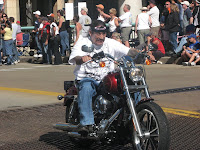 When sexualizing guys, it's often less about the body and more about props. Perhaps the most potent prop is the motorcycle. (And thanks to Oddysey for giving me this example, as well as helping me to clarify my ideas on a number of points in both of these articles.) Motorcycles grumble with adventure, speed, skill, and freedom. A guy on a Harley is not going to be overly much a gentleman. There's no guessing and there's no games, nor will there be an exorbitance of “please.” He'll make it clear what he wants, will appreciate the same candor from her, and she can count on him to be gone by morning.
Horses work just as well, but the symbolism is different. Skill and command are united with sensitivity. He will be aware of her moods, her emotions, and how she reacts to how he touches her. Sensitivity, however, is not a synonym for "nice." Some horsemen will be gentlemen. But not all.
Other props are easier to come by: the dog-eared copy of Byron's poetry promising slow and intellectually stimulating foreplay while hinting at kink, the well-worn dancing shoes that intimate grace and body awareness, the shirtless and sweaty chest with work jeans and dusty boots betokening an honest and forthright vigor.
That all said, we are brought back to Mandy's list of being-verb men. If you're going to invoke any of these props, you need to be able to follow up on their promise. Any woman can slip into high heels that lengthen her legs, or put on the innocent schoolgirl uniform. The hesitant clutz on a motorcycle is a poser and more laughable than a clutz without a bike.
Even worse, the vocabulary is not as well known or understood for titillating women. The above-mentioned schoolgirl uniform can be either innocent or slutty with the same props if they're just worn a little differently. The visual language is understood so well that great nuance is possible. It's easy and natural to talk about what any individual man wants: we know what it means, and women know how to capitalize on it, when we say that Quentin Tarantino is a “foot man” or that Sir Mix-a-lot is a “butt guy.”
 But we don't have the same vocabulary when speaking about women. Or, at least, it's not widely known, especially among men. If you go to the romance novels section of your bookstore you will find that they do come in categories. Some are not overt about it; Regency romances tend to be very tame, while those taking place in the old West sometimes have S&M aspects. Others advertise what they are right on the cover: family, cowboys, suspense and danger, or bad boys. Some of these are known qualities. It's not unusual to say a woman is "into bad boys" or is looking for a husband. But we don't usually see these as roles a guy should try on. Nor is our culture the place where a woman can casually suggest her husband don a loincloth and feathered headdress and tie her up in the living room.
And yet, that is exactly the sort of thing we ought to be talking about when discussing sexualizing men. The wife in the schoolgirl outfit isn't really a schoolgirl, innocent or slutty. And she can just as easily invoke the slutty librarian look, a Wonder Woman costume, or any of a range of lingerie that highlight her husband's favorite parts or brings to mind his favorite fantasies. There are, in short, not just visual vocabularies set up for the sexualization of women, but entire industries devoted to helping her do just that.
These vocabularies and industries do not exist for the sexualization of actual, physical men. In spite of the ease with which it is assumed a woman can get a man in the mood, every woman has available to her an arsenal of tricks and toys to do just that. What do men have? Well, if you believe popular culture, apparently nothing gets a woman hotter than lobster and diamonds. Even those who claim to have the secret to dominating the hookup scene primarily rely on psychological tricks to prey upon insecurities rather than titillations.
Frankly, this state of affairs is bizarre and is hopefully changing. As women become more comfortable speaking about their sexuality and acquire more wealth, we’ll develop the vocabulary, and then the industries, to cater to their desires. We’re still probably a generation away from it, but perhaps someday soon, a woman will more easily be able to express whether she wants a tender, gentle lover, or one she can chain to the bed and have her way with, and her man will be able to easily understand and put together the evening she’s looking for.
Photos by theaudi0slave and aka_serge.
Ask a woman what turns her on, and generally you will get a list like Mandy's. It's largely all about being. Ask a man what turns him on and you'll generally get a list of things you could do tonight to put him in the mood. This is what sexualizing is. At its heart, sexualization is concrete actions. It's not the T-and-A so much as how it's presented: the twisted, broken spine posture, cleavage, the exposed skin, the facial expression, and the scissoring legs.

Horses work just as well, but the symbolism is different. Skill and command are united with sensitivity. He will be aware of her moods, her emotions, and how she reacts to how he touches her. Sensitivity, however, is not a synonym for "nice." Some horsemen will be gentlemen. But not all.
Other props are easier to come by: the dog-eared copy of Byron's poetry promising slow and intellectually stimulating foreplay while hinting at kink, the well-worn dancing shoes that intimate grace and body awareness, the shirtless and sweaty chest with work jeans and dusty boots betokening an honest and forthright vigor.
That all said, we are brought back to Mandy's list of being-verb men. If you're going to invoke any of these props, you need to be able to follow up on their promise. Any woman can slip into high heels that lengthen her legs, or put on the innocent schoolgirl uniform. The hesitant clutz on a motorcycle is a poser and more laughable than a clutz without a bike.
Even worse, the vocabulary is not as well known or understood for titillating women. The above-mentioned schoolgirl uniform can be either innocent or slutty with the same props if they're just worn a little differently. The visual language is understood so well that great nuance is possible. It's easy and natural to talk about what any individual man wants: we know what it means, and women know how to capitalize on it, when we say that Quentin Tarantino is a “foot man” or that Sir Mix-a-lot is a “butt guy.”

And yet, that is exactly the sort of thing we ought to be talking about when discussing sexualizing men. The wife in the schoolgirl outfit isn't really a schoolgirl, innocent or slutty. And she can just as easily invoke the slutty librarian look, a Wonder Woman costume, or any of a range of lingerie that highlight her husband's favorite parts or brings to mind his favorite fantasies. There are, in short, not just visual vocabularies set up for the sexualization of women, but entire industries devoted to helping her do just that.
These vocabularies and industries do not exist for the sexualization of actual, physical men. In spite of the ease with which it is assumed a woman can get a man in the mood, every woman has available to her an arsenal of tricks and toys to do just that. What do men have? Well, if you believe popular culture, apparently nothing gets a woman hotter than lobster and diamonds. Even those who claim to have the secret to dominating the hookup scene primarily rely on psychological tricks to prey upon insecurities rather than titillations.
Frankly, this state of affairs is bizarre and is hopefully changing. As women become more comfortable speaking about their sexuality and acquire more wealth, we’ll develop the vocabulary, and then the industries, to cater to their desires. We’re still probably a generation away from it, but perhaps someday soon, a woman will more easily be able to express whether she wants a tender, gentle lover, or one she can chain to the bed and have her way with, and her man will be able to easily understand and put together the evening she’s looking for.
Photos by theaudi0slave and aka_serge.
Sexualized Male: the Act of Sexualization
Zack over at "Playing D&D with Porn Stars" has posted a very interesting question:
The answers have also been very interesting. I'm putting this here largely because Zack has requested that heterosexual men not respond in the comments to that post. Also, I want to look at the assumptions based around question.
Mandy's answers deserve special attention, I think:
It's a fascinating insight. I also think it misses the question. Notice that everything Mandie discusses is who these men are. These are very much issues of soft being verbs. But when we say someone has been sexualized, that's a very strong action verb. In fact, when we see it used on blogs like “Go Make Me a Sandwich,” it seems very much an act of violation; male artists have done something heinous to their female subjects. Being sexualized has nothing to do with who these women are. It's something that is done to them, or that they do to themselves.
So what is the horrible thing that has been done to these women? The sexualized woman advertises that she is available for sex. Her costume and contortions highlight her physical attributes most associated in the heterosexual male mind with sex. Postures of submission or fear or challenge underscore the invitation. In the moment of sexualization, these women exist primarily, if not entirely, to gratify the lusts of heterosexual men.
Can we simply do the same things to men? Yes, so long as we assume the viewer is a gay man. Hence Nate's Gay Pride carnival:
All of these advertise a man's availability for gay sex. How does a man advertise his availability for heterosexual sex with women?
Answer: he's breathing.
The general assumption in our culture is that any man who can still walk across the room is available for sex with women. Even those who can't walk across the room are assumed to want sex with women. Generally speaking, a man in the West has to go out of his way to advertise his unavailability for sex with wedding rings and priestly vestments.
In fact, sex from men for women is so available, social psychologists speak of it as having no value:
Our culture not only has no real way for a man to signal that he is available for sex, it has trouble conceiving of a need for one. Lacking these signals, and all the cultural baggage that would go with them, you simply can't sexualize a man in the same way that you can a woman.
Does this mean that we can't sexualize men for heterosexual women at all? No! For, while a woman might be able to have all the sex she wants, not all sex is valued equally. A man's availability for sex might be taken for granted, but his ability to deliver sex that she wants is not.
More on that next time…
What constitutes a sexualized male character?
Not 'sexualized' in some ridiculous way that you don't actually find attractive, (like if you don't actually think Han Solo wearing Leia's gold bikini would be hot, don't put that) but in a way that you do find attractive... Remember: not merely "desirable" but 'sexualized'--like how a chick can be hot no matter what she's wearing, but if she's in a chainmail bikini and bending at the waist for no apparent reason, that's sexualized.
The answers have also been very interesting. I'm putting this here largely because Zack has requested that heterosexual men not respond in the comments to that post. Also, I want to look at the assumptions based around question.
Mandy's answers deserve special attention, I think:
Oh and....notice how all the characters I've listed are highly competent and skilled. They're the best at what they do or are special somehow, and it means they've really got most of their shit together. A man who can handle his sword or a man who can command a starship and defend himself in battle or a man you know just not to fuck with because it's made obvious by some action in whatever depiction of the character...That's just hot.
It's a fascinating insight. I also think it misses the question. Notice that everything Mandie discusses is who these men are. These are very much issues of soft being verbs. But when we say someone has been sexualized, that's a very strong action verb. In fact, when we see it used on blogs like “Go Make Me a Sandwich,” it seems very much an act of violation; male artists have done something heinous to their female subjects. Being sexualized has nothing to do with who these women are. It's something that is done to them, or that they do to themselves.
So what is the horrible thing that has been done to these women? The sexualized woman advertises that she is available for sex. Her costume and contortions highlight her physical attributes most associated in the heterosexual male mind with sex. Postures of submission or fear or challenge underscore the invitation. In the moment of sexualization, these women exist primarily, if not entirely, to gratify the lusts of heterosexual men.
Can we simply do the same things to men? Yes, so long as we assume the viewer is a gay man. Hence Nate's Gay Pride carnival:
Pride parades, leather bars, young men in v-necks smoking on street corners. Leather, chainmail, briefs, ass-less chaps, straps, studs, whatever. Muscular men wearing mesh shirts. Smaller boys in white briefs. Fat guys in leather pants and dog collars.
All of these advertise a man's availability for gay sex. How does a man advertise his availability for heterosexual sex with women?
Answer: he's breathing.
The general assumption in our culture is that any man who can still walk across the room is available for sex with women. Even those who can't walk across the room are assumed to want sex with women. Generally speaking, a man in the West has to go out of his way to advertise his unavailability for sex with wedding rings and priestly vestments.
In fact, sex from men for women is so available, social psychologists speak of it as having no value:
[S]ocial psychologists claim that men's sex has no value per se. In the world of prostitution you never see women paying men for sex. Men pay women for sex, men will pay men for sex, but women don't pay men for sex. You get a sense that she has something of value that he wants... Women can get sex whenever they want. Post it on Craigslist and you can have it within the hour.
Our culture not only has no real way for a man to signal that he is available for sex, it has trouble conceiving of a need for one. Lacking these signals, and all the cultural baggage that would go with them, you simply can't sexualize a man in the same way that you can a woman.
Does this mean that we can't sexualize men for heterosexual women at all? No! For, while a woman might be able to have all the sex she wants, not all sex is valued equally. A man's availability for sex might be taken for granted, but his ability to deliver sex that she wants is not.
More on that next time…
Friday, February 04, 2011
WoW Killer
A friend asked me tonight if something will eventually knock World of Warcraft off its perch as top dog and what such a game would look like. I do think eventually something will replace WoW as the 500 pound gorilla in its niche. And here I'm talking about the particular genre this game dominates; in terms of numbers alone, Farmville appears to clean WoW’s clock. But the games are so different in style, content, and business model, that it really doesn't make sense to compare them directly. And I suspect, in terms of raw income, but World of Warcraft still does better than Farmville. I'd love to see some numbers on this.
So what will the WoW killer look like? First, I do think Guild Wars 2 is barking up the right tree with their new classes. Giving everyone the ability to shift between tank, healer, crowd control, etc. is brilliant. It makes it a lot easier to put together a team to tackle any adventure. Once you've abandoned niche protection, you can then focus a lot more on what matters to the players. Play style is almost certainly the way to go. Making one class be about fast, precise clicking, and another about preset macros, and a third about positioning, and other such considerations makes a lot more sense.
Easing the grind is also key. WoW got rid of standing in line for your chance to kill the orc king. That's not fun for anybody. Replacing the grind with more interesting quests is probably the way to go here, and I think BioWare’s Old Republic MMOG will be the model in this regard. I haven't played that game either, but buzz says it has managed to capture a lot of the appeal of their single player games.
That said, don't expect story to be king. It would be extremely simple to give every player their own, unique plot and adventures. Nobody's bothered to do it yet, and that's because the players simply are not interested. Most approach quest text in this manner: "blah blah blah silver hammer. Blah blah blah five wolf pelts. Blah blah Darken Wood blah blah blah." Story is to MMOGs what those scantily clad girls serving drinks in casinos are to Vegas. They are an essential part of the window dressing, but nobody is under any illusions they are why the crowd has come. The folks most interested in story are quite happy with their free-form gaming; those who want to charge them $10 a month have nothing to interest them.
The graphics will continue to avoid rigorous realism, though I doubt the game that replaces WoW will look quite as cartoony. It will probably include neat cross-class combos like Dragon Age did. It will almost certainly be fantasy, and will absolutely be combat focused. It probably won't have much, if any, crafting system. It will be even more amusement park in its geography than even World of Warcraft. I suspect that no character over 10th level or so will ever really die; they will simply enter some form of bloodied or half-dead status in which they can escape to try again later.
Whatever it looks like, I seriously doubt I will be interested in playing it. It's been many years since I've been tempted to play a Diku MUD, graphical or otherwise. Most of the blame can be laid on the topics discussed in the story paragraph above. A game that wants to tackle those topics may attract my attention. I'm not holding my breath.
Thursday, February 03, 2011
New Dogs and Old Tricks
That computer RPGs have been heavily modeled on D&D goes without saying. From the earliest iteration of Wizardry all the way to modern MMOGs, we still see much that we recognize as the basic core of D&D: hit points, armor class, spell lists, niche protection through classes, dungeon and wilderness exploration, etc.
Since then, the relationship between D&D and computer RPGs has been one in which D&D mostly went its own way and computer RPGs swiped bits that fit their medium. Attempts to program various iterations of D&D into CRPGs have done a lot to draw the two communities closer together. That said, from the beginning, D&D held at its core aspects that computer RPGs just couldn't touch. Advances in computing power and algorithm design have still not given us anything close to what a live and creative DM can deliver. But there have been some advances that have narrowed the gap somewhat. The sandboxy aspects of the Elder Scrolls games (and the Ultima games before them) were an early example. More recently, BioWare has been pushing a design ethos heavily based on consequences for player choices and a plot structure that looks very much like an adventure path.
 ArenaNet is currently building buzz for the launch of Guild Wars 2. As usual, they're crowing about unique design, how their game is going to be different from the competition. Also as usual, you have to take everything they say with a grain of salt; there's usually something of a gap between what the game promises during development and what it delivers in actual play. They’re pushing a "not your father's MMOG" look and feel. Clearly, they want to stand out as not just another WoW clone. Still, and despite their protestations that their game will not include the traditional class triad, we're clearly looking at another fantasy-themed combat-focused game.
There is some interesting stuff in the design manifesto published last April:
This is your classic "show, don't tell" writer's advice. And it is very, very good advice. The mysterious cloaked stranger in the tavern is still something of a classic in tabletop RPGs, but you don't see him much in actual published material. I suspect you don't see him much outside of tournament play and other one-shots. Since at least the early 90s, you're far more likely to start an adventure by visiting a local village during market day and then suddenly finding yourself up to your Helm of Brilliance in hill giant marauders intent on stealing the prize-winning largest pumpkin.
There is also new fun to be found some of the oldest tricks:
Yep, it's the good old wondering monster with a bit of a twist. Granted, part of how they make this work is by giving everybody who takes part a full share of the loot, which pokes as many holes in my sense of verisimilitude as does 4e’s insistence that defeated drow cannot be plundered for their equipment.
Still, I'm heartened to see the industry still pushing gameplay envelopes and not relying on graphics alone to draw traffic. I'm still not likely to pick an evening of Guild Wars 2 (sorry, Jesse ;) ) over any of my Labyrinth Lord games, but the computer world is inching closer, bit by bit, to the sort of play I think I would enjoy.
Since then, the relationship between D&D and computer RPGs has been one in which D&D mostly went its own way and computer RPGs swiped bits that fit their medium. Attempts to program various iterations of D&D into CRPGs have done a lot to draw the two communities closer together. That said, from the beginning, D&D held at its core aspects that computer RPGs just couldn't touch. Advances in computing power and algorithm design have still not given us anything close to what a live and creative DM can deliver. But there have been some advances that have narrowed the gap somewhat. The sandboxy aspects of the Elder Scrolls games (and the Ultima games before them) were an early example. More recently, BioWare has been pushing a design ethos heavily based on consequences for player choices and a plot structure that looks very much like an adventure path.

There is some interesting stuff in the design manifesto published last April:
Let’s say a village is being terrorized by bandits. You don’t want to find out about that because there’s a villager standing there motionless with an exclamation mark over his head who says when you click on him, “Help, we’re being terrorized by bandits.” You want to find out like you would in GW2: because the bandits are attacking, chasing villagers through the streets, slaying them and setting their houses on fire. You can stand up for the villagers, or you can watch their village burn to the ground and then deal with the consequences.
This is your classic "show, don't tell" writer's advice. And it is very, very good advice. The mysterious cloaked stranger in the tavern is still something of a classic in tabletop RPGs, but you don't see him much in actual published material. I suspect you don't see him much outside of tournament play and other one-shots. Since at least the early 90s, you're far more likely to start an adventure by visiting a local village during market day and then suddenly finding yourself up to your Helm of Brilliance in hill giant marauders intent on stealing the prize-winning largest pumpkin.
There is also new fun to be found some of the oldest tricks:
We think of GW2 as the first MMO that actually has a cooperative PvE experience. When I’m out hunting and suddenly there’s a huge explosion over the next hill – the ground is shaking and smoke is pouring into the sky – I’m going to want to investigate, and most other players in the area will too. Or if the sky darkens on a sunny day, and I look up and see a dragon circling overhead preparing to attack, I know I’d better fight or flee, and everyone around me knows that too.
Yep, it's the good old wondering monster with a bit of a twist. Granted, part of how they make this work is by giving everybody who takes part a full share of the loot, which pokes as many holes in my sense of verisimilitude as does 4e’s insistence that defeated drow cannot be plundered for their equipment.
Still, I'm heartened to see the industry still pushing gameplay envelopes and not relying on graphics alone to draw traffic. I'm still not likely to pick an evening of Guild Wars 2 (sorry, Jesse ;) ) over any of my Labyrinth Lord games, but the computer world is inching closer, bit by bit, to the sort of play I think I would enjoy.
Tuesday, February 01, 2011
Subscribe to:
Posts (Atom)


 Posts


