Sunday, May 25, 2008

Hobbit Chat

A transcript of the online chat with Peter Jackson and Guillermo del Torro has been posted over at Weta's website. There are a number of interesting tidbits, including a hint that I was wrong about how the movies will be broken up. I suspect Trollwife will be thrilled by what del Torro says about Smaug. Here are some other interesting comments:

KenshinIV What are the chances Ron Perlman will be voicing Smog?
Guillermo del Toro At this time the voice of Smaug is down to a very few choices in my head and I have a completely specific one, Ron has a good chance but I have other plans for RP... we will see...

Eriol So what age rating are you aiming at?
Peter Jackson Hi Eriol - the rating will be the same as the Trilogy, PG13 on both movies
Guillermo del Toro An intense PG-13...

Yetzi did you start casting for the 13 dwarves?
Guillermo del Toro Nope- no catsing has started yet.
Guillermo del Toro Casting- I mean... BUt some people have thrown their helmet in the ring.
Peter Jackson Hi Yetzi - no casting has commenced and won't until the scripts are written. We have had chats with one or two ofthe LOTR actors however but the casting will be driven largely by the writing and it is impossible to cast 13 dwarves without knowing their personality and characters. We anticipate we won't be in serious casting mode for these movies until well into next year.


WetaHost 10- Hi there, thanks for giving this opportunity. my question: will Alan Lee and John Howe be on board again? I really admire their work. good luck for this project and have a lot of fun.
Guillermo del Toro As aI said, I had a marvelous lunch with John and Alan in London a few days ago and we all got very excited as we discussed my ideas on Smaug, Mirkwood, etc They are most definetly back!
Peter Jackson Impossible to imagine it without them!

WetaHost 8 - I always thought creating Gollum would pose a great artisic challenge to the artists whose job it would be to adapt the Lord of the Rings. With the Hobbit I believe Smaug will pose one of the great challenges. Now we have all seen dragons in movies. But for the Hobbit I personally am excepting nothing less than unbelievable . Were will you go for inspiration? What styles will the art dirction look at? Personally I can see a lot being done with the setting from Pan's Labyrinth. Thank you and good luck to you all.
Guillermo del Toro This is a big one-- Allow me to quote form my random responses at Onering.net…

I am a big Dragon fan. I've said it before- And I was fortunate enough to be born a Dragon in the Chinese Horocope...

And although its always impossible to agree on the "greatest" of anything, I bring forth these two as the main film contenders for that title: Eyvind Earle / Disney's Maleficent dragon ( a triumph of elegance of color and design) and Vermitrax Pejorative from Dragonslayer.

In my opinion, every other design has borrowed heavily from these two. I plan to create something new and groundbreaking.

Smaug should not be "the Dragon in the Hobbit movie" as if it was just "another" creature in a Bestiary. Smaug should be "The DRAGON" for all movies past and present. The shadow he cast and the greed he comes to embody- the "need to own" casts its long shadow and creates a thematic / dramatic continuity of sorts that articulates the story throughout-

In that respect, Smaug the CHARACTER is as important, if not more important, than the design. The character will emerge form the writing- and in that the Magnificent arrogance, intelligence, sophistication and greed of Smaug shine through-

In fact, Thorin's greed is a thematic extension of this and Bilbo's "Letting go" and his noble switching of sides when the dwarves prove to be in the wrong is its conceptual counterpart (that is a hard one to get through, Bilbo's heroism is a quiet, moral one) and the thematic thread reaches its climax in the Bilbo / Thorin death bed scene.

Anyway, back to Smaug: One of the main mistakes with talking dragons is to shape the mouth like a snub Simian one in order to achieve a dubious lip-synch. .. A point which eluded me particularly in Eragon, since their link is a psychic one.

To me, Smaug is the perfect example of a great creature defined by its look and design, yes, but also, very importantly, by his movement and -One little hint- its environment - Think about it... the way he is scaled, moves and is lit, limited or enhanced by his location, weather conditions, light conditions, time of the year, etc. That's all I can say without spoilers but, if you keep this curious little summary you'll realize several years form now that those things I had in my mind ever since doodling the character as a kid had solidified waaay before starting the shoot of the film.

A big tool is also how and when he is fully revealed. I could give you specifics- beat-by-beat in fact (I'm geeking out to do it), but...

I will say no more in order to save you from ruthless spoilerage (we have a few years to go, you now...?) and increased anxiety.

Let me, however, say that this is actually one of the points I feel most enthusiastic about.

As to his voice- well, each reader has a Smaug voice in his / her head, just like you always do when "hearing" a great character in a book.

I have mine... and it will be revealed in time...

WetaHost 2 - Hello Mr. Jackson and Mr. Del Toro! Thank you very much for this time. My question is one that I think you will hear alot of from many of us...from what material will you pulling the second movie from? I know it'll be great with you two on board, but I am mighty curious. I am a huge fan of both of you and I look foward to more Tolkien films!
Guillermo del Toro The idea is to find a compelling way to join THE HOBBIT and FELLOWSHIP and enhance the 5 films both visually an in their Cosmology. There’s omissions and material enough in the available, licensed material to attempt this. The agreement is, however, that the second film must be relevant and emotionally strong enough to be brought to life but that we must try and contain the HOBBIT in a single film.
Peter Jackson I'm really looking forward to developing Film Two. It gives us a freedom that we haven't really had on our Tolkien journey. Some of you may well say that's a good thing of course! The Hobbit is interesting in how Tolkien created a feeling of dangerous events unfolding, which preoccupy Gandalf. There's an awful lot of incident that happens during that 60 year gap. At this stage, we're not imagining a film that literally covers 60 years, like a bio-pic or documentary. We would figure out what happens during that 60 years, and choose one short section of time to drop in and dramatise for the screen. I'm really interested in how it effects The Hobbit - do we show what happens to Gandalg during his trips away? We'll see. We may well have seeds for Film Two that we'll subtly sow during The Hobbit.
WetaHost Considering that you're stretching The Hobbit into 2 movies can we assume that Beorn will be featured and will not be given the Tom Bombadil treatment?
Guillermo del Toro

WetaHost My question is, when Del Toro has acknowledged his disdain for Hobbits and "sword and sandals" fantasy, how can he do justice to the movie? Why can't Peter direct it himself after The Lovely Bones? He can direct these 2 movies and then direct the 3rd Tintin movie.
Guillermo del Toro Okay- If by “Sword and Sandal” you mean “Sword and Sorcery” I stand by the general lines of my statement in 2006. But allow me to reproduce the following paragraph from ONERING.net and expand it-

Since the age of 4 I became an avid reader and collector of books; manuscripts, pamphlets, first editions, small press or worn-down paperbacks... they all find a home at my library which has grown so cumbersome and obtrusive that I had to move to a separate home from the family one...

For many decades my main area of interest has been horror fiction: Algernon Blackwood, Arthur Machen, MR James, LeFanu, etc and classic Fairy tales and literature about the engines of Myth: unabridged Grimm, Andersen, Wilde, Bettelheim, Tatar, etc

Now and then I indulge in Science Fiction (not hardware oriented but more humanistic things) and thus I count Bradbury, Ellison, Sturgeon and Matheson amongst my favorites.

My area of interest gets much narrower when we deal with another genre... the genre that is shelved under Fantasy.

As a youngster I read Moorcock, Clark Ashton Smith, Lord Dunsany, Lloyd Alexander, Fritz Leiber, Marcel Schwob, RE Howard and a few others.

Nevertheless I was never propelled into an aleatory addiction to sub-genres like Sword & Sorcery or indiscriminate fantasies about magical this or that- Like any other genre or subgenre there's a great abundance that makes it hard to discern when a new "trilogy" or "chronicle" comes from as genuine a place as Tolkien's or derives from genuine fervor -religious or otherwise- like C.S. Lewis' did. But here I am now: reading like a madman to catch up with a whole new land, a continent of sorts- a Cosmology created by brilliant philologist turned Shaman.

As if he grasped an existing universe outside our Platonic cave, Tolkien channels an entire world, weaving expertly from myth and lore. The oustanding virtue is that all this scholarly erudition doesn't reduce his tales to mere Taxidermy. He achieves an Alchemy all of his own: he writes new life in the freshly sculpted clay of his creatures.

I have, through the years become familiar with the very roots of Tolkien's myths and the roots of Fafhrd or Elric or Hyperborea and many a time I have relished the intricate ways in which demonic wolves, shape-shifter and spindly-limbed pale warriors can be woven into those many tales that become, at the end, the single tale, the single saga- that of what is immortal in us all.

In creating Pan's Labyrinth I drank deep of the most rigid form of Fairy Lore and tried to contextualize the main recurrent motifs in an instinctive rhyme between the world of fantasy and the delusions of War and Politics (the grown man's way of playing make-believe) and in re-reading THE HOBBIT just recently I was quite moved by discovering, through Bilbo's eyes the illusory nature of possession, the sins of hoarding and the banality of war- whether in the Western Front or at a Valley in Middle Earth. Lonely is the mountain indeed.

When that statement was made- at different times during PANS LABYRINTH’s promotion, many a time I made the distinctive call to say that althought I had not read Tolkien outside THE HOBBIT I had been fascinated by the Trilogy films. A statement that I already had the chance to make in 2005 when PJ, Fran and I met about HALO.

So, no, generally I am NOT a “Sword and Sorcery” guy or a “Fantasy” guy- By the same token, I'm not a sci-fi guy but I would make a film based on Ellison in a second- or on Sturgeon or Bradbury or Matheson. I'm not into Barbarians with swords but i would kill to tackle Fafhrd and Grey Mouse... and so on and so forth... I'm a believer but not a Dogmatic.

Allow me to put a final, finer point to our discussion. The aesthetics of HELLBOY II are completely Pop and color-saturated, much more comic book / modern than I would ever use in THE HOBBIT but- I spend two years creating a world of Fairies, Elves, Trolls, etc

Two Years. A career / creative decision that precedes any inkling of THE HOBBIT. I wrote the script years before I met with PJ or Fran. In other words I dedicated the last 6 years of my career (between PL and HBII) to create Fantastical world inhabited by Fairies, Fauns, Ogres, Trolls, Elves, etc

In that respect- I guess I am a Fantasy guy when the particular world appeals to me. Back in the Jurassic Period (1992 / 1993) when CRONOS won the Critic’s Week at Cannes I was referred to as an “art house guy”- I followed that with a giant cockroach movie that proved successful enough to spawn two sequels and allow me to co-finance THE DEVILS BACKBONE which send me back to being an “art house guy”. Then I did BLADE II and people thought of me as an “Action guy”- PJ went through a similar mercurial career with HEAVENLY CREATURES, BAD TASTE, DEAD ALIVE, etc I squirm away from a tag and I hope I can avoid being just a “Fantasy guy” after PL, HBII and H…

I do the tales I love (regardless of what shelf Barnes & Noble classifies the book under) and I love the HOBBIT.

I love it enough to give it half a decade of my life and move half a world away to do it.
Peter Jackson Having directed the LOTR Trilogy, I really felt that I put my heart and soul into dramatising this world and story, only a few years ago. The idea of going back in and essentially competing against my own movies, seemed to be an unsatsifying way to spend the next 5 years. However, I love Tolkien and care deeply about the movies we made. I couldn't bear the idea of somebody else making them without our involvement. Being a writer and producer is the perfect way for me to work here. Guillermo has the ultimate responsibility of directing, and for him it's easier to make these movies feel different, simply because he's not me, and he therefore has an original vision, with new ideas to offer.

Believe me, I thought long and hard about this, and what we're doing here will result in better movies, I promise you. And that's all that counts!

I may be in the minority, but I absolutely LOVE Beorn and I intend to feature him in the films. BTW I also like TB quite a bit…


Saturday, May 24, 2008

Paper Soldiers

This thread at RPG.net on cheap alternatives to minis points to this great collection of paper miniatures. They're historical, not fantastical, so no dragons or orcs. But you do get a wide array of soldiers from many different time periods, ships, siege engines, and bits that you can use in the art program of your choice to mix-and-match.

The quality can be a bit hit-or-miss, but you can't argue with the price! And the pics themselves can certainly be lifted for use as online minis with systems like OpenRPG.

Apologies for the Light Blogging

I'm afraid the easy parts of my Moldvay/Cook/LL hack have been done, and I'm to the heavy lifting. That and Glen Cook's The Tyranny of the Night are eating up all my fun-time. Next week, I'm looking forward to posting how I want to handle magic in my M/C/LL hack, and maybe a bit about the setting I'll be using.

To Have and to Hold...

Noisms continues to bring the good stuff. The man is just leaking brainstorm-fruit:

Realism and D&D make for uncomfortable bedfellows, as we all know. We probably shouldn't devote too much time to trying to make the game emulate reality. Even so, I've occasionally wondered why more DM's don't include the sort of background flavour events - weddings, festivals, religious ceremonies - that can really add to the feeling that the players really are in a world, not just in a crudely drawn dungeon map.

What follows is an example "encounter": a town in the midst of celebrating the wedding of local celebreties followed by a random table of situations that might befall or attract the attention of the PCs.

Myself, I use stuff like this a lot. My calendars are peppered with special events and festivals. Even if the PCs don't get involved themselves, it's important that world clearly go on around them, and without them sometimes. Special events are also great times for the big revelation. Paizo's first Pathfinder adventure, "Burnt Offerings", uses a local ceremony to bring the party together and start things rolling with a bang.

Friday, May 23, 2008

This is How He Rolls

Out in the middle of the table, as it turns out.

James Edward Raggi IV has posted a long but interesting explanation of how he plays D&D and its simulacra. There's some neat stuff here, a lot of which I agree with, and much of which mirrors my own practice. He's hard-core on following the dice, though:


The dice are God, carrying more authority than any player and carrying more authority than the guy running the game. Just picking up the dice is a sign that nobody at the table knows what's going to happen. No fudging. Ever.

If a "story" would be ruined by an "incorrect" roll of the dice, then we're playing wrong. The story is only apparent after the playing is done. It's not a goal in-game. Sort of. More on that later. But if I want something to happen, then I'll say it happens and not bother with a dice roll. I'm in charge only to the point that I pick up the dice. Then I'm not in charge anymore.

July is Worldwide Adventure Writing Month

So hath Jeff Rients spoken! Er, written, I mean. No web page yet, but it's good to know it's going to happen again this year.

Keeping Track of Who is Doing What to Whom

Over at Dungeon Mastering, a neat little "combat matrix" is demonstrated for keeping track of what's going on in your D&D fights. I've scribbled out similar things, but I can certainly imagine that a more formal design could be extremely useful, especially in those big fights.

Beware the Armoured Terror What Lurks in the Deeps

From Noisms comes Old Johnny, a giant crawfish demigod:

The people living around the lake worship Old Johnny as their god. They have worshipped him for so long, and done so in sufficient numbers, that he has actually become a god of sorts; an unthinking, voracious, alien god, but a god all the same. Old Johnny "knows only his own cold hunger" (Milk's line) and unconsciously wills his worshippers to assuage it. They do this by spreading rumours around the neighbouring lands that there are several giant crayfish, ripe for the eating, in their lake - and all are welcome to try to catch them at a small price in gold. Old Johnny then feasts on the unwitting adventurers, fishermen and thrill seekers who are attracted by these rumours.


He also gives us a bit of detail on Old Johnny's worshipers and their fiendish methods.

Thursday, May 22, 2008

Fading into the Myths?

There's a rumor racing around the 'net that Robert Asprin, author of the Phule's Company and Myth books, as well as co-editor of the Thieves World books, has died today.

No word yet on the cause of death. I'll be sure to let y'all know when there's more concrete news.

UPDATE: It appears to be official and true. I'm in shock; he wasn't that old and I hadn't heard he was having any health problems. :/

FURTHER UPDATE: More here and here.

There and Back Again and a Little Bit More

So everyone is getting ready for Jackson and Del Torro's big "Unexpected Party" chat on Saturday, and we're seeing more stuff like this neat "Seven Things We Want From 'The Hobbit'" post. But I think there's some real confusion about what's being done with the two movies that will make up "The Hobbit".

Most people seem to be of the impression that we'll get the entire The Hobbit novel in movie one, and then some sort of bridge story to LotR in the second movie. I could be wrong, but that's not the way I understand it. Instead, what I've been led to expect is a weaving of The Hobbit with what Gandalf is up to every time he leaves, as revealed in Appendix material from the LotR books and Tolkien's notes. In terms of The Hobbit, I expect the break between the two movies will happen either right after Bilbo and the dwarves run into the wood elves, or right after they leave the wood elves. Meaning we won't get much Smaug or the Battle of Five Armies until the second movie.

So what was Gandalf up to every time he left the dwarves and Bilbo (usually just before disaster of one sort or another struck)? He was checking out a mysterious wizard lurking in the southern parts of Mirkwood who went by the ominous title "the Necromancer". These investigations tie in directly to the events of LotR, and will, I assume, be the promised "bridge" between the two groups of movies.

ACHOO!

Ripper X, as vengeance for my removing the thief from my Moldvay/Cook/LL hack, is clearly trying to gross me out. Today, it's a discussion of disease and parasites in D&D, based heavily on Mr. Gygax's work in the 1e DMG.

Now, why would you want to include these things in your campaign?

  1. Local color: some places are just overcrowded, hot, humid sewers, and the risk of disease can really help make a place "real" in your player's minds.
  2. Ticking clock: if the disease is wide-spread, the NPC clerics might not be able to help everyone unless the PCs undertake a quest. And the longer the PCs take on the quest, the more people will die!
  3. Added trouble: it's a truism among authors that if you really want to write a great story, after you get your main character in hot water, you drop a rabid badger on his head and watch the fun ensue. The same can be true of your games, so long as your players recognize you're not just dumping on them. (A fine line to walk, in all honesty, but it can really improve your game if your players trust that they will be given a chance at victory and payback.)
  4. More spotlight time for the cleric, without having to resort to undead. Again.

Lamentations of the Gameless Princess

Mr. Raggi says, "Don't be a whiner! Make it happen! Find a group!"

I love it when he channels Dr. Phil. ;)

Seriously, lots of very good advice here, stuff I forget needs to be repeated because it feels like GMing 101 now.

Wednesday, May 21, 2008

Ain't It Cool News Goes Tabletop

After posting a two-part review of 4e back during the playtest stage, Massawyrm of AICN announces the launch of a tabletop section for the bright orange Mecca of nerd news. In its first installment, he starts with a discussion of Magnificent Egos Miniatures. Magnificent Egos is the sort of company that should warm the heart of grognards everywhere, as they have chosen to forgo the pre-painted plastics that everyone else seems to be embracing, and is sticking with raw pewter. And their range of odd pieces is bound to have something that appeals to everyone. Some have a dungeon-punk look while others will be right at home beside your favorite Ral Parthas. Some are just drop-dead gorgeous while others are just plain bizarre. Some of my favorites skirt the line between cool and disturbing. They also have a range of magical effects, like walls of ice or gripping hands. They carry those nifty Kobolds Ate My Baby miniatures Jeff Rients linked to a while back. I have no idea what the scale any of these are; I'm guessing they're close to the "heroic" 28 mm scale that seems popular these days, but that's just a guess.

After waxing enthusiastic about the minis, Massawyrm then reviews the final release of 4e's core books. Those of you who read his preview from playtesting will not be surprised to hear he's got a generally favorable opinion of the final product. He does mention that the trap design rules from the playtesting docs didn't make it into the final hardback of the DMG which is a shame. If they'd been something really special, they might have convinced me to buy that book even if I never intended to play 4e.

Old School Beyond D&D: The Case for GURPS

Badelaire makes the case for GURPS as an Old School RPG, and I think it's spot on. Here's the part that really does it for me:

* GURPS encourages you to manage your rules as you see fit. You can either run GURPS using the Lite rules (and even play with those to make things even easier), or you can go full-throttle rules madness and buy every supplement you want and incorporate every variable/skill/advantage/power you feel like. The players can either be all over the variables and get as crunch-geeky as they want, or the GM can keep it all "under the hood" and just ask for rolls and do the tweaky bits themselves. This way the game can be played as rules-intense or as rules-casual as you like.

GURPS is one of those systems that just begs for houserules, and lots of 'em! Even if you're using an official setting, you'll want to tailor it to your play style and interests. Be sure to check out the comments for transforming GURPS for more "traditional" fantasy play.

I enjoy the system much more than I get to play it, and it's usually my go-to system for sci-fi play. And being an Austinite, I gotta support the local RPG pros. ;)

Takin' it to the Streets

Over at Grognardia, James Maliszewski has posted an appeal by Dan Proctor of Goblinoid Games for help in getting Labyrinth Lord into retail distribution:

If you support retro-clones and old-school games in general (and especially Labyrinth Lord), now is your chance to demonstrate that support in a loud and unmistakable way.

Key 20 has indicated their willingness to distribute Goblinoid Games products. In order to get Labyrinth Lord into distribution, I need to stock their warehouse with an initial print run of 150 copies of Labyrinth Lord, but this is not an expense I can make on my own without pledges of support from the community I seek to serve.

Check it out, and lend a hand if you can.

Also over at Grognardia, a review of the Esoteric Random Classic... er, Fantasy Critter, uh, Generation Thingy... This thing!

Thar be Trolls!

Hey! 4e art I like!

Ok, it's not exactly unprecedented, and I'm not shocked at all to learn it's by Sam Wood, one of my favorite 3e artists.

Still, it's good to see stuff like this being used, even if it is rather lacking in background.

Tuesday, May 20, 2008

Playing with Skills

I’ve got my character classes for my Moldvay/Cook/LL hack nailed down. Assuming I leave out the halflings, that leaves me with: fighters, magic-users, clerics, rogues, elves, dwarves, and gnomes. Maybe someday I’ll throw in some half-orcs or half-ogres, but for now that looks like a solid foundation I can build on.

The next topic I want to tackle is skills.

And I got nothin’.

Ok, that’s not entirely true. I’ve actually got too much.

Through most of Moldvay/Cook, if you want to try something, you roll a d6. A 1 almost always succeeds, and a 6 almost always fails. Sometimes, you can get bonuses. For instance, an elf succeeds at finding a secret door on a 1 or 2, while forcing a stuck door is adjusted by Strength.

It’s not very granular, but this system clearly works and can be adapted to anything. And, with the standard stat bonuses listed in the book, your character’s stats can be used to adjudicate anything from swinging from a chandelier to unscrambling the Dark Lord’s cipher.

It’s got two issues, though. First if we assume a 6 always fails, that means failure is pretty common. Clearly, this system was devised to handle tasks of extreme difficulty, things even heroes are not likely to succeed at.

Second, it ignores a character’s level. You never get better at these things no matter what level you rise to. On the one hand, this is very fitting for Moldvay/Cook/LL, since level has a very minimal effect on your character, especially in comparison with other iterations of D&D. And that does keep your character from becoming insanely good at everything. (I was going to say, “does keep your character from becoming a superhero”, but in Moldvay/Cook, a superhero is an eighth-level fighter. ;) )

In some areas, percentages are used, but these are extremely rare. We see them, most famously, in thief abilities. We also see them in the chance of others to detect a hiding halfling. These are a lot more granular, but where we see them, they don’t reference stats at all, and outside of the thief’s abilities, don’t apply levels either.

Finally, there’s the roll-under-a-stat method on a d20. It’s actually called saving-vs-abilities in the back of the Expert book, and suggests modifiers up of to + or – 4 for situation with 1 always succeeding and 20 always failing.

I’m tempted to modify that one with my favorite probability tool, the bell curve. A simple task would require a roll of a single d10; anyone but those of sub-par ability should expect to succeed. A challenging task would require rolling a 2d10. Success would be common, but not guaranteed. A difficult task would be 3d10 while a daunting task would be 4d10. With such a range of possibilities, maybe I could add your character’s level to their stat to get our roll-under target? Eh, probably not; things would get really crazy as characters approached 10th level and beyond.

That last method is still my favorite, but the d6 method is already such a strong part of the D&D DNA that it’s got a lot of tradition on its side.

And then there’s how skills are acquired. One thing that constantly bugs me about most point-buy systems is how impossible it is to make a reasonably competent character. At 16 I could fire a muzzle loader (though with admittedly questionable accuracy), swim, drive a car, pilot a motorboat, program in BASIC and PASCAL, tie any number of knots, read a map, use a compass, calculate the volume of all sorts of shapes, balance a checkbook, read the stock pages, lead certain liturgical rites of the Episcopal Church, build a working radio from a kit, change the oil in a car, identify edible plants, light a fire with a single match, find a half-dozen constellations in the night sky…

Yeah, ok, you get the point. You probably had a large number of skills you could rely on as well. In our games, however, you had to be at least 3rd level or somesuch to come even close to something like that. It’s unusual to find a 3e D&D character who can swim at any level. This sort of thing is silly.

Back when dinosaurs roamed the earth and I was playing Moldvay/Cook (I think, though it might have started after we added in the 1e AD&D PHB to our Moldvay/Cook games) we added backgrounds to our characters. This started with the title for 1st level fighters: the veteran. That implied that the veteran had been in a war. Which war? What did our veteran learn? Where were his war buddies?

So we added one line (sometimes one word) histories to our characters. Our veteran had fought in the Goblin Wars. Or maybe the Sorcerer Wars. Our thief had been a pick-pocket urchin. Or a pirate. That sort of thing. These dictated what sort of skills your character could draw on. The veteran of the Goblin Wars might be able to speak goblin, or recognize different tribes by their ornaments. The ex-pirate knew how to handle sailing ships, how to navigate by the sun and stars, and how to tie knots.

Now, we didn’t worry about rolling dice back then. Either your character knew how to do something or didn’t, and if you could convince the DM that it made sense for your character to be conversant in elvish wines or ancient theology, you would be successful in whatever you attempted with those skills.

For the most part, I want to add that to my Moldvay/Cook/LL hack. In most situations, having the skill will give you success. Only in unusual or extreme circumstances should you need to roll. And instead of picking skills individually, you instead describe your character’s background and that dictates what sorts of things your character is skillful at.

I want to add a bit more structure to it this time, however. I’m dividing a character’s youth into stages. First is childhood, which in humans covers birth to seven years old. Childhood is when you learn your first language(s) and the culture of your family and surroundings. The next stage, which I’m calling youth, begins at seven and ends around 14 or 16. This is when you begin to enter the adult world. Urban children would be sent to apprenticeships, noble children would be fostered as pages or ladies-in-waiting to other noble families, and peasant children would join their parents in the fields or among the livestock. This would cover basic education. Adolescence refines these skills. Pages become squires, apprentices become journeymen, peasants might become husbands and wives and parents, with their own fields and flocks.

Describing ever so briefly what your character was doing during these three stages towards adulthood, not more than a single sentence for each, dictates what sort of skills your character has outside of their class abilities. So if your knight (fighter class) was squired to a northern noble, he would know the courtly etiquette from that part of the world, as well as the heraldry of the noble families up there. Your bandit from the Eastern Steppes would know all about horses, the spice trade and how to appraise silks. And yes, your former street urchin probably knows how to pick a pocket and fence the goods.

So, here’s where I am: I have a nicely vague system for figuring out what skills the PCs have. But I’m not certain how I want to adjudicate uncertainty in the use of those skills. Or, to put it simply, how should we roll for success or failure?

Also, should spending more or less time in a “profession” have an affect on skill use? Should spending both your youth and adolescence as a street urchin improve your skills as a pick-pocket? What about older characters? Should there be a penalty for starting a PC at 28 or 35 years old, to counter the greater or broader skill mastery? Exactly how important do I want such skills to be in my campaigns?

I’m not certain yet. Right now, I’m leaning towards rolling d10’s and succeeding if you roll under the appropriate stat +1 per life period spent honing that skill. But I’m not in love with that yet, and it’d be just as easy to apply that +1 to the d6 method.

I’m going to roll this around in my head and search the chat boards to see what others have done.

Photography on the Shadowfell

The folks at Dragon Ave. have posted pics of the Keep on the Shadowfell 4e introductory adventure. We don't get too much detail, but it's not bad looking at all.

Fear the Burning Crane

Yeah, ok, so I'm stretching on these titles. The Fear the Boot folks have an interview posted with Luke Crane, author of the Burning Wheel RPG. You have your choice of formats: the raw "Designers Gone Wild" version, or the censored-for-your-protection version.

Putting You (and Your Loot) Up for the Night

Ripper X continues to deliver the good stuff with Add-In #2: Star Watchers Inn & Depositorium:

The Inn is owned by the famous Wizard “Marcelous the Masterful”, a very business minded individual and head of the Wizard’s Guild, The Magi of the Indicated, which hold regular council in the Inn. Marcelous leaves most of the day to day running’s of the Inn to his apprentices, which there are always at least four. Helga, his wife, has total control of the kitchen and offers a delicious meal for 5sp, her menu varies and always depends on what she feels like cooking that day. The only exception to the rule is on Holidays, the dinning hall always roasts Duck (the specialty of the house), served with all of the trimmings, and includes desert; A fabulous ice cream, which Marcelous himself makes. Needless to say, on all special occasions, the Inn is a very busy place and is quickly becoming world famous!

The Star Watcher’s Inn also offers the service of a Depositorium, consisting of lockers ranging in size that can be rented monthly to keep valuables safe and protected. (25GP for small storage lockers, to 400GP for vaults). Among the Depositorium’s clientele, is none other then the King himself! (Or whom ever rules the nation in your campaign world)


And that's only a taste of the goodies Ripper X has to offer this time.

Playing with Charisma

I mentioned in the comments on my post about the rogue class for my hack of Moldvay/Cook/LL that I was considering the gnome for a class with Charisma as a primary attribute. Here are the details for that:

Since Charisma is the prime requisite, gnomes get a bonus to earned XP with a Charisma score of 13 or more.

RESTRICTIONS: Gnomes use six-sided dice (d6) to determine their hit points. Gnomes can use any type of weapon or armour that has been cut down to their size. Thus, they cannot use two-handed swords, polearms, longbows, or pretty much any other weapon which bigger folk require two hands to wield. They may, however, use short bows and swords. Because of their tiny size, equipment that has been tailored to them costs 75% of the normal price. They must have a score of at least 9 in Dexterity and Charisma, and my not have a score higher than 15 in Strength. They may not advance past the 9th level of experience.

SPECIAL ABILITIES: Gnomes share the dwarves’ excellent savings throws. Because of their small size, their foes who are larger than man-sized suffer a -2 to hit them. Outdoors, gnomes are difficult to spot. If a gnome is hiding, searchers have only a 10% chance of detecting the gnome. If the gnome is not in a forest, but in some sort of cover, even if it’s only shadows, and is remaining absolutely quiet and still, searchers only spot the gnome on a roll of 1 or 2 on a d6.

Gnomes also have a powerful rapport with animals. When a gnome meets an animal who is healthy and normal, double the gnome’s normal Charisma-based bonuses when rolling the reaction adjustment. If the final roll plus adjusted Charisma bonus is 12 or more, the gnome has the option of adopting the animal as an animal companion. Animal companions should be treated just like henchmen in regards to the tasks they are willing to perform and their moral, and no gnome may have more henchmen and animal companions combined then their Charisma score allows for henchmen. The gnome is unable to speak with the animal, but they do share a rapport which allows the gnome to express basic desires to the animal, and vice-versa. For example, an animal companion might be able to express fear, or hunger, or affection for its gnome friend, but won’t be able to communicate that seven orcs were spotted down by the river.

This bond exists between gnomes and all normal animals, reptiles, and birds, including giant versions of normal animals. However, it does not extend to supernatural creatures, even those which are amalgamations of normal animals. Thus a gnome gets the reaction bonus when dealing with crocodiles, giant rats, horses, and sparrows, but not with basilisks, griffons, or pegasi.

Starting at 4th level, gnomes acquire spells from the magic-user/elf list as follows:

Spells

Level

1

2

3

4

1

*

*

5

2

*

*

6

2

1

*

7

2

2

*

8

2

2

1

9

2

2

2

Gnomes to-hit numbers mirror those of fighters.

Here’s the final experience chart:

Spells

Level

XP

Hit Dice

1

2

3

1

0

1d6

*

*

*

2

2,060

2d6

*

*

*

3

4,120

3d6

*

*

*

4

8,242

4d6

1

*

*

5

16,482

5d6

2

*

*

6

32,962

6d6

2

1

*

7

65,922

7d6

2

2

*

8

128,752

8d6

2

2

1

9

262,502

9d6

2

2

2

With rogues, I wanted them to start casting spells at 1st level so there were no questions of why they could suddenly start casting spells after the game started. I’m not worried about that with gnomes because gnomes are fey creatures; the ability to master magic is inherent in them, though like their cousins the elves they also need to use spellbooks and prep spells in advance. (I’m tempted to change that, but not so much that I’ve done anything about it at this stage.)

The other thing I like about this class is how it brings the henchman mechanic front-and-center. It’s an invitation to use those rules, even if you’ve ignored them in the past. On the other hand, it also doesn’t require you to use them for anyone else other than the gnome, and the gnome can quite happily fill out the henchman slots with just mounts and other animal friends who can take advantage of higher moral and a greater rapport with the gnome.

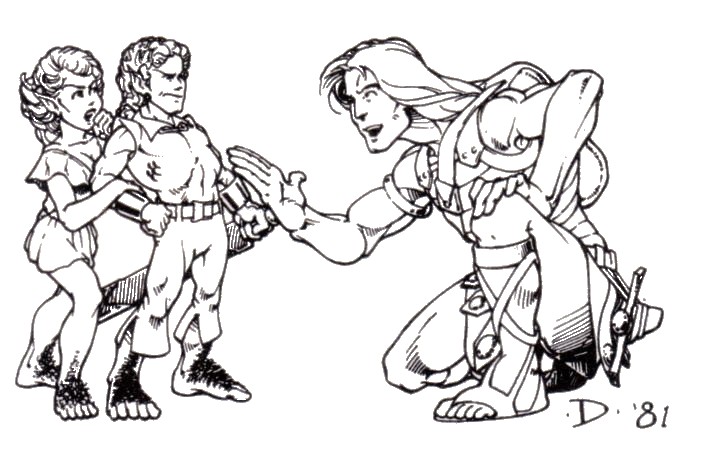
However, there’s a lot of overlap with the halfling. In spite of some really appealing Jeff Dee halfling art, halflings may end up a casualty of my hacking and wind up on the cutting-room floor.

Monday, May 19, 2008

The Only Constant is Change

"I was recently reminded," writes Clay Shirky, "of some reading I did in college, way back in the last century, by a British historian arguing that the critical technology, for the early phase of the industrial revolution, was gin."

Go read the rest. It's heady stuff.

No, seriously. It's long, but it's worth your time. That's the world you're going to have to live in.

That's the world we are living in now.

Here's something four-year-olds know: A screen that ships without a mouse ships broken. Here's something four-year-olds know: Media that's targeted at you but doesn't include you may not be worth sitting still for.

Let that roll around in your head a moment. A screen that ships without a mouse ships broken. There is, fundamentally, something flawed, broken, with purely passive entertainment.

Me, I love me some passive entertainment. Movies, opera, books, even a bit of TV. But really, how passive am I? I write reviews. I steal, er, I mean borrow ideas for my own stories and my games.

One of the excuses we mollify ourselves with for the failure of RPGs to maintain that wonderful, heady momentum of the '70s is the assumption that most people simply prefer passive entertainment. People would much rather stay home and watch TV while sprawled upon the couch, absorbing their entertainment rather than creating it themselves.

But what if that's a load of horsehockey? What if it is true, but also a generational thing, something that is ebbing like a receding tide? What if new generations start demanding more from their entertainment?

Yeah, I know, everybody knows that passive entertainment is more popular than active entertainment. Sorry, I just cringe when I hear that phrase. Here's the deal: I live in Austin, TX. We had, at one time, more bookstores and more restaurants per capita than anywhere else in the USA. We have the best movie theaters on the continent. And you know what? We still have swimming pools. The soccer fields are still full every Saturday morning. We still have billiards halls and bowling alleys and stores where kids play Magic and Warhammer and collectible miniatures games.

At one time, everybody knew that TV would destroy radio, that the VCR would be the death of movie theaters, and that you couldn't pay kids to read books thicker than 100 pages. Just like everybody knows you can't pay the mortgage if you give away your primary product for free. And this in spite of TV doing just that for half-a-century now.

Our RPG hobby is "blessed" with armies of arm-chair experts who will gleefully explain to you how and why things are they way they are. Most of them don't have MBAs, degrees in sociology, or any hard data to back up their assertions.

Guess what: I'm one of 'em. So take what follows with a big ol' block of salt.

Actually, this very next part, you don't have to take my word for it, because if you've been following the Old School Reformation, you've probably seen just about everybody comment on it in one way or another.

Nobody who first encounters RPGs has the foggiest idea how to play these games.

We've seen post after post in blogs and chat boards where someone says something along the lines of, "Yeah, we laid the map of the Caves of Chaos out on the table and tried to move around it like it was a Monopoly board." We stumble around and eventually invent ways to play these games. Some of us find ways that work and we keep playing. What about the folks who don't keep playing? Was it because RPGs really aren't for them?

Or was it because they never really figured out how to play them?

Look at what's going on in the RPG blogosphere. "I used to hate race-as-class," you read, "but look at this cool thing I can do with it now!" Levels, Vancian magic, hit points, alignment, it's all coming under scrutiny and people are, after more than three decades, finally figuring out how these games were intended to be played. Old Geezer makes a post over at RPG.net and everyone has one of those, "oh, that's why it works that way," moment. Think about all the games you played without hirelings or naval combat or strongholds or grappling because those rules seemed more than a little arcane and not worth your effort. Think about all the games you played where the monsters just sat in their rooms and didn't react to the invasion of the PCs because the DM never got around to reading pp. 104-105 of the DMG. Think about all the silly and wrong things the folks at WotC keep saying about how older versions of D&D were played.

Maybe the reason these games never really caught on is because most folks never played them properly. Maybe they got trapped in patterns that undercut their fun, or maybe they never really thought about what they enjoyed and what they didn't, or maybe they just got stuck with a poor GM or poor players or both. Maybe they never felt they'd received permission to play the way they really wanted to.

There are new tides coming. "Half of all new college graduates now believe that self-employment is more secure than a full-time job." Screens that ship without mice are broken. A new generation that embraced fantasy and books and computers while young is growing up. And the grognards are rediscovering the games it turns out we never really knew.

Yep, interesting times...

Behind the Scenes at Lamentations of the Flame Princess

(Yeah, sure, I could abbreviate it LotFP, and I probably will someday. But today, that name is just too cool not to spell out. ;) )

James Edward Raggi IV (another name too cool not to spell out) has posted on the theory and history behind the publication of The Random Esoteric Creature Generator for Classic Fantasy Role-Playing Games and Their Modern Simulacra.

New Review of The Phoenix Barony

Matthew M. Slepin, aka the Fiendish Dr. Samsara, (to whom I still owe notes on my as-yet unfinished readthrough of his own S&S RPG, Swords of Fortune) has written a review of David "Grubman" Bezio's The Phoenix Barony for RPG.net. The Phoenix Barony is a campaign setting designed for Labyrinth Lord in an Old School style. That is to say, it's fairly bare bones, with lots of blank spaces on the map for the DM, er, I mean Labyrinth Lord, to fill in. Some would call this "incomplete". Mr. Slepin does not agree:

There are game products that are beautiful and wondrous and nobody can figure out how to play. But The Phoenix Barony wants you to jump in and game it. Further to that end, Bezio zooms in to present a more detailed Adventure Area of some 420 square miles with another hex map. I love this. Its whole purpose is to say, “Roll up a character, put him here, and let’s slay something.” The Adventure Area has a village to serve as a base of operations and a few evocative locations: the Lost Keep, the Fairy Wood, the fishing hamlet of Jub (where all the adult males have mysteriously disappeared), and so on. Enough to generate ideas for several low-level adventures...


Matt also approves of Mr. Bezio's embrace of Labyrinth Lord's light and easy rules when detailing the setting in imaginative ways:

The Phoenix Barony is full of this exploitation of the minimal rules. Consider some of the organizations presented in the setting: The Templars of Irnoch, an order of holy warriors dedicated to the Baron and the Church; the Border Guard of Emralla, flamboyant, rapier-wielding cavalry; and the Bordain Rangers, the self-sufficient horsemen. In more modern iterations of D&D, these would all be separate classes or prestige classes or something. In LL, they are Fighters. What separates them is not mechanics, but description (okay, the Bordain Rangers get one minor mechanical feature, +1 to hit and damage with the lance). Perhaps more unique and delightful are Frunder’s Riders, the mounted militia of a Halfling community who ride giant weasels and toads into battle. No “Weasel Rider” Prestige Class, here. No “Giant Toad Tongue Lashing” Feat. Frunder’s Riders are Level 4 Halflings. Done and done.


It's quick, it's easy, and it's fun. (Gee, think that might be something of a mantra of mine?) Yes, it doesn't give you that deep-down crunch some players crave. But if you're the sort who likes to keep the rules light, the action quick, and the setting imaginative, it sounds like The Phoenix Barony might be worth taking a look at.

Maybe This is How D&D Was Played?

Over on his wonderfully titled blog Lamentations of the Flame Princess, James Edward Raggi IV laments (even though he's clearly not a princess, flame or otherwise) that few of us were lucky enough to get to play with Gygax or Arneson or any of the other DMs who were there at the beginning of our hobby. Left to fend for ourselves, many of us turned to the published modules for inspiration. Unfortunately, those modules were mainly crafted for tournaments, not campaigns, and so have skewed how people think D&D is supposed to be played.

So the question remains: how was the game played by the folks who invented it? What were their intentions? Well, we know a few things. We know that Gygax himself had a large crowd of players, something like 20 or so, according to Old Geezer (though now I can't find the actual quote, darn it). We know that players often instigated adventures, wanting to plumb the unexplored depths of Castle Greyhawk or other such mysterious locales. And we know the game was deadly, with players each having a stable of PCs and henchmen they could run if their primary PC was captured or slain.

So maybe the game looked something like this:

West Marches was a game I ran for a little over two years. It was designed to be pretty much the diametric opposite of the normal weekly game:

1) There was no regular time: every session was scheduled by the players on the fly.

2) There was no regular party: each game had different players drawn from a pool of around 10-14 people.

3) There was no regular plot: The players decided where to go and what to do. It was a sandbox game in the sense that’s now used to describe video games like Grand Theft Auto, minus the missions. There was no mysterious old man sending them on quests. No overarching plot, just an overarching environment.

My motivation in setting things up this way was to overcome player apathy and mindless “plot following” by putting the players in charge of both scheduling and what they did in-game.

Ok, so I'm making up being late to the ars ludi party by serial linkage. So sue me.

Still, this is a really neat idea, and clearly another way to overcome the issues of trying to schedule gaming around adult lifestyles:

The West Marches charter is that games only happen when the players decide to do something — the players initiate all adventures and it’s their job to schedule games and organize an adventuring party once they decide where to go.

Players send emails to the list saying when they want to play and what they want to do. A normal scheduling email would be something like “I’d like to play Tuesday. I want to go back and look for that ruined monastery we heard out about past the Golden Hills. I know Mike wants to play, but we could use one or two more. Who’s interested?” Interested players chime in and negotiation ensues. Players may suggest alternate dates, different places to explore (”I’ve been to the monastery and it’s too dangerous. Let’s track down the witch in Pike Hollow instead!”), whatever — it’s a chaotic process, and the details sort themselves out accordingly. In theory this mirrors what’s going on in the tavern in the game world: adventurers are talking about their plans, finding comrades to join them, sharing info, etc.

Be sure to check out all four parts (Part 2, Part 3, Part 4) plus the Q&A.

Sunday, May 18, 2008

Greyhawk Grognard's Lore Project

Greyhawk Grognard has made available the first installment of his Greyhawk Lore project:

Essentially, I'm trying to systematically go through all of the Q&A threads on places like Dragonsfoot, ENWorld, Pied Piper, etc. and cut-and-paste the various Greyhawk-specific posts by folks like Gary Gygax, Rob Kuntz, Scott Gregg, etc. Each tidbit is sourced with a link to the original post. They are then collected in an .rtf file to make it easy for the Greyhawk lore-hound to do a search on a given topic in his or her favorite text editor. Search for "Robilar", for example, and you'll get a plethora of posts on the subject of that particular worthy.


He's also got a spoiler-free review of the new Narnia movie, "Prince Caspian".