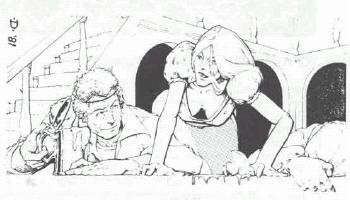
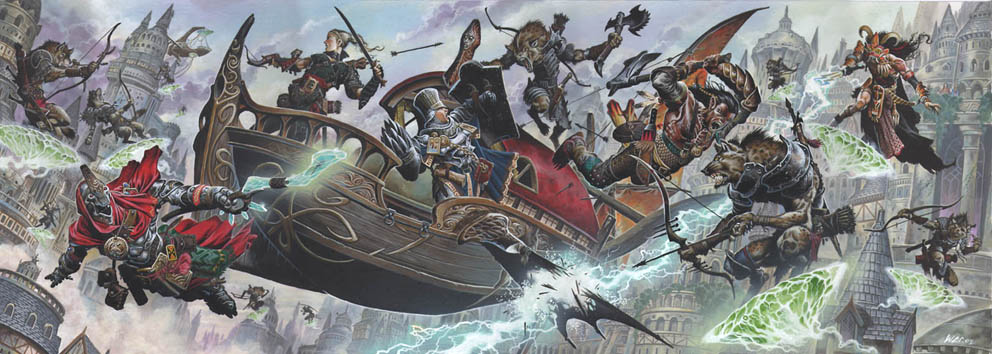
Seems I’ve been thinking a lot recently about art and RPGs. Lately, the two have merged in a discussion over at RPG.net on the surprising renewed interest in 1st edition AD&D. Among the differences between 1st and 3rd edition that have been discussed is the aesthetic themes both games embrace. If you flip through the rule books, it’s clear to see each game has a very different vibe to it, and it goes beyond simply black-and-white versus color. Where the heroes depicted in the new books are young, well-coifed, and heroic, 1st editions art shows grubby and greedy mercenaries, often engaged in combat, and sometimes even bearing the grime and scars one would expect on dungeon adventurers. There’s a moral ambivalence as well. It’s easy to tell villain from hero in 3rd edition’s art. The bad guys, always NPCs, are dark, often deformed, sneering and hunched, while the heroes are tall, leaping into the action, usually brightly colored and with unblemished features.
1st edition art isn’t quite so clear. A classic example is Trampier’s “Emirikol the Chaotic”, found on page 193 of the 1st edition Dungeon Master’s Guide. (You can find a small scan of it here.) A bearded mage gallops up a narrow street on horseback, cloak flying in the wind. We assume that he’s Emirikol. He’s twisted back to cast a spell at a crossbowman behind him. A town guard? Perhaps, as another fellow in similar equipment lunges from the door of the Green Griffon, drawing his sword to intercept the marauding wizard. Another bearded man scowls at the scene from the safety of the Green Griffon’s doorway while some poor fellow smolders in the foreground, possibly another victim of Emirikol’s magic. Frightened citizens flee in the scene.
So what’s going on here? Why is Emirikol involved in a running battle with warriors? Are they the town guard, attempting to prevent a crime or catch a criminal? Or are they the criminals attempting to assassinate Emirikol? Who are the heroes? Who are the villains? Are there any heroes, or is everyone a villain? There are no clear answers. We’re left with only a scene of action, devoid of any moral context. Heck, we don’t even know that the bearded rider is, in fact, Emirikol.
What follows is largely from posts I’ve made over at RPG.net. I’ve tried to touch on what I see as the major differences in tone achieved by the art of both the 1st and 3rd editions of D&D, focusing primarily on the core rulebooks of the Player’s Handbook and Dungeon Master’s Guide. I’ve also made some wild guesses as to the reasons for those differences.
I think a lot of the change in aesthetics can be explained as a collision between the corporate goals of TSR circa 2nd edition and general trends in fantasy literature. On the TSR side of things, there was clearly a move away from the moral ambivalence of 1st edition. 2nd edition not only assumed the PCs would be good-guy heroes, they actively weakened the villains (there’s nothing more pathetic than a 2nd edition necromancer played out of the PHB) and watered down the powers of evil. It’s clear from the early days of 2nd edition that TSR wished the demons and devils of 1st edition would just go away, like the assassin did. Pushing the idea of good heroes always triumphing over evil was an attempt to insulate the company against the “angry mother” syndrome. In the end, the growing cultural irrelevance of RPGs would combine with this strategy to insulate TSR not only from angry mothers, but also consumers, who would be tempted away by the dark anti-heroes of White Wolf’s “World of Darkness”.
Fantasy literature at the time of 1st edition’s publication was a dark genre. In spite of the central place held by Tolkien and Lewis, fantasy was dominated by pulp heroes migrating from the magazines into paperback collections. These heroes included Conan, Elric, and Fafhrd and the Grey Mouser (cited frequently by Gygax as a personal inspiration). These heroes are violent and bawdy, eldritch and intimidating, and usually dirty and in danger. The art of 1st edition reflects this. 1st edition taverns are full of buxom tavern wenches chatting up celebrating adventurers (usually male), while heavy armour, often historically accurate or bulky, is common, and nudity and acts of violence abound.
By the time 3rd edition was released, fantasy had changed. A lot. While much of the “old guard”, like Conan and Elric, were still respected, others had been all but forgotten, like Leiber’s heroes of Lankhmar and Wagner’s Kane. Some were openly reviled, such asNorman
Again, the art reflects this. 3rd edition art lacks the scruffy-looking vagabonds of 1st edition art, replaced by the “beautiful people” of TV and movies. Gone also are the casual cruelty and most of the bawdiness. (It is telling, I think, that while the art of “The Book of Vile Darkness” is wallowing in viciousness and pain, the nudity is barely on par with the 1st edition DMG.) The heroes are either bright and cheerful, or grim and determined. Where the unnamed thieves of 1st edition gloated over their uncovered treasure hordes, the glint of avarice clear in their eyes and blood sometimes still fresh upon their blades, 3rd edition’s perky Halfling babe grins happily at the single, though rather large, coin in her hand, glowing with satisfaction at having overcome the chest’s fiendish traps.
Fantasy literature at the time of 1st edition’s publication was a dark genre. In spite of the central place held by Tolkien and Lewis, fantasy was dominated by pulp heroes migrating from the magazines into paperback collections. These heroes included Conan, Elric, and Fafhrd and the Grey Mouser (cited frequently by Gygax as a personal inspiration). These heroes are violent and bawdy, eldritch and intimidating, and usually dirty and in danger. The art of 1st edition reflects this. 1st edition taverns are full of buxom tavern wenches chatting up celebrating adventurers (usually male), while heavy armour, often historically accurate or bulky, is common, and nudity and acts of violence abound.
By the time 3rd edition was released, fantasy had changed. A lot. While much of the “old guard”, like Conan and Elric, were still respected, others had been all but forgotten, like Leiber’s heroes of Lankhmar and Wagner’s Kane. Some were openly reviled, such as
Again, the art reflects this. 3rd edition art lacks the scruffy-looking vagabonds of 1st edition art, replaced by the “beautiful people” of TV and movies. Gone also are the casual cruelty and most of the bawdiness. (It is telling, I think, that while the art of “The Book of Vile Darkness” is wallowing in viciousness and pain, the nudity is barely on par with the 1st edition DMG.) The heroes are either bright and cheerful, or grim and determined. Where the unnamed thieves of 1st edition gloated over their uncovered treasure hordes, the glint of avarice clear in their eyes and blood sometimes still fresh upon their blades, 3rd edition’s perky Halfling babe grins happily at the single, though rather large, coin in her hand, glowing with satisfaction at having overcome the chest’s fiendish traps.
The action’s taken a more cinematic and extreme style as well. Where in 1st edition, you could show a heroic group spread out around a dragon, bows drawn and swords swinging, 3rd edition’s adventurers cling to a shattered bridge, threatened as much by the precipitous abyss that yawns beneath them as the raging dragon above. And there’s nary a drop of blood to be seen.
Yes, anime and comics have had their influence, but not so much as movies and TV, I think. The unscarred and youthful heroes owe more to “90210”, I think, than they do to “Record of Lodoss War”. The “wall of action” style that graces the Eberron books, as well as the funky “lens” effects, like flare and fisheye, are also an appeal to the cinematic imaginations of today’s fan of action movies and console gaming.
Is it any wonder, then, that the grognards recoil in distaste? They’re still reliving their Thieves World dreams of trodding the jeweled thrones of gritty and brutal worlds beneath their leather sandals. They wish to carve their own paths in their dreamworlds with sword and spell, blood and grit. They rage against the powers that be by plundering temples and evading town guards. They don’t want to rescue orphans, support good king Lomipop, or build hovels for the homeless. They certainly don’t want to be the town guards, who they know are all either inept and bumbling, or corrupt and cruel. At least, that’s the way it used to be…
Where 3rd edition has improved on 1st by clearing away the bizarre game-isms that never made sense and giving fighters a reason to keep adventuring past 10th level, it’s also maintained 2nd edition’s goody-two-shoes pretensions. The rough-and-tumble brawling feel of yesteryear has been replaced by the accounting and bookkeeping of feats and prestige classes. Granted, those feats and prestige classes solve some longstanding issues with AD&D’s mechanics. But they also change the feel of the game, and how it’s played. They’ve increased its complexity, and made it harder for by-the-seat-of-your pants DMs to weave adventures from a few jotted notes and the odd, stray daydream. Truth is, 1st edition AD&D is a very different game from 3rd edition, so it’s no wonder that people hold strong opinions on their preferences, especially when we keep being told it’s the same game, only “improved”.
Yes, anime and comics have had their influence, but not so much as movies and TV, I think. The unscarred and youthful heroes owe more to “90210”, I think, than they do to “Record of Lodoss War”. The “wall of action” style that graces the Eberron books, as well as the funky “lens” effects, like flare and fisheye, are also an appeal to the cinematic imaginations of today’s fan of action movies and console gaming.
Is it any wonder, then, that the grognards recoil in distaste? They’re still reliving their Thieves World dreams of trodding the jeweled thrones of gritty and brutal worlds beneath their leather sandals. They wish to carve their own paths in their dreamworlds with sword and spell, blood and grit. They rage against the powers that be by plundering temples and evading town guards. They don’t want to rescue orphans, support good king Lomipop, or build hovels for the homeless. They certainly don’t want to be the town guards, who they know are all either inept and bumbling, or corrupt and cruel. At least, that’s the way it used to be…
Where 3rd edition has improved on 1st by clearing away the bizarre game-isms that never made sense and giving fighters a reason to keep adventuring past 10th level, it’s also maintained 2nd edition’s goody-two-shoes pretensions. The rough-and-tumble brawling feel of yesteryear has been replaced by the accounting and bookkeeping of feats and prestige classes. Granted, those feats and prestige classes solve some longstanding issues with AD&D’s mechanics. But they also change the feel of the game, and how it’s played. They’ve increased its complexity, and made it harder for by-the-seat-of-your pants DMs to weave adventures from a few jotted notes and the odd, stray daydream. Truth is, 1st edition AD&D is a very different game from 3rd edition, so it’s no wonder that people hold strong opinions on their preferences, especially when we keep being told it’s the same game, only “improved”.
UPDATE: I've tracked down some of the 3rd edition art I reference in this piece. When I first wrote it, it was easy to assume that just about everyone reading it was familiar with the art in the 3rd edition core books. Now that 4th edition is six weeks from release, I just can't make that assumption anymore.
Also, some have suggested that I hate 3rd edition's art. Far from it! I'm not crazy about the dungeonpunk look, and in general I prefer Elmore and Parkinson, but I'm also a big fan of Wayne Reynolds, Arnie Swekel and Todd Lockwood. This article isn't how one style is better than the other, but how they are undoubtedly different in themes, tone, and impact.
I've also cleaned up the writing a bit. Articles, stories, and posts are never finished, just abandoned. ;)

 PDF
PDF


 Posts
Posts